 Jordan Miller
In August 2024, a mother, father, their two sons and their daughter-in-law came to the United States legally as asylum-seekers.
That was the last time they were all together. They resettled in Utah shortly after, but their youngest son, then 19, was stopped at the San Diego border with Mexico because of his tattoos, his family told The Salt Lake Tribune last year.
From there, he went to multiple detention facilities until he disappeared in March 2025, the family said.
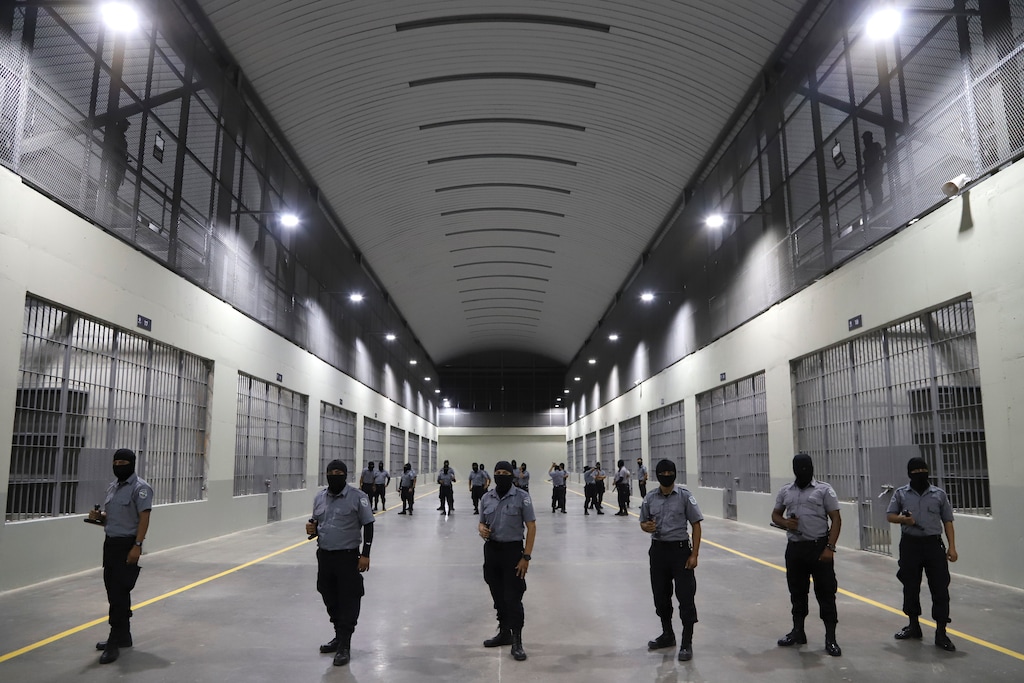
The next time his mother saw her son he was behind bars in a national news report about a controversial and crowded Salvadoran prison called the Terrorism Confinement Center, which has been accused of human rights violations, the Associated Press has reported.
“Sometimes I don’t sleep for about 50 hours in a row,” the mother told The Tribune last year, her voice breaking. “Sometimes I must take pills to go to sleep because of how I‘ve been feeling.”
Her son stayed in the prison there for four months, where he was beaten, starved, and shot by guards with a rubber bullet, according to a notice of intent to sue, filed Tuesday to the U.S. government. The notice identifies the son using the pseudonym Johnny Hernandez, to protect him and his family from “public and government harassment,” according to the filing.
Officials from Immigration and Customs Enforcement and the Department of Homeland Security did not respond to a request for comment.
The federal government has six months to respond to the notice. After that waiting period, the family expects to file a lawsuit. They are seeking $56 million due to the personal injury caused to their son, the notice states.
“Make no mistake: we the American people did this to him,” Brent Ward, the family’s attorney, said Tuesday. “These were conscious, intentional, premeditated acts done in my name and your name by the president of the United States and his agents. He paid the Salvadorans to do it… What must this boy be thinking about that American Dream now?”
(Chris Samuels | The Salt Lake Tribune) Attorney Richard Lambert, left, at a news conference in Salt Lake City on Tuesday, March 31, 2026.
The son’s connection to Utah
When the family left Venezuela, the son was 11 years old, according to the notice. His family was active in the political opposition protesting corruption in then-President Nicolas Maduro’s government, so they were forced to flee the country, the filing says.
The family resettled in Colombia, but then moved to Mexico to start the process of immigrating to the United States. After 9 months in Mexico, the family was permitted entry into the U.S. for a temporary period based on urgent humanitarian reasons, one of the family’s attorneys, Jim McConkie, told The Tribune last year.
But the son was taken by a border guard, according to the notice filed Tuesday. His family said it was because of his tattoos, and the notice alleges that the guard erroneously concluded the son was a part of Tren de Aragua, a Venezuelan gang.
The son immediately denied the accusation, according to the notice. Border officials told the family they would be reunited with their son once an investigation into him was complete.
They haven’t seen him in person since.
From San Diego to El Salvador
After he was separated from his family at the border, the son was taken to an unknown location where he was held for four days with limited communication with his family — and “without the opportunity for due process,” the filing alleges.
He was then transferred to the Otay Mesa Detention Center near San Diego, where he was held for six months, according to the notice. The son appeared “several times” before a judge while at the facility, “each time without real legal assistance,” according to the notice.
In early March 2025, the son and other Venezuelans who were detained at the Southern California facility were put on a plane and handcuffed to their seats, the filing alleges. After stops at four different airports, they were taken to an “overcrowded jail” in Texas, according to the notice.
After five days in Texas, the son was given a choice: either continue his immigration case in the U.S. or be deported to Venezuela, according to the notice.
“This was a blatant lie,” the filing alleges. “[The son] communicated his desire to continue his immigration case but was not given the opportunity to do so. Instead, the next day all the Venezuelan detainees were taken by bus to an airport and ushered onto one or more airplanes, again without being told where they were going.”
(Chris Samuels | The Salt Lake Tribune) Attorney Jim McConkie speaks at a news conference in Salt Lake City, Tuesday, March 31, 2026.
When the plane finally landed in El Salvador, the Venezuelans were ordered to disembark, according to the filing. They refused, telling ICE officers, “This is not our country; we are not leaving the plane,” the notice says.
Eventually, ICE officers brought Salvadoran police on the plane, who then beat the Venezuelan detainees in their seats while “ICE agents looked on and mocked them,” the filing alleges.
This was the first beating the son endured in El Salvador, according to the notice. When the Venezuelan men yelled for help at the ICE agents while they boarded a bus, the agents “simply laughed,” the notice alleges.
‘The only way out is dead’
When the Venezuelans arrived at the prison, they were forced to the floor and their heads were shaved, the filing says. That was when they realized where they were, according to the notice.
“Welcome to hell,” the director of the prison told them, according to the filing. “You are in a prison you will never leave. The only way out is dead. We will make sure of that.”
The son and other Venezuelan detainees were housed in “inhumane and appalling conditions,” jammed into overcrowded cells with one open toilet, four rows of metal slats without mattresses to be used as beds, and bright lights left on at all times.
“On most days, the men were confined in their cells for 24 hours, rarely being permitted to exit,” the notice states. “Cells were cleaned only once a week. [The prison] had no rehabilitation, recreation, or education programs. All family visits were banned, and no telephone access existed for inmates.”
While locked up, the son “endured systematic physical, verbal, and psychological abuse,” according to the filing. The notice alleges that the son was beaten routinely at an area of the prison out of view of surveillance cameras, placed in a small solitary confinement box for up to 18 hours at a time, and was kicked by a guard when he asked a doctor for medical attention due to chest pains.
“‘Now, that is the solution I have for you. Is the pain gone?’” the doctor said after the guard kicked him, according to the filing. “[The son] replied, ‘Yes, the pain is gone,’ believing that if he said otherwise, he would be kicked again. He was then dragged back to his cell. The chest pains that began at [the prison] continue to the present time.”
When prisoners protested the torture and abuse by refusing food for a day, meals were withheld for two additional days, according to the filing. When a few prisoners tried to escape, they were shot with rubber bullets, according to the notice.
The son was shot in the shoulder, the notice states. Guards refused to allow treatment for the open wound, and would disturb the wound with their hands instead, according to the filing.
“He observed guards raping and abusing the Venezuelan detainees and is still traumatized by it,” the filing says. “He continues to suffer from physical and psychological injuries inflicted at [the prison], including but not limited to permanent impairment from the wound to the shoulder, contusions, scars, Post Traumatic Stress Disorder (PTSD), anxiety, and depression.”
After prison
The son was released from the prison and returned to Venezuela in a tri-country prisoner swap among El Salvador, the United States and Venezuela.
While at CECOT, the son “suffered extreme torture,” according to the filing, which resulted in “physical, psychological, and emotional injuries, as well as permanent impairments,” the notice states.
The man is still “recovering from unspeakable horrors,” Ward, the attorney for the family, said Tuesday.
“What did we give Johnny Hernandez to remember us by?” Ward said.