This story is jointly published by nonprofits Amplify Utah and The Salt Lake Tribune to elevate diverse perspectives in local media through student journalism.
Imagine seeing dozens of energetic little people, just inches tall, dressed in brightly colored clothes — jumping and climbing around an otherwise undistorted world — all because you ate an undercooked mushroom.
That’s the focus of Colin Domnauer’s doctoral research at the University of Utah’s Dentinger Lab, a mycology lab based in the Natural History Museum of Utah (NHMU). His exploration represents one of only two labs worldwide studying the mushroom Lanmaoa asiatica, a red-stemmed, brown-capped mushroom that can cause “fairytale-like hallucinations.”
The research is in its early stages, but Domnauer is hopeful the mushroom’s psychedelic properties may have some therapeutic uses. He said lab testing has ruled out psilocybin, a common psychedelic compound in magic mushrooms, indicating they may soon discover a new hallucinogen.
Their exploration comes as psychedelics enter the national spotlight. On April 18, President Donald Trump signed an executive order to make some psychedelic drugs more available for treating mental health conditions like depression and anxiety. Trump’s order also directs $50 million in federal funds to make psychedelics more accessible and orders the Food and Drug Administration to fast-track a review of drugs like psilocybin and ibogaine.
(Will Ruzanski | The Daily Utah Chronicle) Bryn Dentinger, director of the Dentinger Lab at the Natural History Museum of Utah, holds a bag of Lanmaoa asiatica, a hallucinogenic mushroom found in China and other parts of Asia.
Delicious, but with side effects
The mushroom’s mystery has placed university researchers at the forefront of exploring a compound Domnauer said causes visions of “whimsical little fairies and elves” that are “always dressed colorfully.”
“They’re always described as being very active, amusing and playful, like teasing people … [there’s a] perception of abundance, dozens or hundreds of little people,” he said. “The most fascinating thing is that they’re in the environment, they’re not like some closed-eyed hallucination. They’re climbing up chairs and tables.”
Domnauer said he tried the mushrooms at a hot-pot style restaurant in China, where they are a common food sold in markets, and found them delicious.
In the restaurant, “they put it in the boiling soup, put a timer out on the table and set it to 15 minutes, and said, ‘Don’t eat until the timer goes off, or you might start seeing little people,’” he said. “I had things to do, [and] I didn’t want to have these hallucinations, so I waited my 15 minutes. The mushroom is delicious. I see why it’s one of the most popular mushrooms there.”
The hallucinations can last for days, Domnauer added, emphasizing that Chinese researchers — who treat hundreds of cases every year in the Yunnan Province — have reported no deaths or “organ damage from all the studies they’ve done, so it seems safe.”
“It’s just a food that has a side effect,” he said. “People in China always describe it as an amusing and playful experience. They’re neither afraid of it, but they’re not seeking it out recreationally either.”
A new psychedelic compound
The Dentinger Lab uses genome sequencing — a method for decoding and analyzing genetic material — to classify compounds found in the mushroom. So far, they haven’t discovered the active hallucinogen in Lanmaoa asiatica.
“We looked for every hallucinogenic compound that’s known and haven’t found them, so it’s very likely something new, and we had no idea what it could be,” Domnauer said. “When I started, there was no research being done, which is why I was really excited to study it.”
Domnauer began his research after hearing rumors from around the world about the mushroom’s hallucinogenic effects.
The first reports came in 1934 when foreign missionaries encountered locals in Papua New Guinea eating the mushroom and “behaving very strangely.”
Later, anthropologists there documented locals who reported visions of little people after eating the mushrooms. Years passed, and in the 1960s, mycologists travelled to Papua New Guinea to test the mushrooms.
“They couldn’t find any active compounds, so they concluded that it was just a hoax,” Domnahuer said.
“Then, independently, there were reports in southern China of the same type of mushroom causing the same types of hallucinations that those researchers were not aware of,” he said. “There have been reports about it for decades in the scientific literature of local people eating some type of mushroom and having these hallucinations, but the science had not been well studied.”
(Will Ruzanski | The Daily Utah Chronicle) Samples of Lanmaoa asiatica, a hallucinogenic mushroom found in China and other parts of Asia, are being researched at the Natural History Museum of Utah's Dentinger Lab.
Research barriers
Domnauer credited Bryn Denginger, the lab’s director, for taking a chance and approving his research proposal.
“I suppose it was a risk, because it was. A lot of people considered it to be fake or not real,” Domnauer said. “I’ve always been driven by believing anecdotal reports, I think [they are] the most fascinating or intriguing evidence because it shows that something is not well known.”
Dentinger, who has a doctorate from the University of Minnesota, is the curator of mycology and an associate professor at the U.’s School of Biological Sciences. He said the research began roughly four years ago, after Domnauer’s proposal.
“A lot of the initial [research] stages were trying to figure out how to get authenticated material,” Dentinger said. “Eventually, [Domnauer] found a collaborator in China and was able to visit and acquire the original set of samples.”
There are no legal restrictions on Lanmaoa asiatica in the United States, which streamlines their exploration, both researchers said. According to Dentinger, the biggest barrier to research is funding.
“The chances of having somebody say, ‘Oh, yeah, we’re going to invest in this mysterious thing that we know nothing about,’ is really unlikely,” Dentinger said. “There’s not enough money around for science — the science I do, anyway.”
They’ve also encountered inconsistent lab results, with Domnauer emphasizing he thinks “there’s a lot more open questions than answers that we have right now.”
“They’re inconsistent in that it just seems to happen randomly. That makes it a real problem when you’re trying to figure out what things are,” Dentinger said. “It’s possible that we’re completely missing something about the mushroom, or it may be that only certain individuals [respond to] the mushroom.”
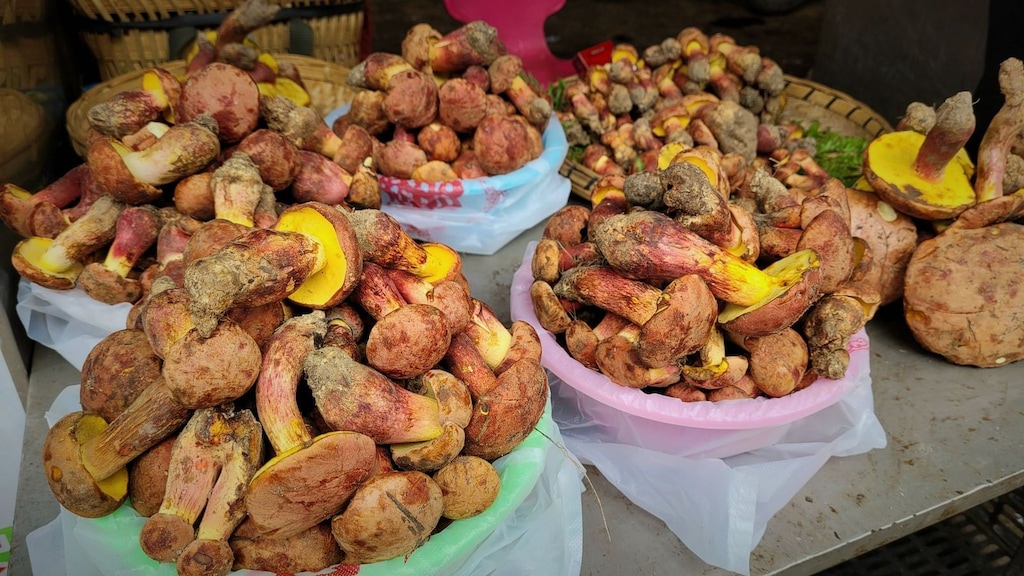
(Colin Domnauer | Natural History Museum of Utah) A vendor sells mushrooms, of the variety Lanmaoa asiatica, at a market in China's Yunnan province. Researchers at the Natural History Museum of Utah are looking at the mushroom's hallucinogenic properties, and whether they would have therapeutic applications.
Potential medical applications
Utah has become one of the first states to medically legalize various psychedelics — including psilocybin (the active hallucinogen in magic mushrooms), MDMA (known as molly) and dimethyltryptamine (DMT) — for treating mental health conditions like post-traumatic stress disorder.
“One of the most exciting parts of this project is discovering a new therapeutic potential,” Domnauer said. “That remains to be seen, if that exists, and what that is.”
Both researchers argued it’s too early to determine any potential therapeutic applications for Lanmaoa asiatica, but Domnauer expressed promise for the future of his research.
“It could open up a whole new class of compounds with a unique bioactive function or mechanism that can open up a doorway to new therapeutic potential, whether the actual compound in this mushroom itself does that or just provides the template for that opening,” he said. “Either way, I think it will answer a lot of unknowns that we currently have.”
What comes next
Only one other lab in the world is researching this mushroom, Dentinger said, and it’s in China. Dentinger said that scarcity aids the U. lab’s scientific process.
“The reduction of competition is good because it allows us to take our time and really explore creatively without the risk of being ‘scooped,’” he said. “This is a situation where we’re allowed to explore our curiosity that can reveal fundamentally new things.”
And if one mushroom can bring dozens of brightly dressed, whimsical little elves to life, Domnauer said the real mystery isn’t the hallucinations — it’s the complexity science has yet to discover.
“Scientists have only described 5% of fungal species on this planet; there’s a lot unknown. But within that 5% that we know, we already have all these exciting discoveries,” Domnauer said. “This highlights just how much, not only medicinal potential, but scientific discovery awaits in nature, and the importance of conserving and sustaining the natural forests as well as the cultures that have this knowledge.”
Will Ruzanski wrote this story as reporter for The Utah Daily Chronicle and a journalism and political science student at the University of Utah. It is published as part of a collaborative including nonprofits Amplify Utah and The Salt Lake Tribune.