This story is jointly published by nonprofits Amplify Utah and The Salt Lake Tribune to elevate diverse perspectives in local media through student journalism.
On Ogden’s Quincy Avenue, part of the parking lot of First Presbyterian Church has become the grounds for a microfarm where people cultivate not only produce but life skills and community support.
The nonprofit Grow Ogden Farm is an initiative designed to confront Weber County’s challenges of joblessness and housing instability, according to founder Karl Ebeling.
The goal, say organizers, is to pay people to learn agriculture, while also teaching life skills and donating food — and to show people how communities can help create nourishment and opportunity.
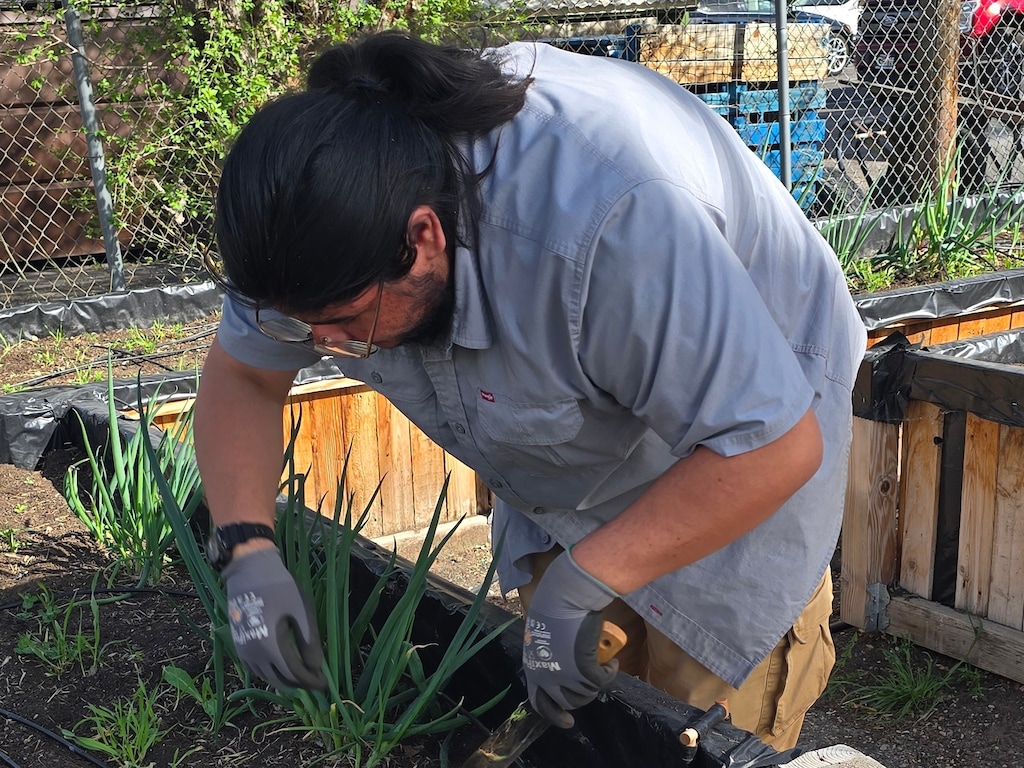
(Erin Drollette | The Signpost) Green onions are part of the early spring harvest at Grow Ogden Farm, a microfarm in the parking lot of Ogden's First Presbyterian Church.
Planting the seeds
The farm occupies one-eighth of an acre on the church’s converted lot, where several timber planter boxes are filled with crops. Christina Humphrey, the church’s community outreach coordinator, leads the partnership
“She’s the liaison on the farm in this place and is the one [who] basically facilitated using this land for one of the farms,” said retired Rev. Neal Humphrey, her husband.
Rita Ebeling says her husband, Karl, was inspired to start Grow Ogden Farm after he worked an internship at Wasatch Community Gardens’ Green Phoenix Farm in Salt Lake City. The 1.38-acre farm, launched in 2016, offers job training and support to women experiencing housing instability through a 10-month job placement program. The produce grown at Green Phoenix is then donated to underserved populations across the Wasatch Front.
Karl Ebeling said Grow Ogden Farm is part of a network of about 150 farms around the world. He said he’s trying to incorporate the best practices from farms he’s toured around the United States.
The goal, he said, is to get the most out of limited resources.
‘Helping them put things in order’
The program pays participants to work as part of a small team, three hours a day, four days a week, for 16 weeks. Training includes practical skills in agriculture, cooking and nutrition, along with life skills that will help them find stable jobs. The students also get help from an advocate to handle other challenges.
“We’re helping them develop job skills, life skills, healing by working in the soil, and just helping them put things in order,” said Rita Ebeling.
Nationally, the Department of Labor encourages “recovery-ready workplaces” that provide the structure, support and second-chance opportunities for people who have difficulty finding employment. Grow Ogden Farm’s model, which pairs paid agricultural work with personal support, reflects those practices, Rita Ebeling said.
(Erin Drollette | The Signpost) Rhubarb grows in the planter beds at Grow Ogden Farm, a microfarm set up in the parking lot of First Presbyterian Church on Quincy Avenue in Ogden.
Giving to others in need
Produce grown at the farm is donated to Catholic Community Services’ food banks, feeding “average people that are just struggling to make ends meet,” said Tyler Lundell, who manages CCS’s basic needs warehouse.
The donations highlight the dual mission of Grow Ogden Farm: to provide food assistance and employment pathways. Rachael Dixon, the farm’s program manager, said that by connecting fresh produce directly to CCS, the farm ensures that its harvests reach families who need it most, while the trainees see how their work benefits the community.
Grow Ogden Farm also aims to foster ecological stewardship. Dominique Dietz, a retired Weber County educator, has helped the farm earn a Habitat Hero certification, which recognizes the farm’s effort to provide sanctuary for birds and bees, conserve water, and avoid chemical fertilizers and pesticides. The pollinator-friendly spaces allow the farm to practice conservation, and show the trainees a model for sustainable agriculture.
Expanding in springtime
In March, Grow Ogden Farm moved into its spring session, building on the program’s successes of last year. The program has expanded its curriculum to add daily yoga to the schedule of farm work, cooking and weekly meetings with advocates.
This year the farm is adding eight grow boxes, and an irrigation system. The First Presbyterian Church has offered additional space, where Dixon said they plan to plan a berry garden. With the expansion, Dixon said, the farm hopes to donate 3,000 pounds of food to CCS this year, up from 2,500 pounds last season.
The interns have already begun harvesting the first green onions of the season and are turning the beds for potatoes. A lettuce bed is already showing early signs of life.
“Because of Pastor Jon Draskovic, the vision, and this church’s community, we can be here. We can do this,” Dixon said.
(Erin Drollette | The Signpost) Rachael Dixon, program manager for Grow Ogden Farm, teaches life skills to the interns at the microfarm.
Breaking down barriers
The need for such programs is significant, said Kenton Jepsen, housing and homeless systems coordinator for United Way of Utah.
Jepsen said there were 2,973 unhoused people reported in Weber County in 2023 and 2024. Those people each remained unhoused for an average of 40.98 days.
Data from the Utah Department of Workforce Services showed Weber County had an unemployment rate of 3.6% in December 2025. A January press release indicated that approximately 67,300 Utahns were unemployed statewide.
Those statistics show the barriers Grow Ogden Farm is aiming to break down, according to Karl Ebeling.
The farm’s paid training bridges a gap between instability and employment, while keeping in mind the complex factors that contribute to housing instability.
“It’s very hard to go from an experiencing homelessness state or on the verge of that to full-time work, because there’s so many things that got you there,” said Rita Ebeling.
(Erin Drollette | The Signpost) Tyelar Haines, center, farm manager at Grow Ogden Farm, directs interns — like Emily, who's moving a wheelbarrow of soil — in readying the garden beds.
Encouraging businesses to hire
The farm’s operators aim to partner with local businesses who are willing to hire its interns, said Rachael Dixon.
“Our next big step is to connect with other community business owners [who] would be interested in coming and understanding our program and understanding what our interns learn,” said Dixon.
She said a certificate from the program shows that an intern showed up and did the work for 16 weeks — completing on-the-job training and professional development skills, and showing employers the interns can be dependable and take initiative.
Parker Goss, operations director, has been with the farm since the start. He emphasized the program’s dependence on community support and encouraged people to volunteer.
“If they’re looking for a way to give back to Ogden or just be a part of their community, then Grow Ogden is one of the best ways to do that. And you really are making a substantial difference in their lives,” Goss said.
Opportunities to volunteer are listed at justserve.org/edenstreetsutah.
Erin Drollette wrote this story as a journalism student at Weber State University. It is published as part of a new collaborative including nonprofits Amplify Utah and The Salt Lake Tribune.