Note to readers • This story is jointly published by nonprofits Amplify Utah and The Salt Lake Tribune to elevate diverse perspectives in local media through student journalism. This story also discusses suicide. If you or people you know are at risk of self-harm, the 988 Suicide & Crisis Lifeline provides 24-hour support. Call or text 988.
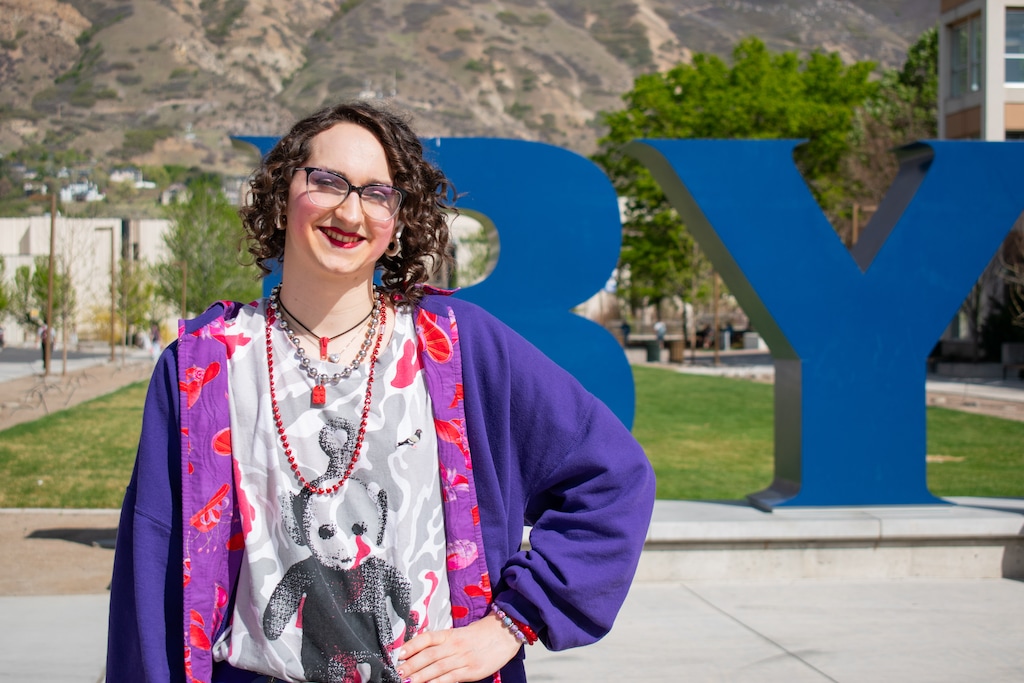
When April Flowers first met with Brigham Young University’s Honor Code Office in 2021, she said officials told her she should follow the dress and grooming standards for women — matching how the transgender student identifies.
That changed, Flowers said, in September, when the Honor Code Office told her she needed to cut her hair to match the university’s grooming standards for men.
“I got an email saying, hey, you’ve been reported for your social media presence and your hair length,” Flowers said. “[They said] we don’t care about your social media presence because it’s not a problem, you haven’t broken any rules, but your hair length does break a rule.”
Students and staff at BYU must adhere to the university’s Honor Code in order to attend the university and other schools within the network of schools owned and operated by The Church of Jesus Christ of Latter-day Saints. The Honor Code requires that students and staff adhere to Latter-day Saint standards, such as attending church regularly and abstaining from alcohol, tobacco and same-sex romantic behavior.
The September meeting with the Honor Code Office, Flowers said, “was a really gross experience that made me uncomfortable.”
For the meeting, Flowers said she brought a letter from her psychiatrist, who said she was diagnosed with gender dysphoria. The psychiatrist’s letter said that her hair length was an important factor in alleviating her dysphoria and helped reduce her suicidal thoughts. Flowers said the office didn’t take the letter into account when making its decision.
“They said, ‘We believe you but we’re not going to read it because it doesn’t do anything. Even if your psychiatrist says this, it doesn’t help the situation at all,’” Flowers said.
Flowers said she has not been able to register for classes for the spring semester until her situation is resolved.
Kevin Utt, the director of BYU’s Honor Code Office, declined to provide clarification on transgender students’ standards without approval from the school’s Communications Office. The Communications Office did not respond to requests for clarification.
‘A lot of violence’
This isn’t the first time Flowers has faced challenges regarding her gender identity at BYU, she said. She said people have thrown slurs at her, and previous roommates and other students have threatened her.
“I have been a victim of a lot of violence, whether it’s just words or physical, my whole time here,” Flowers said, adding that her situation has deepened her depression and led to more thoughts about suicide.
According to the faith’s General Handbook, members who are transgender must attend church meetings that align with their sex assigned at birth. Transgender people must also leave coed overnight activities at night and use single-person restrooms — or have another person check that a restroom that aligns with their gender identity is empty before they’re allowed to use them.
“For a while, the church handbook said along the lines of ‘that’s between you and your bishop and your stake president, and you figure out what you need to do’,” Flowers said. “Now we’re viewed as predators in the church handbook.”
Flowers said she’s just trying to live her life as herself. She said the church’s standards act as a constant reminder that she’ll never be seen as her true self, but rather as a threat within her community.
Her hair, she said, was one way that she could combat negativity. “It helps me get in touch with my femininity and my culture, and it feels like I have control over my life in a place where I don’t, in a place where my existence is viewed as radical,” Flowers said. “I’m this big villain, [this] big threat for just having long hair.”
Flowers isn’t alone in having difficulties within Latter-day Saint spaces for LGBTQ+ people. Echo Oliver, an active member of the Latter-day Saint faith and a nonbinary person, said they have had struggles of their own within their church community.
Oliver has followed the Latter-day Saint faith for their entire life, but spent most of their time in Latter-day Saint communities outside Utah.
“In Utah, there’s more of a cultural idea of what a Mormon looks like, what a member of the church looks like,” Oliver said. “But outside of Utah, there’s not that image, and so there’s a lot more freedom to play around in the space without causing disruptions.”
Oliver said that they’re more hesitant to be openly queer in Utah, where the norm is more defined. But they said they’re trying to live as their true self.
“I don’t want to hide,” Oliver said. “I don’t like pretending to be someone I’m not.”
Oliver said their church community mostly has been accepting of their gender identity, but they are still hesitant to come out to some people.
“I know that there are a handful of people who have exhibited transphobic behaviors in the past,” Oliver said. “So I’m not going to come out to them because we’re not going to dance with that devil.”
The church’s handbook doesn’t directly address nonbinary identities, but the rules are worded in a way that they still apply to members like Oliver. While Oliver said they’ve faced challenges regarding others accepting their identity in their Latter-day Saint community in Utah, they said that it doesn’t affect how they feel about their gender.
“I’ve come to the conclusion that being genderqueer is part of my divine identity,” Oliver said. “And I’m not 100% sure how that fits in.”
‘No scriptural basis’
Oliver said people in Latter-day Saint spaces are confused when they mention their gender identity, and those in LGBTQ+ spaces are confused when they mention their faith. There are people in both spaces who accept them, either as being queer or a Latter-day Saint, but they said they feel like they always have to hide a part of themself.
Oliver said they don’t agree with every aspect of the faith, but those aspects stem from Utah church culture and not the church’s doctrine.
“There’s no scriptural basis for homophobia or transphobia in the church,” Oliver said. “All of the scriptures that people pull up for being like ‘homosexuality is a sin’ all have better explanations, better interpretations.”
Oliver said they hope that one day they won’t need to hide in the church and they’ll get to be fully themself in church spaces.
For LGBTQ+ people, worries about acceptance can create a chilling effect that stops them from coming out and causes them to hide parts of themselves from their communities. It’s something Katie Kassler, an assistant professor of interpersonal and family communication at Weber State University, explored in a study on secret-keeping in regards to LGBTQ+ identities.
“There’s a whole range of negative reactions that LGBTQ+ people often anticipate from family members they perceive are not supportive,” Kassler said. “I do think that translates to larger, broader societal groups.”
Kassler said people who keep secrets related to personal identity from family members or groups can feel more stress. The study found that people will use tactics to avoid topics related to identity when speaking to those who they view as unsupportive. In some cases, the study found, those people sometimes will reduce contact with others.
“Support is one of those things that — when it is present in our relationships — it has really, really great impacts on our well-being, personally, on the relationship itself, on self-esteem,” Kassler said. “When it’s not present, it can be extremely destructive to a person’s whole life.”
The nonprofit group Encircle aims to help bridge the gap between LGBTQ+ people and unsupportive family members and communities. Encircle is geared toward providing community and resources to LGBTQ+ youth and their families.
Callie Birdsall-Chambers, the vice president of marketing and communications at Encircle, said in a statement that the group aims to be a positive force in communities, and help bridge the gap between people of all backgrounds and religions. She said the organization is aware of the high rates of mental health challenges among LGBTQ+ populations and wants to help alleviate those challenges through community building efforts.
Flowers said that, despite her challenges at BYU, she’s been able to find her own circle of support on campus.
“We’re so small here, but we’re so loud,” Flowers said. “I always think about it like carbon. BYU and the Mormon environment pushes on us so hard, we have no choice but to all band together and shine. It feels like it’s turned us into diamonds.”
Note to readers • Jared Mitchell wrote this story as a journalism student at Weber State University. It is published as part of a collaborative including nonprofits Amplify Utah and The Salt Lake Tribune.