 Gordon Monson
When the towel-swinging, the cheering and the rock music stopped, as the mist floated up off the ice and that ice was cleared of players from both teams, one fact remained for all to absorb: The Vegas Golden Knights are better at hockey than the Utah Mammoth.
The Mammoth fans in the Delta Center on Friday night, what was left of them in the minutes afterward, went ahead and cheered again for their team, for what it had accomplished — participation, competing with diligence in a first-round series in the Stanley Cup playoffs. Winning was another matter.
Painful as that realization might have been, might be, for the eliminated lessers, it’s an opportunity for them to learn their lessons, hard instruction regarding not to get sloppy with the puck in critical moments, not to allow a talented opponent to control the disc long enough to gain multiple chances at the goal.
Vegas coach John Tortorella attributed a measure of his team’s success in the 5-1 series-clinching win to “simplifying things” and to proper “puck management.” He could have added playing with poise and composure.
And so, like that, with those attributes in place and mastered, Game 6 of the Mammoth-Golden Knights first-round playoff series came to an abrupt halt, Vegas taking victory and punctuating the deal 4-2. The Golden Knights will go on to the next round, as the Mammoth rewind in their minds what happened over the past two weeks and review it, over and over again, as they should.
As tortuous as that will be for them, it’s necessary to realize their own shortcomings and repair mistakes made. A question for Mammoth fans to consider is this: Is there shame in losing to a better, more experienced foe?
Probably not.
That’s not an excuse for what happened both in the sixth game and in the other three games Utah lost. It’s an explanation. The Mammoth have to get better, through individual advancement and improvement in personnel. Yeah, many of the Mammoth’s best players are young, yet. Guys like Dylan Guenther and Logan Cooley and others, too, will benefit from defeat, as will all the players.
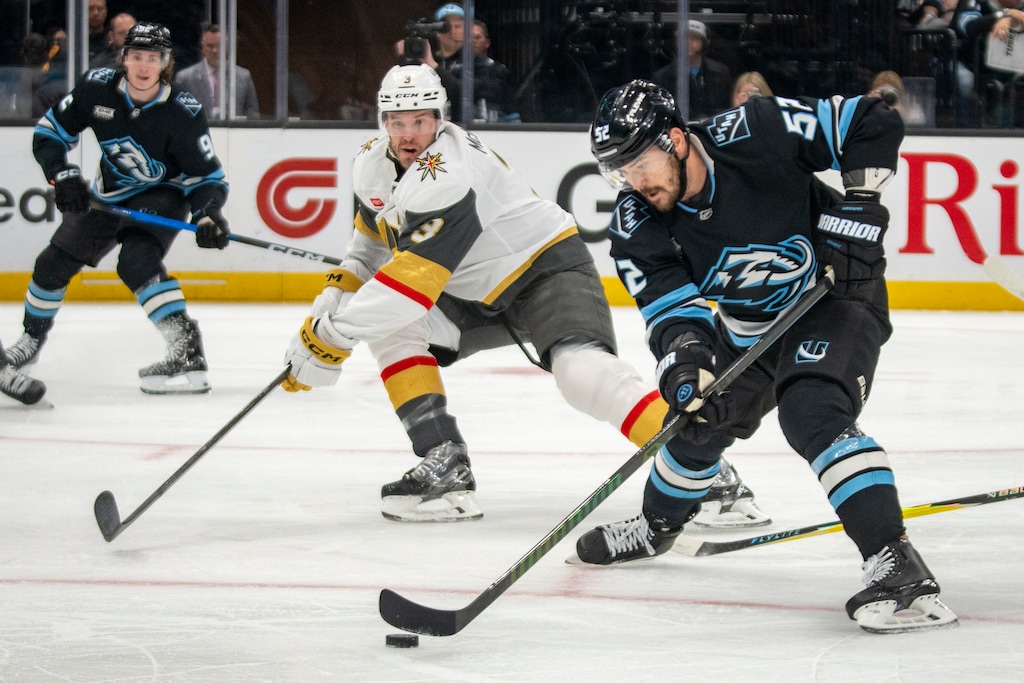
(Rick Egan | The Salt Lake Tribune) Fans watch the the final minutes of action as Mammoth trails 5-1 in the Stanley Cup Playoff game between the Utah Mammoth and the Vegas Golden Knights at the Delta Center on Friday, May 1, 2026.
But it became fairly obvious in these games, as tight as some of them were, that Vegas has a deeper team, able to provide savvy play when savvy play was required.
The Mammoth may have been speedier than the Golden Knights, may have been able, at least at times, to fly up the ice in rushes to score, showing stretches of promising talent. But Vegas showed calm and confidence, discipline as well, in important moments, again and again in their wins. And when the Mammoth mishandled the puck, they yielded up opportunities that ultimately killed them.
Game 6 was the latest and last example. Vegas took control as it took the lead, 1-0, 2-0, and then, the Mammoth started breaking through Golden Knight resistance that had mostly prevented Utah from executing those favored bursts. The Mammoth eventually cut the lead in half, and, with the building going berserk, it looked as though they might achieve what had been done so many times in this series by both teams — leveling the score.
Instead, it was Vegas that sealed off that comeback by getting a goal of its own. It was like a team playing keep away from the other, resulting in a third score, what Tortorella called a “big goal.” A subsequent power-play goal made the seal certain. A garbage goal ended the lopsided scoring.
And the series was over.
A happy-relieved Tortorella complimented the Mammoth afterward, saying they are “very talented,” and, he said, “That’s a good hockey team. … That team didn’t win 40-plus games and if you look at their metrics as far as their regular season, that’s a team that’s going to [have to] be reckoned with for quite a while now as far as some of the kids and skill and speed that they have. We’re fortunate to be moving on.”
Maybe so, but Mammoth coach Andre Tourigny wasn’t in the mood in the postgame to hear any of that. He said he was “mad” and “disappointed.” Not so much at his players, he clarified, but at simply the cruel nature of losing.
Back to the notion of playoff hockey’s higher education, he added: “Your failure makes you stronger. You learn from it. It makes you better. In order to make sure that happens, it has to hurt. And I don’t even want to feel good about it. I want that to hurt. …”
(Rick Egan | The Salt Lake Tribune) Utah Mammoth defenseman Sean Durzi (50) gets tangled up with Vegas Golden Knights right wing Mark Stone (61).
Make no mistake, the Mammoth were hurting.
“… There will be a ton of things we will unpack and learn and grow. As a coach, as a player, as an organization.”
He said what his team was feeling in defeat is important for its future. He said that would be “the fuel for tomorrow.” He said he loves his team. And he thanked the fans for their support.
“We need to find solutions,” Tourigny concluded, but he didn’t want to get specific about his criticisms of his team’s shortcomings because he said his head had no space for that in the immediate aftermath. He said he would dispense and hash over that information later.
(Rick Egan | The Salt Lake Tribune) Vegas Golden Knights right wing Mitch Marner (93) skates up the ice between Utah Mammoth defenseman Mikhail Sergachev (98) and Utah Mammoth right wing Dylan Guenther (11).
The fans, the ones who remained at game’s end to give the Mammoth that aforementioned tribute cheer, seemed to understand what had happened — a step forward had been taken, with many more steps still necessary to take. And as the players stood on the ice, like their coach, all “mad” and “disappointed,” they appeared to appreciate the appreciation. Then, they exited the ice with thoughts banging around inside their own heads, and with two absolutely sure things caroming like a Super Ball hurled inside their collective skull:
First, they had their chances against Vegas, in overtime games and in regulation games; and second, they must play with more poise, with more composure, with more control.
The classroom that is the Stanley Cup playoffs features a tough schoolmaster. It doesn’t grade on a curve. It doesn’t show much empathy or sympathy. Next year, perhaps the Mammoth’s hurtful education will leave them better prepared to pass their test and graduate on to a better end.