 Andy Larsen
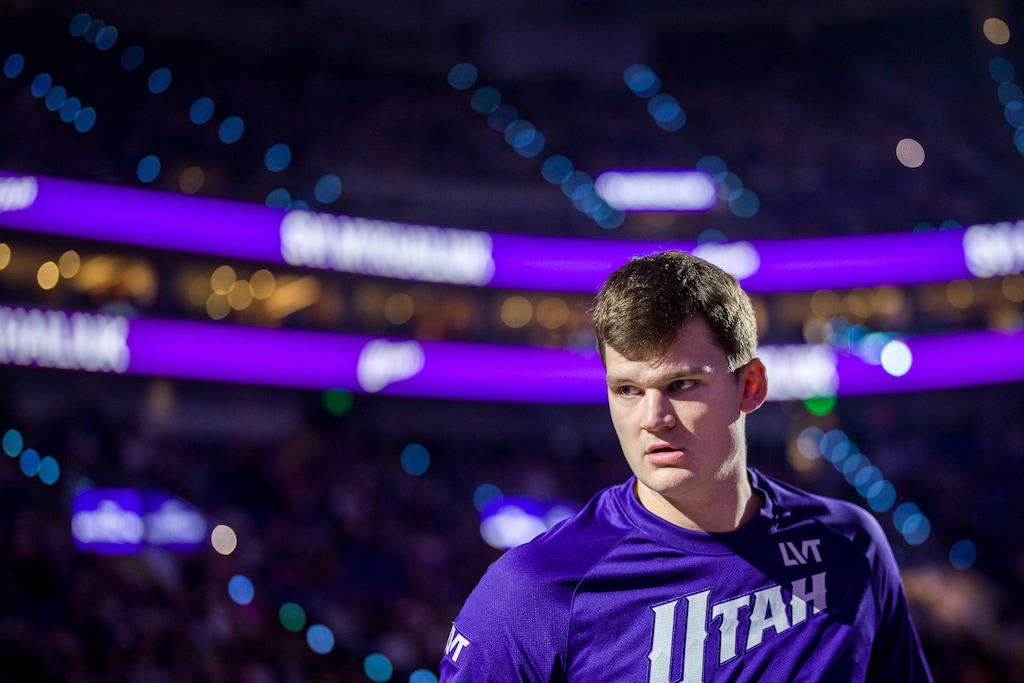
Will Walker Kessler be the Jazz’s starting center of the future?
It’s a fair question to ask given what’s occurred as Kessler seeks his second NBA contract after playing just five games in his fourth NBA season.
But just as important to remember is that the Jazz control Kessler’s immediate future — and team officials have made every indication that they plan to keep him. Only Kessler (and his representation) choosing a rarely-used nuclear option would seriously change that dynamic.
It’s a reality that persists even after Kessler reportedly turned down a contract offer that would see him paid $28 million per year, and one that Kessler himself seems to understand, as he posted on Instagram Wednesday about his desire to stay in Utah.
The history
For those who haven’t spent the last few years keeping a close eye on the struggling Utah Jazz, here’s the timeline of events regarding Kessler:
June 2022: Kessler is drafted by the Minnesota Timberwolves as the No. 22 overall pick. Just a week later, the Timberwolves would agree to trade him to the Jazz as one of nine different pieces in the Rudy Gobert deal.
2022-23: In his rookie season, Kessler impressed the NBA, performing well above his draft slot and ending up third in Rookie of the Year voting.
2023-24: A frustrating season for Kessler, in which he spent most of the year coming off the bench. This frustrated him and his representatives, who felt he had deserved a starting spot.
2024-25: But Kessler’s third season was a bounce-back one, in which he started every game he played while being asked to miss others as the Jazz tanked — again, a decision that frustrated Kessler. The center led the league in offensive rebounds per game and finished second in blocks per game behind San Antonio’s Victor Wembanyama.
Summer 2025: Kessler’s team sought a rookie contract extension from the Jazz’s front office, but negotiations between the parties were short. Because any extension above Kessler’s $14.6 million cap hold would have seen the Jazz lose cap space, Utah was reluctant to offer contracts much larger than that figure, and the Jazz’s final offer reflected that. Meanwhile, Kessler and his team wanted a much larger deal. The Jazz declined to negotiate further and decided to push Kessler’s contract talks into the summer of 2026.
Winter 2025: Kessler plays just the first five games of the 2025-26 season before suffering a torn labrum and undergoing shoulder surgery.
February 2026: Despite being injured, Kessler has several suitors at the NBA’s trade deadline. Most notable are the Los Angeles Lakers and the Indiana Pacers, the latter of which would have traded two first-round picks to the Jazz for Kessler while agreeing to a new deal with the center worth between $30 and $40 million per year, according to ESPN’s Tim MacMahon. The Jazz decline the offer, and instead trade for Memphis forward Jaren Jackson Jr., intending to play him alongside Kessler.
Monday: The Athletic’s Sam Amick reports that Kessler is “at odds” and is “currently disenchanted” with the Jazz’s front office as a result of how his contract negotiations are being handled. In particular, “with the Jazz choosing to leverage the realities of restricted free agency against him as a way to minimize his market, sources say he is strongly considering the prospect of a basketball future outside Utah.”
Tuesday: MacMahon appears on Utah radio station ESPN700 and says Kessler has received an offer for a five-year, $140 million contract that would pay him an average of $28 million per season, but has declined it. Criticism from some Jazz fans ensues.
Wednesday: Kessler goes to Instagram, saying “I’ve seen what’s being said, and I want it to be clear that I have always wanted to be here — I love this city, these fans, my teammates, my coaches — that’s real to me. You don’t grow roots where you don’t want to be.”
What comes next?
Kessler has four options.
The first is the simplest: take the Jazz’s offer on the table for the reported five years, $140 million. Such an offer would make him roughly the 10th-highest paid center in the NBA:
That does seem to be about right for a player of Kessler’s contributions, accounting for assumed improvement from Kessler as he begins to enter his prime. In the 2024-25 season and at 23 years old, Kessler finished 14th in Box Plus-Minus and 15th in Win Shares per 48 minutes among centers, per Basketball Reference.
The second is to go out to the NBA’s free agent market and receive an offer from one of the other 29 teams.
Only three teams — the Brooklyn Nets, the Chicago Bulls and the Los Angeles Lakers — will have cap space under ESPN’s projections. The Lakers, especially, are looking for a center to play next to Luka Doncic, but would likely only realistically have room for Kessler’s contract if LeBron James were to leave the team.
In this scenario, the Jazz would have 48 hours to match that contract offer if they so chose, in which case he would be obligated to play for Utah under the NBA’s restricted free agency rules.
The third would be to accept his qualifying offer, at just one year, $7.1 million. That would see Kessler play for the Jazz in the 2026-27 season, then become a fully unrestricted free agent in the summer of 2027.
That would mean Kessler is strongly betting on his future value, especially with $28 million per year on the table. If Kessler were to receive a full maximum contract in the 2027 offseason, his starting pay would be over $42 million. On the other hand, if the upcoming season were to go poorly, he could receive far less than he’s currently being offered.
Taking the qualifying offer is an extremely rare move, and history explains why — it generally hasn’t worked out well for the player who does so. Players like Ben Gordon and Nerlens Noel ended up taking contract offers smaller than those they received earlier on.
The fourth would be complicated but certainly isn’t impossible: being part of a sign-and-trade to another NBA team. That team would have to both offer Kessler enough money to sign and offer the Jazz enough in trade assets to do such a deal. Given that the similar arrangement with the Pacers in February didn’t work out, it seems the Jazz’s bar in negotiations is quite high.
So in the end, the reported general expectation around the league is that Kessler ends up with a long-term contract with Utah after all of this drama plays out.
That also explains Kessler’s Instagram post — he wants relations with his team and its fan base to stay positive.

Andy Larsen, a lifelong Utah resident who graduated with a math degree from Salt Lake City's Westminster College, is now The Tribune’s data columnist (after previously covering the Utah Jazz). When he's not writing about numbers in our world, Andy enjoys playing soccer, tennis and chess.