 Gordon Monson
A huge question hanging over the Jazz now that they have the No. 2 pick in the coming NBA draft is, what should they do with it?
If the answer to that question is solely dependent on what the Washington Wizards intend to do with the No. 1 pick, it’s only partially true. Because what the Wizards do might depend on how determined the Jazz are with what they want to do, and how motivated they are to do it.
The two flippable pieces in that equation appear to be AJ Dybantsa and Darryn Peterson. If the Jazz are set on one over the other, and they should be, then they also should do whatever’s necessary to get that guy. They’ve never had such a lofty position from which to operate in a draft. Adding in the generational talent at stake in this one makes the urgency attached to the opportunity even more critical, more once in a generational.
Some player evaluators figure that if the talent gap between Dybantsa and Peterson is so negligible, even if their individual skills and strengths do somewhat separate them, the Jazz could and should be satisfied with whichever of the two they naturally get. Each of these young players will be better pros than they were collegians; both will not only thrive in the NBA but also boost the Jazz in a big way. Even with their differences, either would fit nicely into a lineup that could include Lauri Markkanen, Jaren Jackson, Ace Bailey, Walker Kessler, and Keyonte George.
That being true, what’s the big deal?
It’s not the physical, it’s the mental.
Which of these two exceptional talents would be more at home playing for the Jazz? Either could, who would?
Oh, man, here we go again living in the echo of Derek Harper’s infamous words, “You go live in Utah.”
Let’s back up even further for a historical view. The two best players ever to suit up for the Jazz — John Stockton and Karl Malone — were unique because Utah was where they not only wanted to play, but also where they wanted to stay. As much as Malone squawked and gesticulated about his contract with Larry Miller — he once demanded that a bowl of fruit be provided in his hotel room on road trips — it was obvious he wanted to remain right where he was. Even in the last stage of his career, when he ended up with the Lakers, that happened not so much because Malone wanted out. It was more that the Jazz wanted him out. Stockton was mostly silent throughout, tethered as he was to his comfortable situation in Utah and his connection to Jerry Sloan.
Other Jazz greats such as Deron Williams and Donovan Mitchell, who thrived with the Jazz until they didn’t, grew ill at ease on account of their surroundings in the locker room and/or because of some of the attitudes sensed within portions of the club and community. They were mostly fantastic here, while they lasted.
Neither lasted.
Which brings us back to Dybantsa and Peterson.
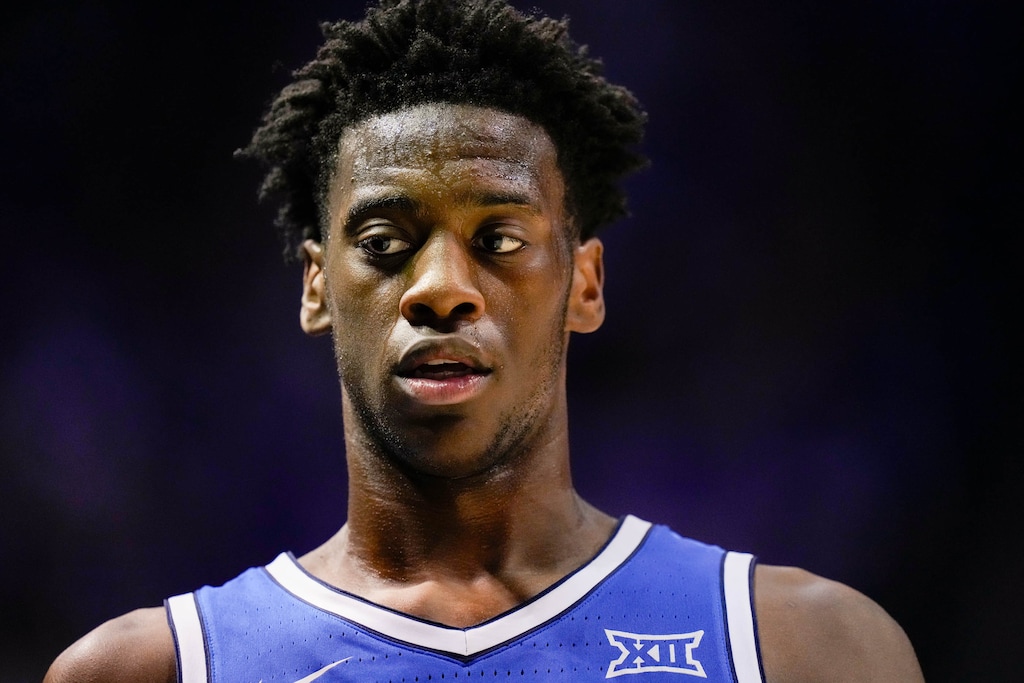
(Charlie Riedel | AP) Darryn Peterson has elite skills, but plenty of questions to answer after a strange freshman season at Kansas.
Which of the two is more likely to not just lift the Jazz through the stages of a rookie contract, but beyond that? Which is more likely, when all is said and done, to have a Salt Lake City street named after him? Yeah, it’s a lot to project onto a rookie. But with the kind of uncommon talent that seems to be on display here, it’s not a wholly unfair question. OK, maybe it is a bit unfair.
Dybantsa, originally from the Boston area, chose to come to Utah on his own volition twice before arriving at this juncture. He actually wanted to live here — at Utah Prep and then at BYU. There was money that enticed him on both accounts, but for a kid like Dybantsa, there was money on offer everywhere. He could have gone anywhere, and he came to Utah.
Those alone make him … what’s the word? … unusual. And his experience at BYU, despite the Cougars not conquering the Big 12 or the NCAA Tournament, was a positive one. That’s what Dybantsa said and how he acted. He said he intends to continue on as a remote student at BYU, even as he plays in the NBA. Wow. Unusual.
Nobody wants to come across here like Sally Field accepting her long-ago Oscar — “You like me! You really like me!” — but Dybantsa likes you, Utah. He really likes you.
If that sounds insecure and slightly paranoid, so be it.
Remember when LeBron James, after playing in Cleveland and Miami, wanted to return to play for the Cavs for no better reason really than because it was near where he grew up, it was home? And folks around here were encouraging parents to have children and encourage them to hoop it up from an early age so Utah could one day, some day, have one of its own feel about Salt Lake the way James felt about Cleveland? Uh-huh, that was a thing. A ridiculous thing, but a thing. And LeBron ended up in L.A., anyway.
Dybantsa may be the closest thing to an NBA superstar native son this area will ever get.
(Trent Nelson | The Salt Lake Tribune) AJ Dybantsa as the Utah Jazz host the Sacramento Kings, NBA basketball in Salt Lake City on Wednesday, Feb. 11, 2026.
And from the way BYU boosters Ryan Smith and Danny Ainge have connected with the wing, Ainge going back to his days with the Celtics as Dybantsa was emerging, it appears that they, too, want to keep that connection the way it’s been. Ainge, the former BYU star, was often at Cougar games watching Dybantsa.
The only mysteries with that procession are these: Was it sincere? Or were Ainge and Smith making their interest in Dybantsa a little too obvious for it to be automatically authentic? Was it real or a show, a deception for the rest of the NBA to see and bite on? As for Dybantsa, is his like for Utah the real deal, or would he really prefer to play elsewhere?
Only they know where the truth is. But maybe we’re about to find out.
As for Peterson, there’s the sometimes exasperating storm that surrounded him at Kansas. His abilities seemed undeniable. His willingness to play through adversity seemed deniable. What to do with a supreme athlete who scores 20 points in the first half of a college game and then benches himself in the second due to cramps or some other malady?
Beats me. I’m not sure. But the Jazz, at this point, have to be.
Some evaluators invoke the name of Kobe Bryant when Peterson’s skill level is discussed. But on the basketball court, Kobe was an assassin, a competitive monster, and that as much as his talent made him what he was. He played hurt. Outside of a rare occasion here and there, pity the fool who tried to drag him off the floor in the midst of important competition.
In a modern NBA where load management is enough of a problem, would the Jazz want a player who casually leans that way? Would Peterson lean that way as a pro? And if he did, what effect would that have as a franchise player on a team that needs him, needs to follow him and his example, and whose fans are notorious for caring as much about effort as they are about darn-near anything else?
Maybe skeptics have Peterson all wrong. Maybe he won’t be what he was in college, maybe he won’t be the antithesis of what Dybantsa was at BYU. As Dybantsa’s team crumbled around him, in large measure because of severe injuries and an inability to shoot straight, he powered on in an admirable way that jacked up his scoring from 20-plus points a game to 30 and 40. Nobody doubts Dybantsa’s drive.
Where do the Jazz go from here?
They do everything they can to get their hands on Dybantsa, that’s what. Even if the Wizards are well aware that he’s the guy the Jazz desperately want and are more than willing to extort them. That’s what the Jazz do, what they should do. Go after the athlete who’s more than popular around here, the athlete who could help them contend for what they’ve never achieved, not even with the two former stars who wanted to play and stay in Utah.
Do the Wizards want Dybantsa or do they want Peterson? Do they want somebody else? Do they want to trade out of the top spot? The Jazz need to find out, and do what they can to secure their future with the unusual dude positioned so unusually for them and their future.