 Kevin Reynolds
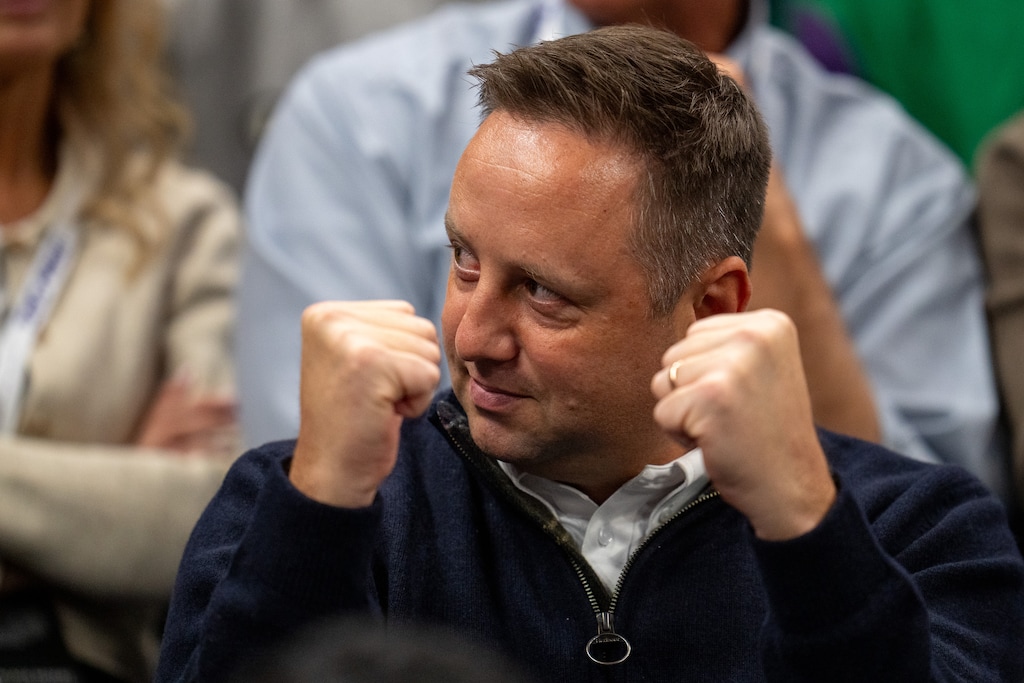
Chicago • Inside a sterile room on the edge of Lake Michigan, Austin Ainge let out a “yes” that cut through the quiet.
“Well, I couldn’t just sit there and do nothing,” Ainge justified later, smirking.
The Utah Jazz’s president of basketball operations spent the last year trying to create NBA draft lottery luck in a place where none previously existed. Not only did he guide his team to 60 losses to secure the fourth-best odds, he personally surveyed every potential draft room representative to see who had the best fortune — only to see the battle scars of the past four years laid out in front of him.
“Who wants it?” Ainge asked among the Jazz’s front office executives. “Justin Zanik said he’d already gone and lost. [Danny Ainge] same thing. Ryan Smith went and didn’t get the pick. You’re all fired, I said. I’ll be the one to go.”
So it was Austin Ainge, fist-pumping and grinning ear to ear, who was the first to know the Jazz’s fate in Chicago.
For the first time in franchise history, Utah moved up in the draft with its own pick to go No. 2 overall. For a franchise always snakebitten by the lottery balls, the Jazz basically won the lottery twice.
After it was announced that Utah landed at two, the next draw also came up Utah’s way. The NBA had to re-spin the lotto balls, eventually giving Memphis the third pick. Ainge was so giddy he reached across the desk to fist bump Memphis general manager Zach Kleiman.
“When you look at the playoff teams, most of them had the balls bounce their way at some point,” Ainge said.
Utah is finally in the club.
And now the excitement turns from the lottery toward the player Utah can bring in to solidify a budding playoff contender.
“We will be looking at this [as changing] the next 10 years,” Ainge said.
The Jazz can choose nearly any direction they desire now.
They could bolster the guard line with Kansas’ Darryn Peterson. They could add length with North Carolina’s Caleb Wilson. They could draft a do-it-all big man like Duke’s Cameron Boozer (whose father happens to be former Jazz star and current scout Carlos Boozer).
In some fantastical worlds, though perhaps unlikely, they could even make a play for presumed top pick AJ Dybantsa if somehow the Washington Wizards pass on BYU’s star.
Ainge is operating under the assumption that everything is on the table, including Dybantsa.
(Nam Y. Huh | AP) BYU forward AJ Dybantsa smiles as he talks to media during the NBA basketball draft lottery in Chicago, Sunday, May 10, 2026.
“I doubt [Washington] decided who they want, just like we haven’t decided who we want,” Ainge said. “We will figure out who is one and two on our board and be ready. There are at least two good players in this draft.”
That’s a slight understatement for a draft that is looked at as generational in the top four. Some analysts believe Dybantsa, Peterson, Boozer and Wilson could’ve all been top picks if they came out in different drafts. It’s why Ainge coyly smiled when he said having a top-four pick “changes things. That’s for sure.”
But even if the player is up in the air, the approach is solidified for Ainge. He’s looking to take a swing that changes the next decade for the franchise.
He will not draft for need or any immediate concern on a roster that could contend for the playoffs next year.
“Need is a bad evaluator,” he said.
He also doesn’t care if the player can contribute right away. The Jazz have their core set with Lauri Markkanen, Jaren Jackson Jr., Ace Bailey and Keyonte George. If this player can slide right in, that is only a bonus.
George, who represented the Jazz on stage Sunday, said this prospect will be in no rush to be ready.
“You look at the talent, there’s high-level talent in his draft class,” he said. “ It’s hard to tell the future, but obviously whenever that guy comes into the building we will try our hardest to make sure he understands what it takes to win on day one. Then after that, everything else will take care of itself.”
So Ainge is really looking at the skill set that will elevate a franchise one day.
He’s not sure who that is yet, but it will be a holistic evaluation. Many mock drafts have Peterson as the second pick, an explosive scorer who was the darling of draft evaluators early in the year.
Then cramps complicated his draft stock as he sat out large chunks of games. Against BYU, he scored 18 points in 20 minutes and parked himself on the sidelines most of the second half. He wasn’t even on the bench for a top-five matchup against Arizona.
(Nam Y. Huh | AP) Kansas guard Darryn Peterson attends the NBA basketball draft lottery in Chicago, Sunday, May 10, 2026.
But the Jazz will be making this decision on an entire body of work, not on a few months where Peterson exited games early.
Over the next few days, and weeks, the Jazz will make their own evaluations on what happened with Peterson in Lawerence, Kansas. But Ainge will also be making the rounds in Chapel Hill and Durham. Maybe Provo, too, just in case.
You can never be too sure of a decision that will alter the next decade of a franchise.
And it’s finally Utah’s decision to make.