 Gordon Monson
Ogden • Eric Kjar lifts a trophy every day.
Not because he’s winning yet another football championship, which he’s done repeatedly, but rather because he’s celebrating yet another day of breath, of life, of an existence worthy of his full embrace.
It hasn’t always been that way. And this might be difficult to understand for those who have never suffered through or been exposed to the sometimes-monstrous effects of a psychological disorder. But they are real. Real ominous.
Winning all those state titles at Jordan and Corner Canyon high schools and now turning Weber State’s football fortunes around have been and will be monumental achievements for the ultra-driven, uber-talented coach. But that’s nothing compared to the multiple mountains — mental and physical — the man’s already summited.
Even now, Kjar’s not sure the view from the top is as bright as the sights from the bottom are bleak. He would know.
Dark days in his past betrayed him, clinically fooled him into believing he didn’t want to live, not for another minute; days when suffocating blackness surrounded him, took him prisoner, laid him flat, robbed him of energy, of happiness, of hope, days when despair threatened to burrow straight through his body and brain, reaching in to steal his soul.
Over the span of a year, dull emptiness wrapped in sharp pain is what Kjar endured.
The moments in the morning, right after he awakened, brought the worst of grim thoughts that came and crashed in waves. When the guy who would go on to become a super-successful coach, who would mentor prep players that became college stars and NFL stalwarts; the lucky dude, who already had a beautiful wife, beautiful kids, a seemingly beautiful life, had a thousand good reasons not just to abide the day, but to jump up and attack it, couldn’t see a single one of those reasons.
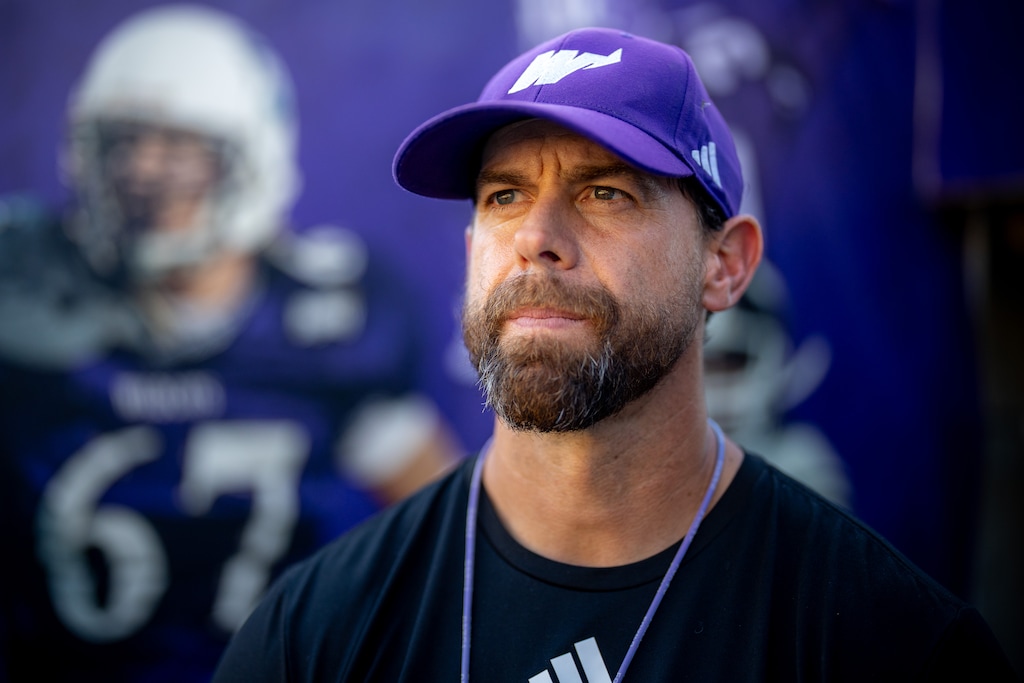
(Trent Nelson | The Salt Lake Tribune) Weber State head football coach Eric Kjar in Ogden on Wednesday, Sept. 30, 2026.
The depths of depression had blurred his vision, had put his spirits in a vice grip. And he wasn’t initially sure, not with any exactness, what to do or where to turn. His own father, Kim Kjar, a heavy-machine mechanic, who was as hardworking and decent and gregarious a parent as any son could wish for, had also been blinded and caught in an excruciating trap a decade earlier.
Kim Kjar was a physically active man who loved and lived to go on long runs through the countryside. Sometimes he ran alongside his kids, including young Eric, relishing God’s wonders as he galloped ahead. Then, he suffered a cut on his arm that got infected, a staph infection that penetrated to his heart, necessitating surgery to install heart valves. Thereafter, he labored to run and lacked the fire and spunk that previously defined him.
“He changed,” Kjar says. “He wasn’t the same dad.”
Kim fell into a state of serious moroseness. In the midst of it, he had attempted to take his life and failed, but horrible success came a few months later when he disappeared one October morning, and his body was discovered lifeless in the Wyoming outback, not far from the home where Kjar and his siblings years earlier had found such bliss, hunting and fishing, distance running and playing sports with their father.
“I was like, ‘Why, Dad? Why?’ … Mental illness destroys people,” says Kjar. “It’s hard. So hard.”
He uses one word to describe what family life was like before tragedy struck: “Awesome.”
“I had good family, good friends, good people I grew up with, good teachers in high school,” he says. “Good everything.”
Except for that one awful thing.
Talk about pain on pain. His father passed when Kjar was a freshman in college. And then, at the age of 29, he wandered into his own abyss.
“Depression kicked my butt,” he says. “The worst thing I’ve gone through, for sure.”
The more fortunate son, though, remembered that initial surge of hurt at his dad’s death and, in part, used it as motivation to attend to and fight off his private suffering, determined to pass no more heartache on to his immediate loved ones. In doing so, he managed to lean away from suicidal ideation and toward his wife, Andrea, who lovingly guided Kjar to seek the help he needed to find relief. She did and he did.
The coach calls his wife a “hero” and says he’s uncertain whether he’d have survived the illness that plagued him without her help. He stumbles to settle on proper ways to describe what he was experiencing.
It was like a shadowy stranger had invaded his body and taken over, he says.
“He wasn’t himself, the Eric I had known — positive, energetic, fun, always on the go,” says Andrea. “It was a very difficult time. He had those dark thoughts. We talked a lot. I was glad I was able to be there for him. I told him things would get better. It might not seem like it, but we’ll figure out the treatment that will be best for you. I’m here, the kids are here, we’re all here and we want you to stay.”
Whew.
When Kjar was teaching driver’s ed at school, alongside his coaching duties, Andrea and her four young children sometimes sat in the driver’s ed shack by him while he taught. “We wanted to make sure,” she says, “he knew we were always right there with him.”
At Andrea’s urging, Kjar (pronounced “care”) got proper care. That pronunciation of a Danish name now has taken on a more profound meaning for a mended, modest man.
“I still deal with it,” he says. “It’s not like it just goes away. But I feel like I’ve been way lucky. And also blessed.”
Adds Andrea: “It was hard to see my best friend, the man I fell in love with, in such a dark place. But he came through. Everybody has challenges in their life. He’s had a few.”
More on that in a minute.
At the original onset of that psychological fight, in 2010, Kjar was an emerging coach who already had shown signs of his brilliance at Jordan High. His football team annually ascended to a level of competitiveness and eventually won a state championship. Thereafter, when Kjar was hired at Corner Canyon, he and his players went throttle up, not only winning six state titles, but also drawing in and developing exceptional talent, including quarterbacks like Zach Wilson and Jaxson Dart, Isaac Wilson and Devin Brown, among gifted players at other positions, such as offensive lineman Jackson Powers-Johnson.
(Trent Nelson | The Salt Lake Tribune) Weber State head football coach Eric Kjar in Ogden on Wednesday, Sept. 30, 2026.
That perennial winning carried him to a job offer this past year as the head coach at Weber State, where he is in the midst of his first college season. The Wildcats are looking to build that program back to where it was a few years ago, conquering the Big Sky Conference and making deep runs in the FCS playoffs, back when a coach named Jay Hill was doing his business there.
It won’t be easy. A recent loss to Portland State is a prime example. In that game, the Wildcats fell behind on their home field, 28-7. They bounced back late to tie the score at 41, only to have the outcome turn on an interception that resulted in a field goal and defeat.
“Losing hurts,” he says.
Kjar isn’t clueless about the heavy lift at hand at Weber. He’s willing and able to put in the work, rising as he does every day at 5 a.m. to drive from his home in Draper to Ogden, and then return at 9 at night. He acknowledges that it will take effort and execution and all the coaching clichés — mixed with additional financial resources — to get the ask and the task done at the school. He says top Big Sky teams are spending about a million dollars on their rosters and that Weber State will have to catch up. Optimism is his swing thought for this season and the seasons ahead.
“There’s a lot of football talent in Utah,” he says. “I love being around our players, our coaches, and going through the challenges we have. … We’re headed in the right direction. The big thing is, we want to get to the point where we’re winning Big Sky championships, and making runs in the playoffs. That’s what you shoot for. You don’t aim for anything less.”
If doggedness and determination are part of that winning equation, Kjar has that mastered. There’s symmetry in that the man once hiked to Delicate Arch in Arches National Park on crutches while suffering from a severe Lisfranc injury, an aching, busted-up arch in his foot. The humble coach — yeah, a rarity in football these days — says he hasn’t really mastered anything. His coaching philosophy centers on connecting with players, making sure they know a couple of things: 1) that he is sincerely invested in their well-being, and 2) that he listens to them and they, in turn, listen to and learn from him.
“I’m a teacher,” he says.
Isiah Jackson, who played for Kjar and who now is an assistant coach at Weber, says this of his boss:
“He puts in a ton of detail, [with] extreme attention. Everybody’s got to be on the same page, everybody’s got to be correct on timing. He does a really good job of emphasizing that in a motivational way. … He expects the most out of [his players], every rep, every play, every down. He comes across at times a little harsh. But that’s how you get a lot out of your players. He cares, and he shows it. He might yell at you, and then, after practice, he puts his arms around you and says, ‘Hey, I love you, you’re doing a great job.’”
When it comes to mental health, Kjar correctly claims some people, especially in the macho world of football, have not yet completely comprehended the nature of such complicated conditions. They are nothing to be ashamed of, he says. They can be treated. He’s Exhibit A. And it requires and demonstrates strength when they are discovered, diagnosed and dealt with. Kjar takes a daily dose of medicine to tend to his matters of the mind.
He uses what he’s experienced to recognize manifestations in others, and to help them in the way he’s been helped, saying: “I just try to help people understand that [mental issues] affect a lot of people. It can be anybody you’re around who might be dealing with some of this stuff. It’s something they can [recover] from.
“It’s nothing to be embarrassed about. I’m telling you right now, the people who deal with it and battle it every day, they’re the toughest people on the planet. They’ve got to know they can win. They can.”
Kjar is one of the toughies, hanging in, hanging on.
“Nothing’s ever 100 percent,” Andrea says. “You just find the course of treatment that works for you and you stay the course. If that needs adjustments, then you make adjustments and move forward that way.”
As for how outsiders view her husband and his depression, she says: “There has been a stigma with it, but it’s more open now. Some people still think it’s a mindset. ‘C’mon,’ they say, ‘be positive.’ But it’s as real as our son, Noah, who has diabetes. It’s not just mind over matter. It requires treatment.”
Kjar’s mind was and is treated. His body is in equal need.
(Trent Nelson | The Salt Lake Tribune) Weber State head football coach Eric Kjar in Ogden on Wednesday, Sept. 30, 2026.
A year after his initial battle with depression, the coach started feeling weakness up and down the left side of his face, his left arm, his left hand, his left leg. It was a tingling sensation that left him fatigued. “I had some tingling and numbness,” he says. “I ended up barely being able to walk for a while. It usually didn’t last too long, but it hit pretty hard.”
He had noticed similar, but milder symptoms when he was playing football at Wayne State College in Nebraska, where he started his college career as a quarterback before moving to wide receiver.
Having been raised in Kemmerer, Wyoming, a mining town located northeast of Evanston, where everything outdoors was a big part of darn near every kid’s life, Kjar fell hard for another outdoor game — uh-huh, football. Like a lot of small-town kids, he enjoyed basketball, baseball and track. But football called his name.
“I loved it,” he says.
The more he played the game, the more he grasped its nuances, and the more fascinated he became with it, especially the offensive side. He studied film, read books, listened to coaches and decided while at Wayne State that he would make football his career.
“I learned so much,” he says. “It was a springboard into coaching.”
Since he met and married Andrea, who was from Sandy, he commenced that teaching/coaching calling at Jordan, and stayed at the school for 13 years before moving to Corner Canyon for nine years before taking the top job at Weber.
While working at Jordan, dividing his vigor and verve among his wife, his children, his students and football, he was faced with the double-barreled blast of major depressive disorder and then …
And then, he was diagnosed with multiple sclerosis, a disease that, according to the Mayo Clinic, causes the breakdown of the protective covering of nerves. It can cause numbness, weakness, trouble walking, vision changes and other symptoms.
At first, Kjar took injections to treat the disease, which caused him some misery, flu-like symptoms. Now, he pops a pill, which makes day-to-day living better. The coach, who is 6-foot-4, looks to be in phenomenal shape. “I’ve worked my butt off and trained to keep my body as healthy as possible,” he says. “[The MS] hasn’t progressed the way it sometimes does. You hear the horror stories. They have great medications now and my doctors have been awesome.”
He says other than stretches of exhaustion, he feels good.
He definitely coaches good.
“Teaching kids the game is rewarding,” he says. “The creative part of it, the intellectual stuff, the hard work, the camaraderie, the teamwork, spreading knowledge, everything from passing schemes to blocking and tackling. It’s enjoyable watching kids progress, trying to make a difference in their abilities to play the game, in making connections with teammates and coaches, and, hopefully, in their lives. I’ve enjoyed that across the board.”
In college, he once considered becoming an accountant. One semester in, he changed his mind. “I thought, ‘Nope, I’m not doing that,’” he says. Bill Walsh’s game never stopped beckoning, never stopped whispering in his ear.
Kjar’s records indicate he made the right choice. In his first season running Jordan football, in 2009, he says: “I wasn’t a very good head coach. I needed to improve, needed to get more organized, and grow into it.”
He was 500 miles ahead by the time he took over at Corner Canyon, and that school’s subsequent dominance under his direction is a testament to that. He says, year by year, he studied ways to become a competent coach, not just from a technical standpoint, but from the human side.
“I got to know the game,” he says. “And learned on the teaching side how to handle people and build relationships with them, both coaches and players. That really matters. That allows you to coach hard and teach the right way. They have to know you care about them. I can be pretty tough on our guys. But you have to have positive energy, give positive feedback. I want players to know, before that, that I have their best interests in mind. It’s a partnership. I’m there to help and sometimes that comes off with a little bit of urgency.”
Which is to say, because Kjar cares, as Jackson says, he can kick ass, too.
Winning adds to the blend. But he underscores that the competitive nature of football at all levels can kick back. “I’ve never felt like I’ve got coaching totally figured out,” he says. “It’s just a constant battle to rise up, to get to the top. Everybody’s scrambling for it. …”
He pauses.
“… Having good players always makes you look really good as a coach.”
When asked which of his coaching talents, after all the years, is his best, he looks down at his feet and answers: “I don’t think I have a lot of them, but one is, I can read people, how they’re doing, if they’re struggling, how I can help them, even if it’s just talking to them, just building them up, seeing them.”
Kjar has been on the receiving end of that kind of human connection. It not only made his life better, it saved it from the darkness that seemed as though it might never clear away.
It did clear away, and that joyful fact enabled him to regain what was most important to him — a rediscovery of self, his bond with his family, his place as a difference-maker in coaching.
“I’m grateful,” he says.
Now, at Weber, Eric Kjar has the opportunity to mentor two of his football-playing sons — Noah and Tate — and, more significantly, to live a life that isn’t always easy, that knocks him around a bit, but that offers the promise of a new day, a chance to wake up in the morning with brightness beaming straight through his body and brain, his soul now armored against the wretched thief that once tried to steal it.
“He’s an inspiration,” Andrea says.
The inspirational son hopes his father, from his seat in the stands somewhere in the great beyond, would be content, pleased and proud and comforted, to see the happiness his boy has found.
Gordon Monson has been a columnist at The Salt Lake Tribune since 1993. Before coming to Utah, he was a sports and feature writer at the Los Angeles Times and the Los Angeles Daily News. He's hosted a sports-talk radio show in Salt Lake City for 22 years, the past 16 years at 1280 AM/97.5 FM The Zone.