 Gordon Monson
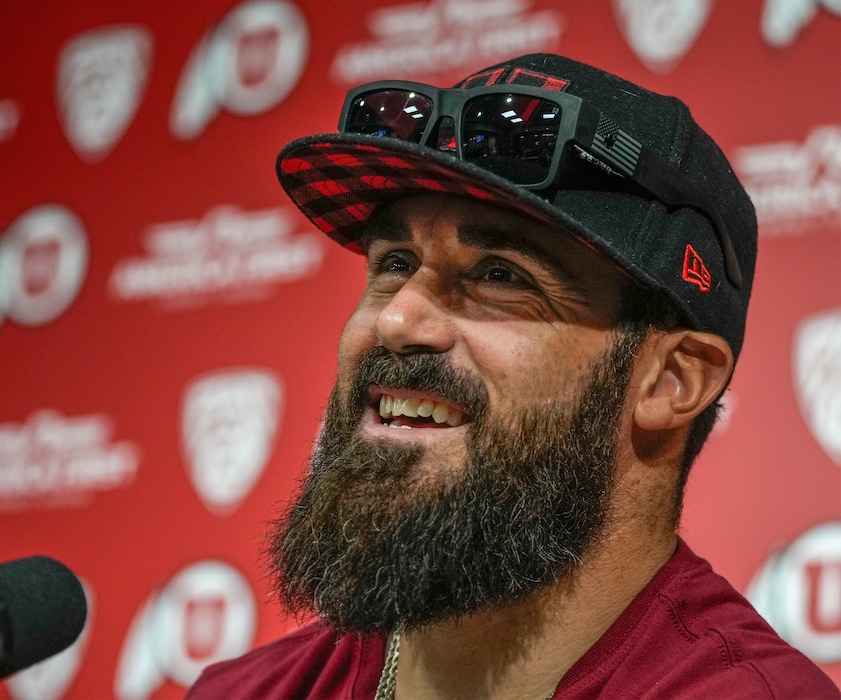
Eric Weddle couldn’t go where he wanted to go to play college football because that school did not want him; coaches there didn’t think he was good enough to play at that level; he was too small, they said. So, as it turned out, he went to a higher level. He went to the only school that seemed motivated to get him.
He came to Utah.
UCLA’s recruiting blunder was the Utes’ blessing.
That mistake/miracle was a long time ago, nearly a quarter-century back now. But everything that happened thereafter — some of which we’ll get to in a minute — underscored both the blunder and the blessing.
On account of that, primarily what he did for the Utes, he’ll be saluted at Saturday night’s Utah-Arkansas game, having his name hoisted into and onto the Ring of Honor at Rice-Eccles Stadium, joining just three other names already riveted there — Alex Smith, Ron McBride and Roy Jefferson.
Considering the athleticism, attributes, accomplishments and attitudes possessed and demonstrated by the honoree, the tribute is more than fitting.
Weddle, who grew up in Southern California, didn’t just go on to play for Utah, didn’t just pad up and take the field, not in any conventional way. He transcended that status, becoming a four-year starter as a defensive back — at corner, at nickel, at safety — and riding a rocket over a memorable span as one of the best, most versatile Utes ever.
At various times, beyond his defensive contributions, he also filled roles as quarterback, running back, receiver, punter and punt returner. Somebody once said the only participants at a Utah game who were on the field more than Weddle were the referees.
And none of that took into consideration that on more than a few occasions Weddle was playing in pain. Over the years, the jack-of-all-trades and master-of-them, too, suffered injuries that included a ripped medial collateral ligament, a shoulder separation, a torn hamstring and a broken elbow. During his sophomore season, Weddle got dinged hard on the first play of the first game, necessitating two weeks off, then the wearing of a brace. After that came the shoulder injury, which he played through, despite the hurt. He laid off contact during practices, got shot up with painkillers before games, which only temporarily dulled the ache, and endured the throbbing the rest of the time.
(Trent Nelson | The Salt Lake Tribune) Kyle Whittingham embraces defensive back Eric Weddle on senior day in 2006.
He played on because he thought his team needed him. Call that determination, or call it dumb. Either way, that’s what Weddle chose to give.
“I couldn’t sleep the night after a game,” he said at the time. “It was hard. I was in constant pain. Every time you hit someone, it caused a sharp pain. But it’s just something you have to deal with. You’re playing football, out there with the guys you love, guys you want to help, playing a game you love. It’s a contact sport. It was a relief to get all that pain over with. I was glad when the season ended to just let it heal.”
More of that grit and glory came in the NFL, where Weddle offered up a stellar 14-season, All-Pro kind of career — with his old pal, pain, never completely leaving him alone. He was rewarded for that companionship, becoming at one point the highest-paid safety in pro football. He intended to cap his career after 13 seasons with the Chargers, Ravens and Rams, but after he became a full-time, carpool-driving, grocery-hauling, knock-around-the-TV-den dad, he was asked back by the Rams to join them in their postseason run for a Vince Lombardi Trophy. He returned and became a Super Bowl champion in 2022.
“It’s the craziest story ever,” he said. “Things like this don’t happen all the time. … I’m humbled by it all, and grateful.”
Grateful enough when the winning was done, at last, to walk away from the game he loved.
At the risk of going overboard here with the superlatives, while at Utah, Weddle played for one of the best — no, let’s dump the qualifier — played for the best team in school history: the undefeated 2004 Utes. The stamp he put on all his college teams from 2003 to 2006 was unmistakable.
He was one of those rare young All-American talents who said he cared more about the team than he cared about himself — and really meant it. There was less BS with Eric Weddle than there were blown coverages or missed tackles.
“I just want to win,” he said. “My teammates know that’s what I’m all about. If we win a championship, then I’ve succeeded.”
One of his Utah coaches back then described Weddle like this: “He’s a team leader, and he’s accepted that role. He’s such a great athlete, he has great instincts, and he’s so mentally tough. He prepares for an opponent like no one I’ve ever been around.”
Now, the school that gave him a chance and the game that gave him his career, and also took away bits and pieces of him, will recognize and celebrate him in a way that allows present-day Ute football fans to honor him with fondness, and, in the years ahead, cause Ute football fans who never saw him play to read his name with wonder.