 Gordon Monson
Now that the dark overlord is gone to Michigan, where the Wolverine attack looked like a pack of clumsy dogs the other night, here are five major offensive questions and answers to consider ... and guess at ... and find out ... in the weeks ahead for Utah football, starting against Arkansas on Saturday night, after the beatdown the Utes put on Idaho in Game 1.
1. How good will Devon Dampier be against an SEC opponent, then Utah State, and then through the coming Big 12 schedule?
Guess here: Really good.
Dampier looked comfortable against Idaho, such as it was, but there were remnants of the brilliance he showed against Nebraska in last season’s bowl game, a memorable performance that included the quarterback’s three rushing touchdowns and two scores through the air. Not to mention the 458 total yards he accounted for — and now the leadership and cool demeanor he demonstrated against the Vandals.
Quality QBs can get the ball where it needs to go, even if, at times, the pitches aren’t perfect, and with Dampier, he adds that secondary skill so valuable in the college game and, for that matter, in the pros, as well. He can move. With defenses concerned with so many other aspects of slowing an attack, the ability Dampier has to punish them with his quick judgment and feet is a bonus that these days is darn near a necessity.
Against Idaho, in a showing that lasted just more than a half, Dampier completed 13 of 18 passes for 176 yards and three touchdowns, and he scooted for 31 more yards.
All of that spoken for and attended to, the other important aspect of Dampier’s game is the aforementioned leadership. It’s a super-small sample size thus far this year, but when the senior is under center, the entire Ute offense seems comforted just knowing he’s there.
2. How much of an opportunity will Byrd Ficklin get to play, even as Dampier shines?
Guess here: Much more than most backup quarterbacks get.
Ficklin is an obvious athlete, a sophomore who’s in training to take over full time when the other guy’s eligibility runs out. And even though last Thursday’s opposition was substandard to what the Utes will face most — or all the other — weeks yet to come, Ficklin’s role will continue to be significant. Short of injury to Dampier, he won’t play an entire half, as he did in the third and fourth quarters against the Vandals in a rout. But he will blend in with Dampier, as he did in the first and second quarters — on account of his fleet-footedness, his talent for picking up crucial yardage, and his lively arm when it comes time for an additional option to throw.
Think of it like this: What defense in its right mind would look forward to facing a QB like Ficklin when the Utes are inside the 10-yard line, threatening to score? He’s a red-zone nightmare. As nimble as Dampier is as a run-throw threat, Ficklin is that and more.
3) How many yards will Wayshawn Parker gain this season?
Guess here: A boatload.
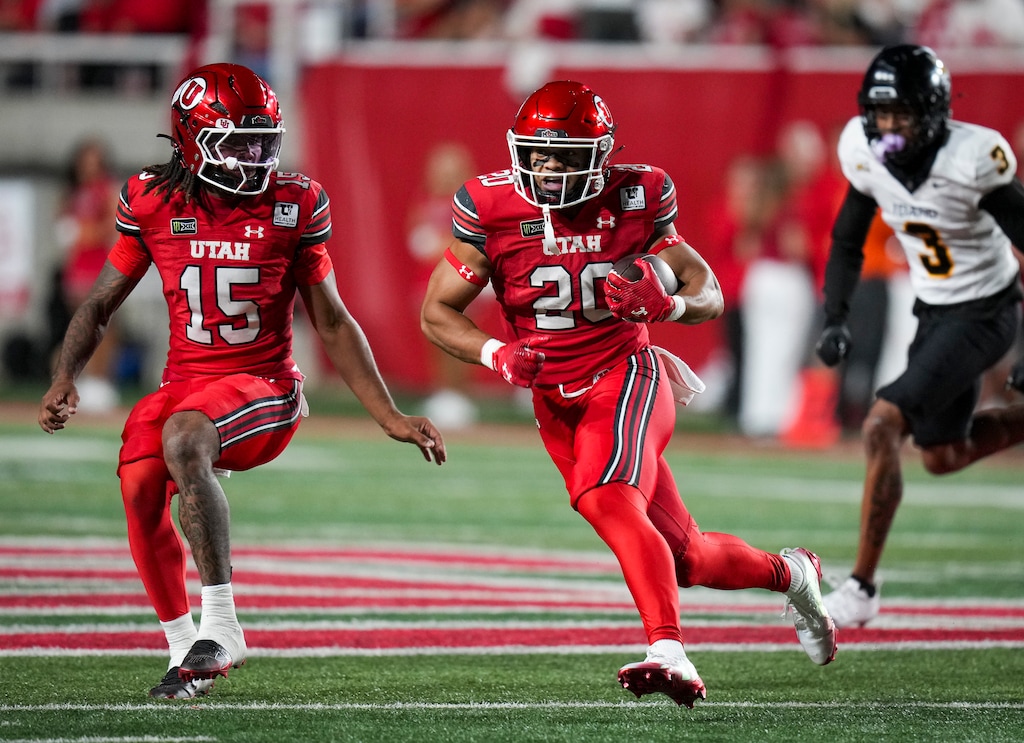
That’s not exactly a clinical response, but a precise number is unnecessary. The Utes have always relished a running back who can be depended on to pick up tough yards. It’s well known that Parker last season averaged — averaged — 6.6 yards per carry. He did nearly the same against Idaho, getting 5.9.
The offensive front may not be quite as formidable as it was last time around and might not create quite the same amount of space for Parker, but with him, that is likely to be a minor inconvenience. He’ll get his yards, even after he absorbs initial hits, leaning forward for more.
A subsequent question does exist: With quarterbacks who can run, and with RB backups like freshman LaMarcus Bell, who revealed bursts of speed in the first game, will Parker’s total number of carries be reduced in a sharing-is-caring kind of way? If they are, it won’t minimize Parker’s value to the Utes’ attack.
4. Will Utah’s “throw game,” as a certain former coach used to call it, finally be what that coach said it needed to be — even as he sometimes pulled back on the reins to inhibit it — for the Utes’ offense to round out all prim and proper?
Guess here: Probably.
The Utes had that rock-and-rolling run game last season, and it was typically difficult to stop. But this season, there might be additional accoutrements over the top.
In the first game, Utah State transfer Braden Pegan impressed pretty much everyone with the way he was getting open and catching passes. Morgan Scalley mentioned him specifically in Monday’s press availability, and he added: “… I think Devon had eight different wide receivers [oops, not quite that many WRs] he was able to connect with, and then Hunter Andrews was in the mix, and you add our running backs and the depth that we have there. So that was the biggest thing for us — the ability to show different personnel groups and distribute the ball to different guys. … [W]hen you’ve got that many guys getting the ball, it can be a tough one.”
That was manifested with scoring totals progressing through each quarter: 17 points, 14 points, 14 points, 21 points.
Parker caught a nine-yard TD pass. Parker had a 21-yard TD run. Pegan hauled in a seven-yard TD pass. Parker caught a three-yard TD pass. Pegan had a 12-yard TD run. Noah Bennee caught a 35-yard TD pass (from Ficklin). Andrews caught a nine-yard TD pass. Steve Chavez-Soto had a five-yard TD run. Bell had a 34-yard TD run.
All told, Utah gained 364 yards on the ground, 269 via the pass. Total yards: 633.
Now, we’ll see if the appetizer on attack against Idaho will move straightaway into the main course against an SEC team on Saturday night and everything that comes thereafter in the weeks and months ahead.
5. Will the offense make that happen?
Guess here: Um … sure? … maybe? … could be? … might be? … won’t be? … would be a gas, a laugh a minute for the Utes and their fans if it actually does.