 Gordon Monson
David Locke had an idea.
It was a crazy, first-of-its-kind idea, an idea that grew out of fundamental belief in his abilities nourished by his family, the kind that, once it was transformed from a vague thought bubble into reality, caused a whole lot of people to wonder why they didn’t think of it and make it real first.
Too late. Too bad.
At the fresh end of an NBA season just more than a decade ago, after he finished another season as the Utah Jazz’s radio play-by-play announcer, that aforementioned notion bounced around in the far reaches of his mind, caroming to the near reaches, like a Superball hurled in a shower stall, and now, in time and after a whole lot of growth and effort, has evolved into the largest sports podcast network in the country.
It’s called Locked On Podcast Network. Maybe you already know of it. A whole lot of others certainly do. Fans around the NBA, the NFL, MLB, the NHL and major college programs listen in and view individual episodes of it, to the tune of nearly 2 million views and listens each day. Maybe you’re one of them. There are more than 200 shows available, covering teams from coast to coast. Has it survived and thrived? The network in all its breadth and depth celebrated its 10th anniversary in June.
“The idea was right,” Locke says. “It’s been great. It’s been amazing.”
And the key to its programming success, according to the man who conjured it, has less to do with being big and more to do with being small, with dialing in and capitalizing on keen interest in your team. He knew from his time as a radio host and program director that “local ratings are always better; people are fans of teams.”
Each show, each team, in some cases each league, has an on-air talent or multiple hosts dedicated to everything (Locked On) Cougars or (Locked On) Utes or (Locked On) Eagles or (Locked On) Dodgers or (Locked On) Mammoth or (Locked On) Jazz.
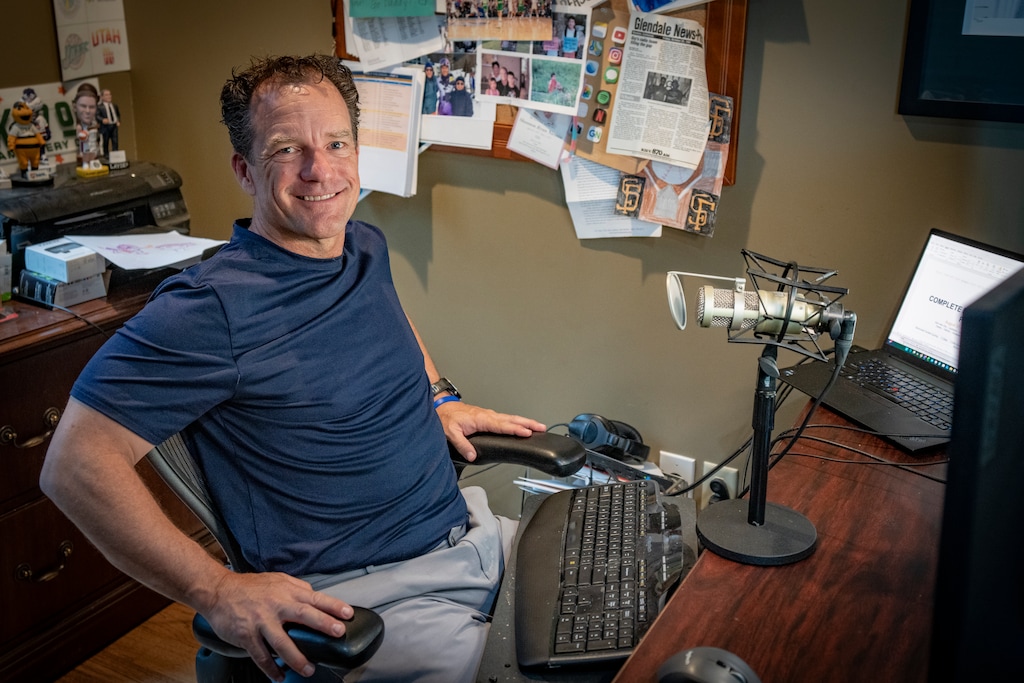
(Rick Egan | The Salt Lake Tribune) David Locke in his podcast studio, on Friday, July 17, 2026.
Locke himself, even now, is the one who handles Locked On Jazz, the podcast that started all the others. Hundreds of episodes are recorded rapid-fire, sometimes multiple shows in a single day, feeding the voracious appetites of fans who can’t quite get satiated, can’t get enough information about and commentary on the latest happenings of their favorite teams.
“There’s a revolution in sports media where there are niches,” says Jake Hatch, host of Locked On Cougars, the network podcast that centers on BYU. “People want to have content specific to their team every day. They can listen to or view this whenever it’s convenient for them. You can get your team whenever you want it. We call those people ‘every-dayers.’ I number them in the thousands. I had one BYU legend who told me he listens all the time. I was flattered. There’s a lot of appreciation for it locally, all across the country and even internationally.”
Kevin Graham, a former Salt Lake radio host and veteran program director at sports stations in places such as New York City, Detroit, San Francisco and Boston, and now a Locked On consultant, says Locke had a vision for creating hundreds of podcasts, harvesting hosts in each city, stringing them together in one network, selling that content to sponsors in block form and letting the whole thing fly from there.
It flew.
“David had a great idea before anyone figured out how to implement it,” Graham says. “He found a way to build and implement shows on specific sports teams, and then he sold it like a network to generate the revenue. Now, you don’t get a thousand downloads, you get a million. It’s impressive.”
The Locked On Podcast Network was initially funded by its founder, before a $750,000 infusion of cash from investors Bruce Gordon, Podfund and Summit Capital. The network was then sold to Tegna, a TV company, in 2021, for an undisclosed amount. Locke declined to divulge details, but published reports suggest the sale was for just shy of $14 million. Whatever the number was, suffice it to say, the deal made the radio voice of the Jazz a wealthier voice than he already was. He remains both the Jazz’s radio play-by-play announcer and the head of the network, which loads up his schedule enough for him to find satisfaction and fulfillment in all extensions of his craft.
“There were a lot of days when I didn’t know if we’d get through it,” says Locke. “I didn’t know how to run a company. But I believed in the idea. We’ve had amazing people to make it happen. It’s been a collective quest for greatness. And it’s been fun.”
To understand what all of that means is to back way up, all the way through Locke’s personal story from start to his network’s onset.
He was born in Palo Alto, Calif., the only child of caring parents, Hal and Carol, his father a prominent businessman and Harvard graduate who blazed trails of his own. Locke, from a young age, was keyed in on sports, including skiing, biking and hiking. His dad had business connected with Utah’s Solitude ski resort, so he spent time here, ending up with posters of Jazz players on his bedroom wall in his family’s home in the Bay Area when he was 10 years old. But the scope of his interests blew past just that.
“Every night, we watched The MacNeil/Lehrer Report on PBS, then we ate dinner,” he says.
He also called games, whiffle ball games, games of little or no consequence to anyone outside of those actually participating in them, namely his friends, practicing for what would come years later as a professional.
(Rick Egan | The Salt Lake Tribune) David Locke in his podcast studio, on Friday, July 17, 2026.
Although some of his work colleagues now think he, as an adult, has a big brain, Locke, as a kid and straight into his college years, was a lousy student — for a reason that he at first didn’t understand, but discovered and conquered later: a form of dyslexia. School for him was “brutal.” He thought he was dumb. That hardship, he says, at first was a stumbling block, but it became a blessing because it caused him to process what he saw and internalized and experienced with his available powers of perception in ways outside of the norm. It’s one reason he’s able to call Jazz games, all the action on the court, in the manner he does. Turns out, he did and does have a big brain.
He eventually attended Occidental College in the Los Angeles area, ever focused on pursuing a sports broadcasting career. Upon graduation, in the early 1990s, Locke’s father bought him time late at night on an obscure L.A. radio station, during which the aspiring announcer offered sports talk to which, he says, nobody listened: “I had my friends call in to the show.”
When he moved to Utah shortly thereafter, he worked as a ski instructor at Solitude and tried to find employment at a Salt Lake radio station. He badgered Barry King, who back then hosted a modest sports talk show here, into giving him air time. From there, he hooked on with AM-570, the station contracted to broadcast Jazz games. He hosted his own show. When the Jazz shifted to a different station — 1320 KFAN — Locke, all of 25 years old, was tabbed as program director and show host. He stayed in that role until KJR in Seattle hired him to host an evening show. He also became the play-by-play announcer for the WNBA’s Seattle Storm. That led to his job in a similar role as the play-by-play guy for the Seattle Sonics. When that team ended up in Oklahoma City, Locke was fired.
Shortly thereafter, the Jazz lured him back to Salt Lake City, where he hosted a daily show before becoming the Jazz radio announcer in 2010. He’s done that since.
“When I was young, I remember riding in the car with my dad, listening to Hot Rod Hundley interviewing some Jazz player. I told him, ‘I want to be that guy.’”
Well. Hundley was a Jazz broadcasting legend. And Locke now, figuratively, at least, sits in his seat. Does the reality of the job match the youngster’s dream, the youngster who used to call whiffle ball games played with his friends?
“It’s so much better than I, as a kid, ever could have dreamed it would be,” he says. “I love it. I want people who listen to the broadcast to have a great experience. If anyone tunes into a Jazz game and thinks I’m not having the best time of my life, I’ve failed.”
Locke’s lived and learned behind the mic, evolving from the beginning in 2010, when he overcooked some of his calls, favoring the bombastic, to a more sophisticated methodology that mixes the relaying of what’s happening on the court, painting artful pictures there, with proper storytelling.
“I’ve worked at the craft,” he says. “There are nights when it just comes to you and others when you’re throwing your headsets. When you’re on, it’s the greatest feeling in the world. But it’s never completely mastered. There’s always room to get better.”
(Rick Egan | The Salt Lake Tribune) David Locke in his podcast studio, on Friday, July 17, 2026.
In the midst of such ascending adventures, in 2016, just after the Jazz season ended, Locke, facing an offseason of relative idleness — “I don’t sit still well,” he says, “I like to have a purpose. I like to work.” — gave birth to his new idea.
The idea.
The one that spawned a network that now employs more than 200 people, that delivers thousands of podcasts, gaining millions of downloads.
He started by searching for and hiring what amounted to part-time talent in cities wherever pro and major college teams existed. Those jobs, in many instances, turned into full-time gigs for that talent, some of whom make more than a comfortable living and have gained an affluent existence doing so. The network shares revenue with its hosts, and then those hosts gain additional monies based on the number of listens and views they draw in.
Hatch, who has been with Locked On for nearly eight years, has seen his audience grow and grow over that span. He also works as a radio show producer, but with the success of his podcast, he doesn’t have to do both jobs. Not anymore. He does them, at present, because he wants to.
He broadcasts from what he calls his “Harry Potter closet” under a set of stairs at his house, using a small camera aimed directly at his face, with what looks like a neon light behind him that spells out “Locked On Cougars.”
From that spot, he delivers what he refers to as daily “infotainment” about his beloved BYU sports teams. He’s a fan and makes no attempt to hide the fact, but he also attempts to take something of a journalistic approach to what he reports and comments on.
“I’m not a shock jock,” he says. “I try to do this responsibly. There’s a work element to it, but I have a passion for BYU sports. It’s helped me expand my brand. YouTube has made a big difference. I love it. It’s fun. It’s an opportunity to have my voice heard. This allows me to be a star of my own show.”
Like talent on all the other Locked On podcasts, Hatch creates and hunts down and delivers his own content, typically knowing, as most of the hosts do, what his listeners and viewers are craving the most.
“Locked On has been on top of riding the digital wave,” he says. “David sees things before they become mainstream. He’s seen the waves as they’re coming and we ride them.”
Tasty waves and a righteous buzz they offer.
Locke says he takes great satisfaction — along with the accompanying financial rewards — from the network’s success, and he credits people like Hatch and hundreds of others who power the bus forward.
He says he leaned on a number of influential people, and enjoyed a degree of “privilege,” too, throughout the network’s founding and growth — for which he is grateful, which he acknowledges, to whom he gives credit.
He summarizes his story, at least this part of it, with two questions and two answers: “Was I capable of building a company, building this network? I grew up in a family where you were told you could do things. It gave me belief. Did I think it would be what this became? The answer is, ‘Yeah.’”