 Kevin Reynolds
From the outside, Utah’s bid for a Major League Baseball team has felt a little like a runner crouched a few feet off the bag at second base.
Ready and waiting for the crack of a bat or some silent sign to get moving.
But at least one person is standing on the third base line, waving furiously toward home.
Longtime USA Today baseball columnist Bob Nightengale recently wrote that “cities like Portland and Sacramento,” considered Utah’s top competition in the west, “might be wasting their time.”
“If MLB indeed expands,” he continued, “Salt Lake City and Nashville are the heavy favorites.”
But there are still obstacles to clear.
Here’s where things stand right now.
Tampa Bay’s stadium issues
MLB Commissioner Rob Manfred has said he wants the league to expand to 32 teams — adding one in the east and one in the west — before he retires in 2029.
But he’s also said he wanted to see both the Athletics and Rays settled in new stadiums before expanding.
With construction underway on a new ballpark along the Las Vegas Strip, Manfred is now closely monitoring things in Florida.
The Rays organization has been presenting a $2.3 billion stadium plan, with over $900 million coming from public coffers.
Residents, too, were wary of tax hikes. The Tampa City Council expressed reservations about the gaudy price tag, too.
But councilmembers, by a 4-3 vote, approved a non-binding memorandum of understanding to move forward with the stadium deal last month. There would be more details to be voted on later, and the Council’s yes came with a warning.
“If this is your final offer, it’s a bad one,” one of the council members told Rays officials.
And since then, a new wrench has been thrown into the workings. Florida is now considering a property tax reform that could soon cost Hillsborough County more than $461 million a year, according to reports. That could make local politicians even more skeptical about helping fund a stadium project there.
Portland’s push
(Portland Diamond Project) In hopes of landing a Major League Baseball franchise, the Portland Diamond Project signed an agreement of sale on 33 acres of waterfront property in downtown Portland, Oregon, last year.
Two years after Utah leaders publicly announced their intention to get a Major League Baseball franchise, Portland’s expansion group made a play to get Manfred’s attention.
Portland’s baseball aspirations were nothing new. The city put together MLB proposals dating back to 2003 and then again in 2017, with little success. But in 2025, the Portland Diamond Project announced its most serious pitch yet.
The group unveiled renderings for a $2 billion stadium right off the Willamette River in downtown Portland. It coupled that by signing a sale agreement for 33 acres on the possible stadium site.
But the most significant step was figuring out how to pay for it.
The Portland Diamond Project asked for $800 million worth of public funding. To get there, they proposed a “jock tax.” Instead of taxing Oregon residents directly, they wanted to capture a portion of the income tax generated from the salaries of MLB players (including visiting players) and officials and redirect it back to pay for stadium bonds.
The plan was endorsed by Gov. Tina Kotek. Even as some economists warned the tax burden would still fall on the average citizen, and might not be enough to generate $800 million, it passed last summer. The runway was clear for Oregon baseball.
“This project is a grand slam for Oregon,” State Rep. Daniel Nguyen said the day it passed.
It doesn’t guarantee a team is coming. In fact, back in 2003, Oregon also passed a “jock tax” to build a baseball stadium and no team followed. But it’s a significant step to show Manfred the commitment he wants.
Austin joins the fray
With Salt Lake and Portland going full steam ahead, a relatively rogue group out of Austin tried to make a last-ditch effort to make the Texas capital a major league city.
Matt Mackowiak, a longtime political consultant, launched the Austin Baseball Commission and said the city had 4.5 million fans waiting for MLB to tap into. Even with two baseball franchises already in the Lone Star State — the Texas Rangers and the Houston Astros — Mackowiak said Austin had the base to support a team. It also had the benefit of not having another big-four sports franchise in the city, unlike Portland and Salt Lake City.
He hinted at plans to build a stadium in Travis County, where Austin sits, that would hold 40,000 people. He added that legislation was in the works to capture public funding.
But in the last year, the project has stalled. At least publicly, there have been no concrete stadium proposals or bills passed by state legislators.
The bid doesn’t even have an ownership group outlined, something Mackowiak acknowledged is an uphill battle. Last year, he said cities like Salt Lake that have proven ownership groups are at an advantage.
He also admitted that Austin’s MLB project needed to be fast-tracked if it was going to catch up to its competitors by the time Manfred turned to expansion. At the time, Manfred was still bogged down by Tampa’s stadium deal, giving Austin a runway. But now time is running out and Austin still doesn’t have the same progress as some of its competition.
Salt Lake’s bet
(Chris Samuels | The Salt Lake Tribune) Rep. Ryan Wilcox, R-Ogden, holds a baseball and a Big League Utah folder at the Capitol in Salt Lake City, Tuesday, Feb. 20, 2024.
Even as other cities have made their campaigns public, Salt Lake’s baseball officials have largely operated in silence since their initial overture.
After a photo-op of Utah officials breaking ground at the proposed stadium site two years ago, leaders have let their proposals do the talking.
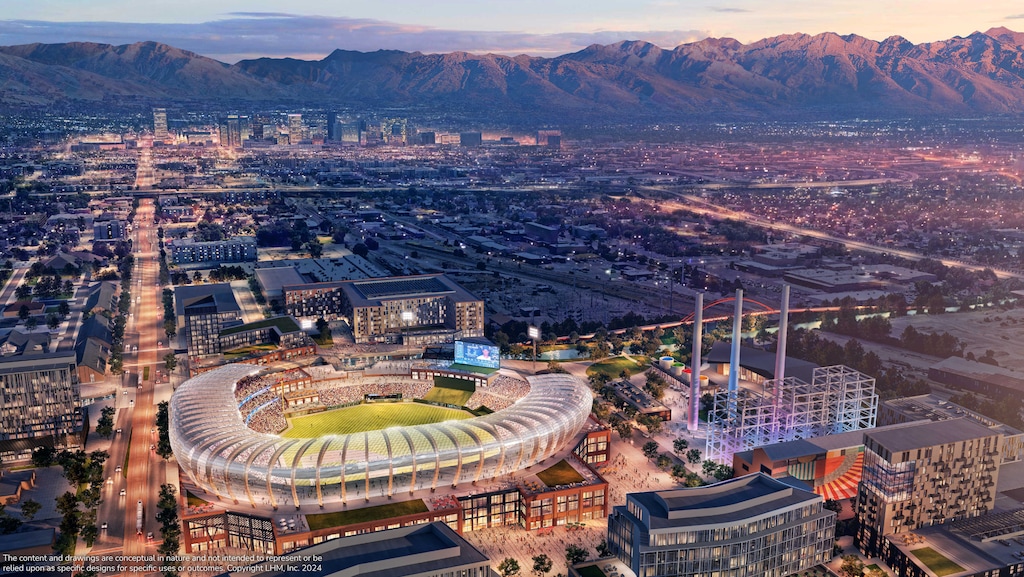
Big League Utah, a group led by Gail Miller and the Miller family, put forth plans for a $1.8 billion stadium and an accompanying “Power District” with restaurants, housing and business. The Miller name immediately lent the group cachet in MLB offices. The family owned the Utah Jazz for decades and recently bought the city’s Major League Soccer team, Real Salt Lake.
Utah officials also moved quickly to give the group public money. The state legislature is prepared to front the Millers $900 million for a stadium, raised largely through tax increases.
Big League Utah officials say everything is ready.
Manfred just has to give the sign.
Kevin Reynolds, a Dallas native who graduated from SMU, has been covering BYU since 2022.