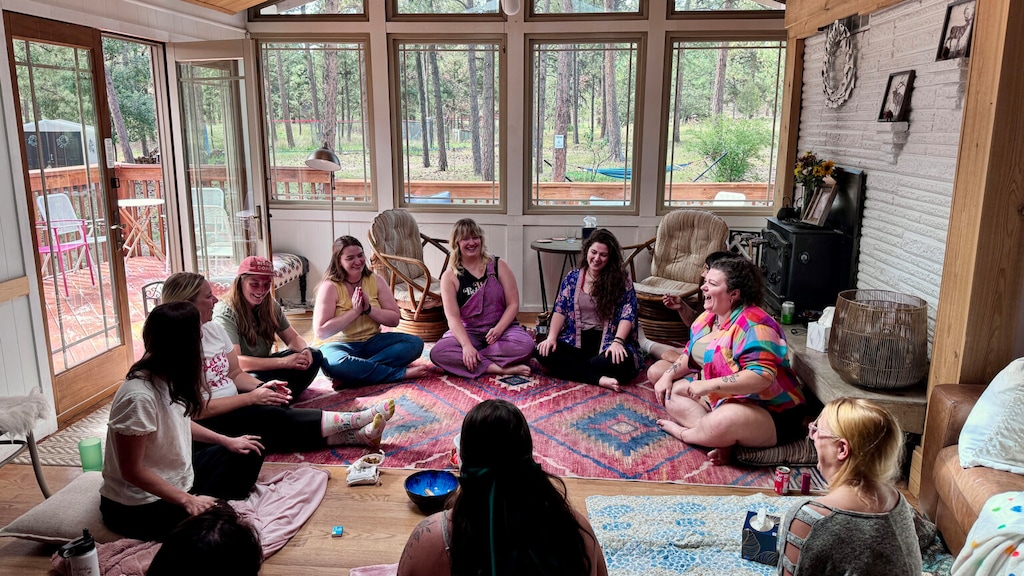
Colorado Springs, Colo. • On a September evening in Colorado Springs, about a dozen women wearing an eclectic array of formal wear, nighties and hobbit costumes spun and stomped their bare feet on a makeshift dance floor in an Airbnb living room.
“Twenty-four/seven baby machine, so he can live out his picket-fence dreams,” they sang defiantly to Paris Paloma’s 2023 song “Labour.” “It’s not an act of love if you make her. You make me do too much labor!”
The dance party marked the final night of a retreat for the Deconstruction Doulas, a network of ex-fundamentalists and former real-life “tradwives” who left insular religious groups where long skirts, early marriage, physical abuse and educational neglect were often the norm.
But through Deconstruction Doulas, they are working to disentangle their identities from the coercive communities they have left. Sometimes, that process looks like dancing cathartically in clothes that evoke their inner child. Often, it involves a curriculum that “deprograms” all-or-nothing thinking, sharing personal stories on Zoom and pooling resources to help women escape violent marriages. Together, these women are building the kind of trust-filled support system they say was absent from their former churches. And as the patriarchal religious teachings they were raised on are reflected in the rhetoric and policies of national leaders, they are speaking out about the costs of fundamentalism.
“Doug Wilson is constantly talking about household voting,” said Erin Kelly, a co-founder and “doula” for the group, referring to the self-proclaimed Christian nationalist pastor whose adherents include U.S. Secretary of Defense Pete Hegseth. “We’ve been hearing that for 30 years.”
Colorado Springs is home to more than 50 evangelical Christian organizations, including evangelical juggernaut Focus on the Family — a media organization founded by James Dobson and known for the radio show “Adventures in Odyssey.” That evangelical influence was evident at the light-filled Airbnb house that served as the retreat center, where Bible verses were inscribed on the handcrafted mugs and bathroom décor. But for women recovering from religious trauma, Bible verses can bring up negative emotions. “Trigger warning!” one of the women called before sharing the Wi-Fi password — Philippians 4:6-7.
Several women drove from neighboring states, and Keitha Son, a 31-year-old Texan who speaks her mind in a gentle Southern lilt, took a 20-hour bus ride to meet the others in person. She recently completed a Deconstruction Doulas peer-support cohort. She said she joined after hearing Hegseth echo teachings she heard from the pulpit growing up.
“I was just looking for a community of girls who could understand what I was going through,” said Son, who at age 16 left the Primitive Baptist church — an independent, old-school Calvinist tradition that opposes evangelism.
While knotting friendship bracelets and mixing bath salts, the women traded stories about courtships gone wrong and which Christian romance novels they’ve read. Their conversations featured rapid-fire references to “IBLP,” Doug Wilson and “The Pearls” — all fixtures in fundamentalist homeschooling circles that favor father-led authority structures and corporal punishment — but the women’s views varied widely. Churchgoers and agnostics, recent Donald Trump voters and Never Trumpers, a polyamorist and women who believe marriage is between a man and a woman gathered over shared meals of charcuterie and roasted potatoes.
“We’re all in very different places of deconstruction, and it’s OK,” said Hannah Stanifer, a real estate agent with shoulder-length blond hair and whimsical earrings. “There’s such safety for where you’re at.”
Stanifer, 34, connected with the Deconstruction Doulas in April looking for help navigating family dynamics. Raised the sixth of 11 kids in Everett, Washington, she grew up in a strict homeschooling environment and was given a purity ring at age 12, a symbol of her promise to save sex for marriage.
“There was never a dress that was long enough, loose enough, unattractive enough,” Stanifer said about her family dress code.
Her parents viewed ministry leaders like Bill Gothard, Doug Phillips and James Dobson, who each framed their versions of authoritarian parenting as God-ordained, as child experts, while their strict teachings were reinforced at the elder-led home church her family attended. Her father’s authority over her was absolute — unless and until she married — and her will, she was told from a young age, needed to be broken through discipline.
Stanifer stopped attending church in 2016, married in 2017 and has limited contact with her parents, but she hadn’t interrogated the religious views she was raised in until joining the Deconstruction Doulas cohort.
“I don’t feel crazy anymore,” said Stanifer. “I’ve been in therapy since 2016. … It was different to see nine faces crying over my story. That was so healing in a way that I never expected.”
(Kathryn Post | RNS) Attendees sing and dance together during the final night of a Deconstruction Doulas retreat in Colorado Springs.
Safety is ‘bedrock’
The trust between participants is what makes the Deconstruction Doulas model so effective, several women told Religion News Service. Many credited co-founders Margaret Bronson, 35, and Kelly, 34, with creating that safety.
Bronson, who has light green eyes and wears bright, bold-patterned clothes that are a strong departure from the shapeless skirts she wore in her youth, spent her formative years in a Particular Baptist church in southeastern Pennsylvania, where women wore head coverings, TV was banned and teen marriage was “not uncommon.” Her own deconstruction, she said, happened in adulthood.
“That safety that exists between us is the bedrock upon which ‘DD’ is built,” said Bronson, who interrogated her faith in late-night conversations with her husband, David Bronson. “And with Erin, it was the same.”
In 2020, she met Kelly, who was raised in the Orthodox Presbyterian Church, in an online book club, and the two exchanged frequent video messages about parenting, politics and religion. When Bronson began posting about deconstruction, survivors flooded her messages, saying they resonated with her content. In 2022, she and Kelly created the Deconstruction Doula cohorts, small online groups with curriculum based on Bronson’s own path out of fundamentalism. The group’s name, Kelly said, describes their role as leaders.
“The doula is there to give agency to the person who’s laboring,” Kelly explained. “They’re not a doctor. They’re not calling the shots. They’re just providing support and information so that the person who’s laboring can make the decisions.”
After leaving fundamentalism, many people struggle with “ambiguous loss,” said Rachel Bernstein, a longtime marriage and family therapist. She also focuses on cult intervention, reacclimation and recovery. They may grieve a former church, severed relationships and the loss of a religious formula that explained how life works. Many also grapple with the religious trauma of having been told there is only one holy way to live, and there are eternal consequences for leaving.
“It is one of the most brave things to do,” Bernstein said, “to leave an organization when you have been made to feel, in this very real way, that something awful will happen to you … and you leave anyway.”
As the group’s “doulas,” Kelly, Bronson and her husband prioritize participant agency. Discussions on topics like prayer are not about abandoning or embracing faith; instead, participants reflect on what they were taught to believe and what they believe now. They learn to exchange stories without interrupting or dismissing pain with a positive spin.
“It’s never been about pushing people to reach a certain conclusion,” said Deconstruction Doula volunteer Dani Strock.
‘They often have nothing’
For ex-fundamentalists, it’s new to join a group where belonging isn’t contingent on ideological alignment. Many decide to stay in touch long term. Since 2022, about 200 people have completed a Deconstruction Doulas cohort, and 150 have attended their retreats, according to Bronson. Brittany Ericson, who, like Stanifer, was raised in a home church movement in Washington, has been connected since her first retreat in 2023 — an experience she described as “magic.”
“These guys would actually laugh at (my) dark humor, but also understand the deep hurt behind it,” said Ericson. “… I just relaxed in a way, and I was goofy in a way that I had not been for years.”
Many of the women who come to the doulas after leaving high-control religious communities have no income, college education or, in some cases, driver licenses. Others are trying to escape abusive homes and violent marriages.
“When they leave, they often have nothing. They might have a cellphone, but it’s in his name. It’s his plan,” said Bronson. “The husband will take the car back.” Some women, she said, also lose their homes and access to their kids.
By 2024, the doulas expanded their mission to incorporate mutual aid, with the network pooling resources to support each other. Participants have helped nearby women in need by coordinating transportation, locating domestic violence shelters and driving women to courthouses to file for divorce. So far, Bronson said, they have aided a dozen women fleeing abusive homes.
The group says it is seeking nonprofit status, hoping to raise funds to make these efforts sustainable — Bronson receives some compensation but isn’t salaried, and Kelly is a volunteer.
“This is really an organic community effort,” said Kelly. “We really need people who are not survivors to resource us so that we can care for survivors.”
For Bronson, helping women escape fundamentalism also means confronting its public influence. She is speaking with state legislators about the harms of child marriage, and the Deconstruction Doulas appeared on a CNN segment about Christian nationalism earlier this year, criticizing Doug Wilson’s teachings.
According to Bernstein, many of the survivors she has worked with say watching political leaders, such as Hegseth, Trump and Vice President JD Vance, can be “retraumatizing.”
“It’s been very difficult for a lot of people who have been involved in more fundamentalist groups, and also cults in general, now to watch the government and how it’s operating,” said Bernstein. “The forcefulness, and the mocking of people who are considered weak, the public shaming of the reporters — it is too similar.”
Even as the Deconstruction Doulas expand their work, their focus, they say, remains on survivors. At the retreat, hours before the living room transformed into a dance floor, the women lounged across layers of quilts for a guided somatic exercise. At the practitioner’s invitation, they connected with each of their five senses — but when asked to imagine the earth holding them, some said they struggled to envision being held at all.
Then, without prompting, the women reached for one another, some weeping, and wrapped their arms around one another.
“I feel like in some ways I’m more Christian than I ever was,” Ericson told RNS. “I feel like this is what I was searching for my whole life … this feels holy.”
Note to readers • This story was produced with funding from the Templeton Religion Trust.