 Gordon Monson
Hey, all you sports fans out there, you folks who love to lay down cash here, cash there, on NFL games, on NBA games, on NHL and MLB games, on college games and on games of all kinds, listen up.
Don’t do it.
Do not gamble.
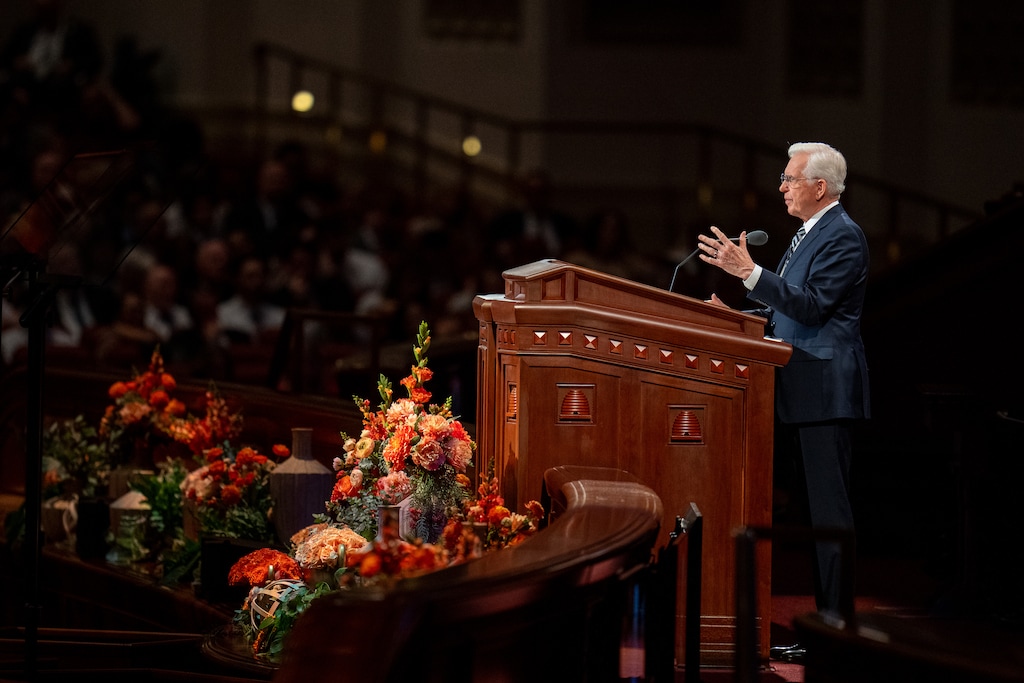
That was the message fired off by apostle D. Todd Christofferson in the opening session of Saturday’s General Conference. The second counselor in the governing First Presidency of The Church of Jesus Christ of Latter-day Saints stepped largely away from testifying of Jesus and his divine mission and instead warned one and all against the perils of gaming, particularly sports betting, and the ease of participating in such activity in these modern times.
He said the percentages of young males and females, too, who gamble are rocketing upward, and that, in so many words, dabbling in such a way with games of chance can blast from dabbling to dousing yourself in debt, soaring from a little happy fun to a big devastating habit.
“Putting money or something of value at risk to bet on a particular outcome or event is an activity that has plagued mankind almost from the beginning of time,” he said. “Time has not made it any more worthwhile or any less harmful.”
A real problem, Christofferson said, is how simple, how convenient it is to gamble now: “The smartphone has transformed gambling from an occasional activity requiring a trip to a casino, racetrack or lottery kiosk into an activity available continuously, privately and almost anywhere. This has led to an explosion in gambling.”
He said these days you can bet on all kinds of things, even on the timing of the Second Coming, and then he delivered the line of the morning, maybe the best line of the entire conference, if you want to bet me on that.
“Where do you go to collect on that bet?” he deadpanned.
The gathered throngs loved it. They laughed. How they felt about the subject of the whole talk might be a different matter. A lot of people around here, even the prayerful, like to place a few wagers.
‘Casinos in their pockets’
Christofferson emphasized online sports betting, especially among the younger crowd. “Youth and young adults are disproportionately affected,” he said, adding that “continuous mobile access can transform occasional entertainment into repeated behavior.”
That can increase debt and create far-reaching family and social costs, he said. And he added that a wave of gambling goes throttle up when tens of millions of people have, what an Atlantic writer described as, “casinos in their pockets.”
Where does this lead? Christofferson asked, rather ominously.
He said even if gamblers can keep their recreational impulses under control, their example might hurt others. Ultimately, he called gambling “morally wrong” and declared that “it produces nothing of value.”
That’s what Christofferson said.
Agency, of course, allows even faithful individuals to make their own call on that.
I know good, righteous people who have a lot of fun gambling on sports. It’s one of the reasons NFL football is so freakishly popular. For them, it’s a matter of no harm, no foul. It’s like dropping down a few bills to go to a concert or to a fancy restaurant or to buy jewelry. I also know people who have allowed it to mess up their finances and, in a few cases, their lives.
‘Devastating’ and ‘heartbreaking’
A few years back, I interviewed people who found themselves hooked on gambling. They said they didn’t get into it because they sought “easy money.” It was because they craved the action, the thrill of the chase. In the end, that is what landed Andy P. and Sarah H. and Tommy K. in Gamblers Anonymous-type sessions.
One gambler’s wife tearfully said her husband’s overblown betting was “devastating” and “heartbreaking.”
An expert told me that more money was spent at that time on sports gambling than moviegoing. And, yeah, last year’s totals in the U.S. went like this:
• Going to movies — $9 billion.
• Betting on sports — $166 billion.
Whoa.
Either Americans get a whole lot of enjoyment out of betting on athletes and games, or it’s more serious than that. It’s an endeavor that hasn’t just captivated them, it’s captured them. In some cases, perhaps it’s a combination of both.
OK, so it can be dangerous. But is throwing a few bucks — legally — at a Seahawks-49ers game really, as the apostle said it, sinful or morally wrong?
Beats me.
Is investing in a risky startup business wrong? How about putting money into the stock market? Christofferson would differentiate that from straight-up gambling, I presume, because he implied the latter wouldn’t “build anything.”
“Simply put,” he said, “the gambling industry’s entire business model is built on its customers losing money.” That’s not the foundation of legitimate investment markets.
So whether the venture in a particular startup or stock is equally foolish or risky is a deal for the investor to decide.
Another slightly different consideration, one Christofferson didn’t get into, is the overall effect sports betting has on … sports. On the integrity of sports.
Years ago, sports writer Rick Reilly told the story about how he was hanging around with Pete Rose, doing a magazine profile long before the baseball star’s troubles with gambling became known. He said when the two of them walked into Rose’s house and when Pete’s wife went to hug him, he brushed her off and ran straight in to watch a hockey game and check scores on his television. Reilly said he thought, rather naively at the time, “Wow, this guy really loves hockey!” Later, he and everyone else discovered that Rose was a voracious gambler, betting on all sorts of games.
Traditionally, college and professional leagues and teams have been vigilant about prohibiting anyone associated with them from betting, not wanting scandals erupting over accusations of individuals fixing games. While players and coaches continue to be strictly instructed not to gamble, leagues now send a conflicting message, partnering with betting services on sponsorships. Is that a problem? Could it lead to problems?
Thank you, Pittsburgh
I know more than a few people who bet on sports and, as mentioned, it’s a good bet they are every bit as decent and righteous in their day-to-day living as most of the faithful in the Conference Center.
They’ve never talked me into betting on sports. I won’t do it. I don’t do it … well, outside of that one time in 1971, when I was in the ninth grade. My friend Mark — who punched me in the head a couple of weeks before, breaking his hand in the process, and was eager to get even — said he would give me five bucks if the Pittsburgh Pirates, who were down two games in that year’s World Series to the Baltimore Orioles, came back to win the series. I had to put up two bucks if the Orioles went ahead and grabbed the trophy.
The Pirates won, and I won, and I’ve never gambled on sports since. So, I’m with you on that Brother Christofferson. But I wondered: Does filling out March Madness brackets, throwing $10 in on that, count in this condemnation? Think that through, all y’all.
I won’t call those who do engage straight-up sinners, nor will I say what they’re doing is morally wrong. I’ll leave that to the apostle.
(Francisco Kjolseth | The Salt Lake Tribune) Tribune columnist Gordon Monson.
Gordon Monson has been a columnist at The Salt Lake Tribune since 1993. Before coming to Utah, he was a sports and feature writer at the Los Angeles Times and the Los Angeles Daily News. He's hosted a sports-talk radio show in Salt Lake City for 22 years, the past 16 years at 1280 AM/97.5 FM The Zone.