Some might question why — in a city Brigham Young founded — there are several streets, a Latter-day Saint ward, even a whole neighborhood honoring a Catholic saint named Mary. The answer to that question is a century old this year.
At the invitation of Irish priest (and soon to be Utah’s bishop) Father Lawrence Scanlan, the Holy Cross Sisters arrived in Salt Lake City from Notre Dame, Indiana, in 1875. Sisters Raymond Sullivan and Augusta Anderson then opened a school near where the Salt Palace now stands and christened it St. Mary’s Academy to honor the mother of Jesus.
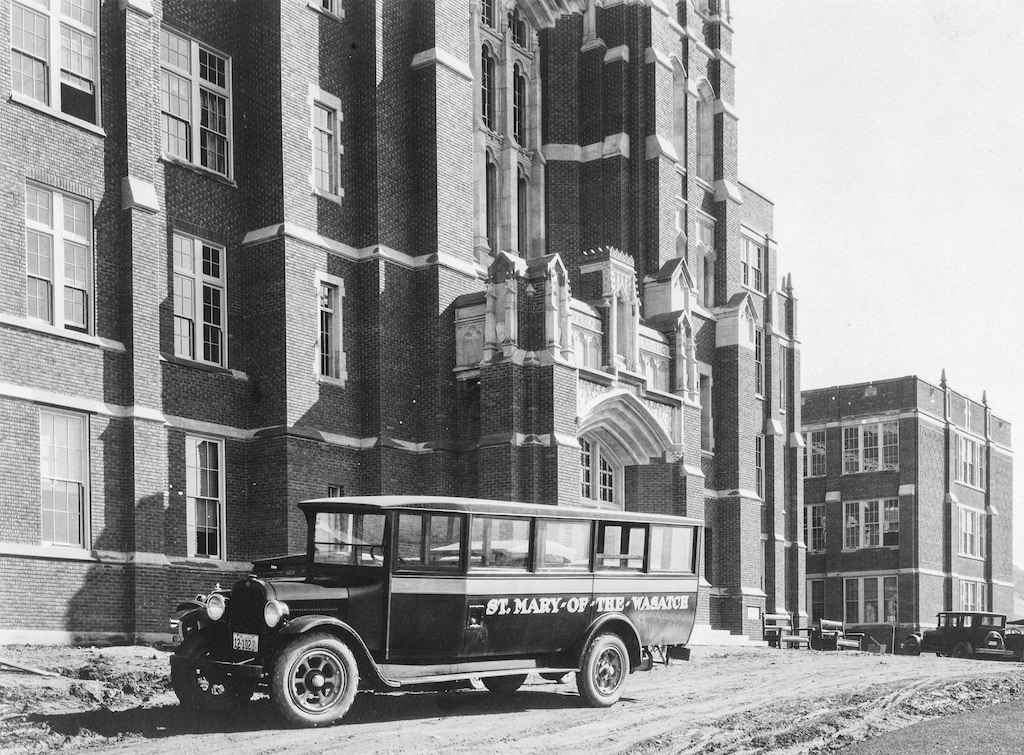
St. Mary’s grew and flourished so well that a half-century later the Holy Cross Sisters built an even larger school along the east bench at about 1300 South and 3000 East.
The sisters constructed their new school (for grades 1-12) on land originally set aside for a country club and established a Catholic college for women on the same site. They dedicated the new St. Mary’s Academy and College of St. Mary of the Wasatch in October 1926.
The ceremony attracted Catholic luminaries like Cardinal Patrick Hayes of New York City and several other bishops. University of Utah President George Thomas attended, too, praising the accomplishments of the Holy Cross Sisters and adding, “In this new and larger building…I am sure you will do even better and greater work.”
The sisters chose an acclaimed 20th-century poet — Holy Cross nun Madeleva Wolff — to lead the new institution. Madeleva later described her seven years in Utah as her “happiest mission.”
Madeleva, who went on to serve as president of Saint Mary’s College in Indiana, studied under J.R.R. Tolkien and C.S. Lewis. She also befriended author Bernard DeVoto — the first Utahn to win the Pulitzer Prize — after they met at an Ogden bookstore.
(St. Mary's College) Sister Mary Evaline "Madeleva" Wolff, who became a noted 20th-century poet, spent considerable time in Utah, where she drew much of her lyrical inspiration.
The 400-acre St. Mary of the Wasatch campus included a four-story main building, a convent for the sisters, rooms and a dining hall for boarders, a gymnasium, a social hall and a reservoir. The grounds featured a stone wall tower and gate, pine trees, wild roses, even a private canyon in the mountains.
Madeleva wrote a wonderful description of the place:
“We had often been cold, sometimes hungry. Coyotes had cried under our windows at night. Water shortages had left us parched and unwashed during all but unbearable months in summer. … Days at a time we lived literally in the clouds and above the clouds. We watched weather in the making. … We followed the silver path of the sun in its setting behind the mountains beyond Great Salt Lake. After its long, rose-colored afterglow, two firmaments awoke in the darkness: the stars above us and the twinkling lights of Salt Lake City and its five suburbs covering the valley below.”
The new Catholic college — then the only such institution for women between San Francisco and Denver — offered a full liberal arts program for undergraduates. It also operated a prenursing program taught in conjunction with another revered Utah institution started by the sisters, Holy Cross Hospital.
(The Catholic Diocese of Salt Lake City) This is the former College of St. Mary of the Wasatch, where Catholic Holy Cross nun-poet Madeleva Wolff worked as president.
Gifted teachers
One of my favorite high school teachers went there. So did Patricia “Pat” Murphy Pignanelli, who attended from 1956 to 1958 and then enjoyed a long and distinguished career as a Utah teacher, school principal and member of the Holladay City Council.
Originally from Rawlins, Wyoming, Pignanelli enrolled at St. Mary of the Wasatch because her parents wanted her to get a quality Catholic education. Her favorite memories from those bygone school days include being close to the mountains, her introduction to literature and culture, excellent teaching, lasting friendships, and learning the importance of kindness and equality.
Pat also met and fell in love with Frank Pignanelli — her husband for over 67 years — at a dance held on campus. Frank has his own war stories about navigating the ever vigilant and watchful eyes of the Catholic nuns when he tried to visit Pat.
Those memories include early curfews and intense questioning from Sister Ann Josephine, the formidable woman who later ran Holy Cross Hospital. Frank persisted and his happy union with Pat produced many good things, including their son and my longtime friend Frank Pignanelli.
In the 1950s, a sharp decline in enrollment and serious financial problems plagued St. Mary of the Wasatch. The college closed in 1959, and the high school followed a decade later.
(Utah Historical Society) The famed gate to the former College of St. Mary of the Wasatch.
In 1972, the Holy Cross Sisters sold the land to a developer who tore down the buildings and replaced them with houses, giving birth to the St. Mary’s neighborhood. The school’s iconic stone gate tower was incorporated into a home — nicknamed the Castle House — located at 1319 S. Roxbury Road.
Today, at least two neighborhood streets bear St. Mary’s name, and two other roads honor a couple of beloved Holy Cross Sisters (Augusta and Mercedes) involved with the school. The local congregation of The Church of Jesus Christ of Latter-day Saints even calls itself the St. Mary’s Ward.
‘Only one Mary’
(Francisco Kjolseth | The Salt Lake Tribune) A statue of Mary at St. Thomas More Catholic Church in Cottonwood Heights.
Invoking those Catholic names in a Utah town established by Brigham Young is unorthodox, to say the least.
The neighborhood’s history certainly explains it. But enshrining Mary’s spirit high on Salt Lake Valley’s east bench to watch over all of us below also appeals to me in a much deeper way.
Catholics venerate Mary as a loving and caring mother for everyone. The “Salve Regina,” prayed by Catholics since the Middle Ages, implores Mary — “our life, our sweetness and our hope” — to help us “poor banished children of Eve” who are “mourning and weeping in this valley of tears.”
I know something about that valley of tears. My 2021 book, “Monastery Mornings,” explains why I believe Mary probably saved my life during the most horrific moment of my childhood.
But what about my Latter-day Saint friends who now occupy most of the homes in the St. Mary’s neighborhood? Do they like having her up on that hill, too?
I think so.
Apostle Bruce R. McConkie also answered that question a half-century ago, a bit after the neighborhood started. In 1981, he wrote, “Can we speak too highly of her whom the Lord has blessed above all women? There was only one Christ, and there is only one Mary.”
Who wouldn’t want a mother’s heavenly love in the neighborhood?
(Michael O'Brien) Writer and attorney Michael Patrick O'Brien.
Note to readers • Michael Patrick O’Brien is a writer and attorney living in Salt Lake City who frequently represents The Salt Lake Tribune in legal matters. He is the author of “Monastery Mornings: My Unusual Boyhood Among the Saints and Monks.” His new holiday novel, tentatively titled “The Merry Matchmaker Monks of Shamrock Valley,” will be published in time for a future Christmas read. He blogs at theboymonk.com.