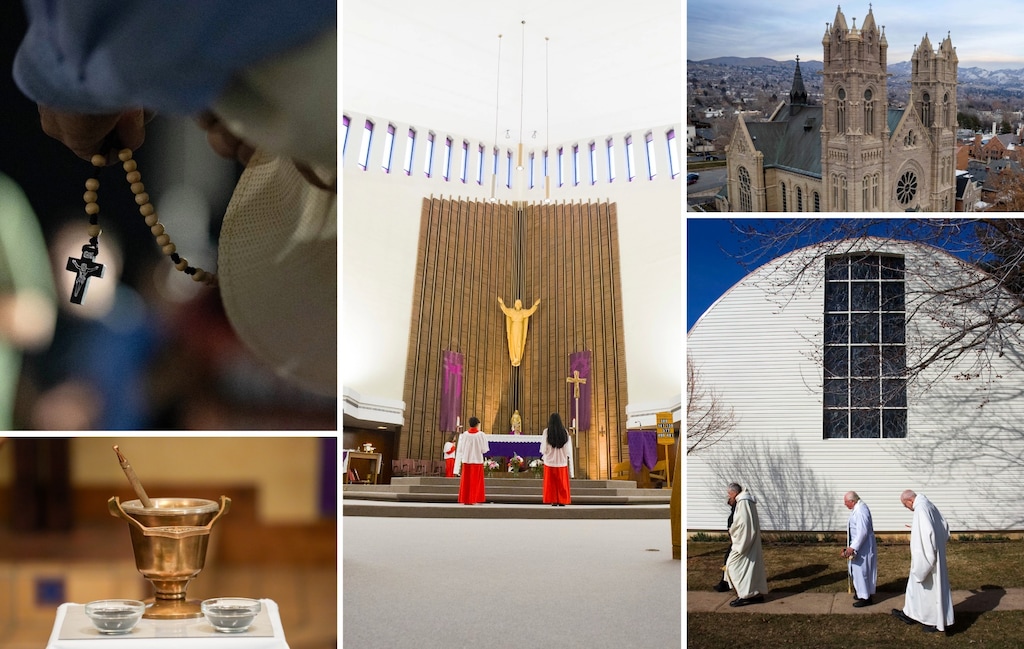
Catholics arrived here 250 years ago in 1776. Back then, there was no Utah, no United States, and the land beneath my Salt Lake City home was part of the Viceroyalty of New Spain.
Spoiler alert — things evolved a bit during the quarter millennium that followed. I was around for about 25% of that time, but almost always looking forward and not back.
So perhaps now is a good time to consider William Shakespeare’s admonition from “The Tempest,” “What’s past is prologue.” And maybe I should heed writer Michael Crichton’s warning that ignoring history could make me “a leaf that doesn’t know it is part of a tree.”
All that begs the question: What does it mean to be a leaf on a 250-year Utah Catholic tree?
I asked my Utah historian friend, Gary Topping, for help forming an answer. For many years, Gary worked as the archivist for Utah’s Catholic diocese.
Together, we compiled a list of the 10 most important Utah Catholic developments during the past 250 years:
1. An expedition led by Franciscan priests Atanasio Domínguez and Silvestre Vélez de Escalante reached central Utah and the Spanish Fork area in about September 1776. Catholics returned to Utah about a century later.
(Abigail Landwehr | The Salt Lake Tribune) A depiction of The Domínguez–Escalante expedition is displayed in the Utah Capitol.
2. Brigham Young set a precedent with his benevolent attitude toward Catholics. He resolved an 1866 land dispute in favor of a Catholic priest trying to build a church and warmly welcomed the Holy Cross Sisters. Catholic leaders did not endorse but also did not attack Latter-day Saint practices.
3. In 1873, Catholic priest (and the region’s first bishop) Lawrence Scanlan led a wave of Irish priests to minister in Utah, mainly but not only to Irish miners.
(The Salt Lake Tribune) Holy Cross Sisters in Salt Lake City around 1900.
4. The Holy Cross Sisters arrived in 1875 and started Catholic hospitals and schools throughout the state.
5. Beginning in 1900, Utah Catholics constructed (and have since restored) the majestic Cathedral of the Madeleine in the heart of Salt Lake City.
(Trent Nelson | The Salt Lake Tribune) Inside the Cathedral of the Madeleine in Salt Lake City.
6. Other enduring Catholic institutions developed, including a strong network of parishes, Catholic Community Services, the Knights of Columbus, the Intermountain Catholic newspaper and Mount Calvary Cemetery.
7. Utah produced larger-than-life wealthy Catholic public and business figures/donors, including names like Kearns, Judge, McCarthey, Gallivan, McDonough, Seiner and Skaggs.
8. In July 1947, Trappists established the Huntsville monastery in northern Utah. Later, there was a decline/departure of the monks and numerous other important religious orders, including Jesuits, Benedictines and Franciscans.
(Trent Nelson | The Salt Lake Tribune) Trappist monks chant at the Huntsville monastery's Abbey of Our Lady of the Holy Trinity in 2002.
9. The Catholic priest abuse scandal erupted in the 2000s.
10. Due to a shortage of priests and nuns, married deacons, women and laypeople play a more important role today than ever among Utah Catholics.
My place in history
It’s a solid list, but all history is, ultimately, personal. Those past 250 years of Utah Catholic history formed me, too.
Perhaps taking a cue from Brigham Young’s kindness toward Catholics, my Latter-day Saint friends always have shown me grace and friendship. It has been a great blessing.
It is odd to be a pale Irishman living in a hot arid desert, but it was here that I first connected with people born on the auld sod of my lush green ancestral home. They were the Irish priests and nuns that Bishop Scanlan brought here to serve the Catholic population.
Some of those good folks taught me in school, including the Holy Cross Sisters, who now have served Utahns for more than 150 years. The sisters’ Fighting Irish spirit infected me, too, inspiring one of the best decisions of my life — attending the University of Notre Dame.
The same sisters helped bring all three of my children into the world at the old Holy Cross Hospital in Salt Lake City. Before those baby carriages, however, there was my marriage at the historic Cathedral of the Madeleine.
I like to think Bishop Scanlan completed that marvelous edifice in 1909 anticipating our wedding there eight decades later, but that’s probably not completely true. He also almost certainly did it so all three of our children could celebrate their Judge Memorial High School graduations there, too.
(Chris Samuels | The Salt Lake Tribune) Judge Memorial Catholic High School rises from the fall treetops in east Salt Lake City.
(Francisco Kjolseth | The Salt Lake Tribune) Pastor Adrian Komar delivers a morning service at St. Thomas More Catholic Church in Cottonwood Heights.
The St. Thomas More Catholic Church I have attended in Cottonwood Heights for half my life enriches my spirit, but it also comforted me after my brother’s death. Our children learned compassion and charity at Catholic places like St. Vincent de Paul Parish School, where they did service projects at places like St. Vincent’s soup kitchen.
None of these places would be here without benefactors like the names I mentioned before — Kearns, Judge, McCarthey, Gallivan, McDonough, Seiner and Skaggs. The same is true in my Ogden hometown, where I could afford to attend Catholic school, thanks to the generosity of locals like the Evans family.
Few people helped me more than the kind monks at the Trappist monastery in Huntsville, as explained in my 2021 book, “Monastery Mornings.” The old abbey will forever be the still point in my turning world.
A more skeptical disciple
(Francisco Kjolseth | The Salt Lake Tribune) This Is the Place Heritage Park harks to Mormon pioneers' entry into the Salt Lake Valley.
Not everything in Catholic Utah was wonderful.
The abuse scandal forced many of us to navigate a nadir of Catholic Church history — the abuse of children and the related cover-up. Although still a Catholic today, I am emerging from that darkness a very different and more skeptical one.
My many positive Utah Catholic experiences help me with that process — as does the emergence of new leaders in the church, including married deacons, women and the laypeople formerly relegated to the pews. I hope their perspectives will prevent future abuse or cover-ups.
During my Catholic school years in Utah, I learned about more than just Augustine or Aquinas. I also read about Brigham Young’s arrival here and what he reportedly said at that moment when his wagon emerged from Emigration Canyon.
It was a landmark moment of Utah history but hardly the only one.
Another such moment is memorialized in a century-old mural in the Utah Capitol Rotunda showing Franciscan Fathers Domínguez and Escalante — soon after they emerged from Spanish Fork Canyon — looking over Utah Lake in 1776. I first saw it many years ago during a school field trip. I learned another important lesson that day.
Utah Catholics, hundreds of thousands of them, also get to say, “This is the right place.”
(Courtesy photo) Writer and attorney Michael Patrick O'Brien.
Note to readers • Michael Patrick O’Brien is a writer and attorney living in Salt Lake City who frequently represents The Salt Lake Tribune in legal matters. He is the author of “Monastery Mornings: My Unusual Boyhood Among the Saints and Monks.” His new holiday novel, tentatively titled “The Merry Matchmaker Monks of Shamrock Valley,” will be published in time for Christmas. He blogs at theboymonk.com.