 Addy Baird
 Abigail Landwehr
On July 4, Utahns across the state will celebrate Independence Day. This year, it will mark the 250th anniversary of the Declaration of Independence, the country’s founding document signed by the delegates at the Second Continental Congress in 1776.
The story of the American Revolution is often focused on the original thirteen colonies, but the story of the United States at the time of the revolution is not a monolithic one.
In fact, on the other side of the continent, in the area that would eventually become the state of Utah, 1776 marked a historic turning point: For the first time in recorded history, European explorers came to Utah.
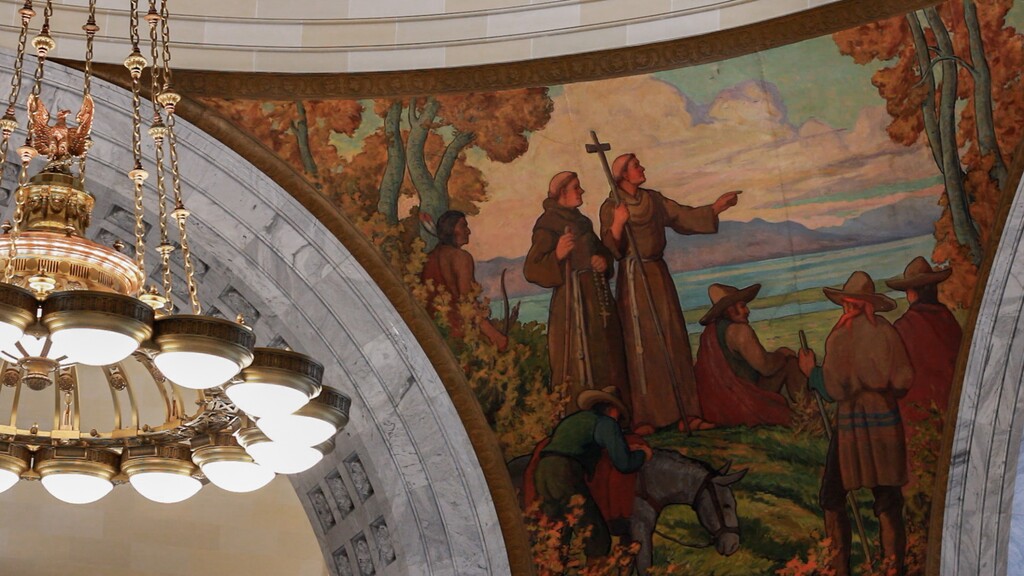
On July 29, 1776, just weeks after the colonies first declared their independence from Britain, an expedition led by Spanish missionaries Atanasio Domínguez and Silvestre Vélez de Escalante left New Mexico in search of a land route to the mission in Monterey, California. With the help of indigenous guides, the Spaniards began a trek around the area we know today as the Four Corners.
“This is an extraordinary expedition,” said Claudio Saunt, a University of Georgia professor who specializes in American and Indigenous history.
During their expedition up to Colorado, west to Utah and later south to Arizona, the missionaries not only came upon landscapes they had never seen before, “but had difficulty even imagining,” Saunt said.
The best example of this is the Great Basin, which challenged the explorers’ ideas of how continents were formed and shaped.
“The idea that there was this low-lying area that was actually below sea level, from which water did not escape,” Saunt said, “that was totally foreign to them.”
It is also interesting to track, he added, just how much the missionaries relied on Indigenous people over the course of their trip.
“Especially as they get further west into the drier regions and they’re desperate for water, they really are reliant on the Native peoples they encounter to help them find water sources,” he said.
Welcome to Spanish Fork
The missionaries first entered Utah on September 11, 1776, in the area we know today as Uintah County. They went west through the Uintah National Forest, battling bad weather and difficult terrain and eventually emerged into the Utah Valley through what Utahns know today as Spanish Fork Canyon. It’s here where they met members of the Ute Tribe and saw, for the first time, Utah Lake.
“The lake is 20 miles wide and 51 miles long,” a translated journal excerpt from the expedition reads. “It extends toward the northwest and, we were told, comes in contact through a narrow passage with another much larger lake.” (Utah Lake, at about 13 miles at its widest point and 24 miles long, is smaller than their estimate)
The lake was filled with “several species of good fish, geese, beavers, and other amphibious creatures which we did not have the chance to see,” they wrote. “Around the lake live Indians who eat the lake’s many fish, so the other Utes call them Fisheaters.”
And of the Great Salt Lake, which the Spanish explorers never saw but heard about from the Utes, they wrote, “The other lake… covers many miles, so we were told. Its waters are harmful and very salty, and the Timpangois told us that anyone who put some part of the body in its waters immediately felt a lot of itching in the part that got wet.”
Meanwhile, in New York, George Washington led American troops in the Battle of Harlem Heights — and following a series of losses, it marked Washington’s first victory as commander in chief.
But according to Saunt, the missionaries exploring what we would later call the American Southwest and the Indigenous people in the area had no idea what was happening in the British colonies.
“Word does eventually reach them that there’s unrest, but … they’re so far away, it’s not a pressing concern for them,” he said.
And though the Spanish would eventually play a role in the American Revolution, for the administrators and missionaries in the West, the war was of little concern.
“This is the far north of a vast Spanish empire, and these administrators in Santa Fe, and the missionaries out in San Diego and San Francisco, they are vastly outnumbered, surrounded by thousands of native people,” Saunt said. “So they have much more immediate concerns and are not much interested in what’s going on in Boston.”
One hundred and twenty years later, Utah would become the 45th state. Today, the professor said it’s important Americans understand the revolution that led to the country we are today.
But as we approach the country’s semiquincentennial, it’s just as vital that we learn the nation’s history too, he said.
“It’s a vast nation, and that encompasses all kinds of peoples with different, varying histories and regions that have their own separate histories,” Saunt said. “I think it’s imperative that we also understand those histories as well.”