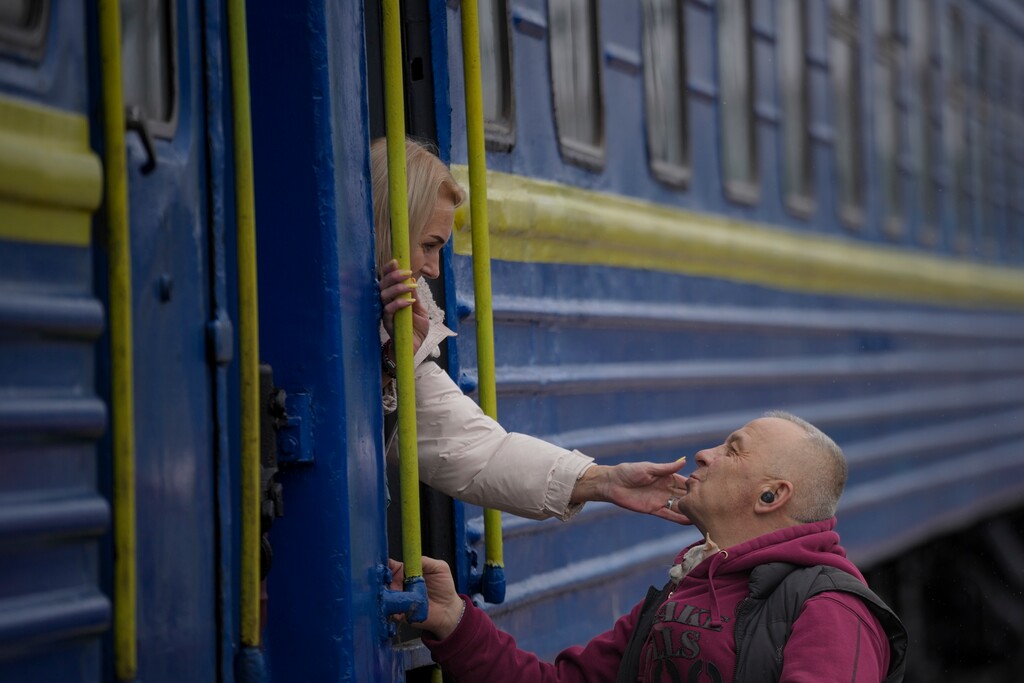
The first time I ever took an overnight train in Eastern Europe was in October 2003. I was a Latter-day Saint missionary who had been sent from Kyiv, Ukraine, at the center of the country out to the far western city of Lviv, near the Polish border. The journey was nine or so hours and included a four-person cabin with benches jutting from the walls, forming two sets of bunk beds, which my mission companion and I shared with a couple of strangers.
I had been advised by more experienced travelers that the single restroom positioned at the end of our train car would become increasingly less sanitary as the train bounced along the tracks, which at that time could have used some updating. This was confirmed for me at around 1 a.m., when I opened the restroom door to what I could only describe as toiletry atrocities.
Since that inaugural trip, I’ve taken many of these overnight trains in Ukraine and other parts of Eastern Europe. Some were more comfortable than others.
In 2009, my friend Kimberly and I booked a train from Moscow to St. Petersburg, opting for a communal car because that’s all we could afford. The communal car was an open room with scattered bunk beds and dozens of companion passengers assigned at random like Russian roulette.
As a babushka printed our tickets at the train station, she made us promise we would tie our bags to our bodies and stay together for the length of the journey. She then crossed herself three times, whispering a prayer that didn’t leave us feeling particularly good about this choice we had made.
Perhaps none of these experiences was as memorable as the one I had with my friend Brandt in 2014.
We had arrived in Ukraine just two months after the conclusion of the bloody standoff between protesters and government police in Kyiv’s center square — the true beginning of the Russian-instigated conflict that simmered and then escalated with Moscow’s invasion of Ukraine in 2022.
(Eli McCann) Damage remained two months after the deadly 2014 uprising in the heart of Kyiv, Ukraine.
(Eli McCann) Remains a couple of months after the deadly 2014 uprising in the heart of Kyiv, Ukraine.
Brandt and I bought two tickets in a four-person cabin for an overnight trip to Lviv, the same itinerary I had booked countless times before.
It’s always fun to see whom your cabin companions will be. Some get chatty. Some keep to themselves. I’ve never had a bad experience in these encounters, but certain ones have been livelier than others.
Two women on a train
On this 2014 trip, we arrived at our cabin first, only to be greeted minutes later by two headscarfed, husky Ukrainian women in their 80s, each toting heavy blue woven tarp bags with handles hanging by a thread.
Brandt and I were assigned the top bunks, but it’s a social norm that all cabin passengers sit on the two lower benches — in this case, these women’s beds — until lights go out a few hours into the evening’s journey.
The women rested on the bench across from us, our knees nearly touching, asking why our mothers let us come to this country that had so recently seen conflict. We teased them, and they teased us back, with me translating the Ukrainian for Brandt.
They told us about their own sons — good young men, by their accounts — and their grandchildren, one who was left an orphan.
They taught us Ukrainian folk songs. They shared their food with us — homemade pastries stuffed with poppy seeds. They poked our ribs and told us we needed to eat more. I’ve never met a Ukrainian woman over 60 who didn’t think I needed to eat more.
One of them took my hand, looked me in the eyes, and told me she was happy they were fortunate enough to meet us, that she hoped we felt welcome in her country, and then she begged me to be careful while we traveled. Just after that, they declared it bedtime.
“These old bones need sleep,” one of them groaned.
Brandt and I hoisted ourselves atop the two bunks, and we spent most of the rest of the journey the way I typically did — wide awake and wondering how often these old trains derail.
Sometime around 5 a.m., I heard a familiar sound: a recitation of the Lord’s Prayer in Ukrainian. The women were standing in the cabin’s hallway, looking across some misty Ukrainian farmland at a distant church, barely lit by the dawning sky.
I walked out to stand with them, listening to the chants of their morning prayers, said in unison, methodically and so rehearsed it was clear this wasn’t just a practice but pieces of who they were. When they finished their incantations, the woman standing closest to me reached over and squeezed my right hand with her coarse and stiff fingers. We didn’t say a word as we watched this beautiful country go by until the train began slowing to make a quick stop at a tiny platform for the village that housed the farm cottages of our travel companions.
(Eli McCann) Guest columnist Eli McCann after arriving in Lviv, Ukraine, in 2014.
Is this religion?
I’m not religious. I sometimes tell people I probably don’t believe in God, even if she does sometimes seem nice.
That may sound indecisive or wishy-washy, especially to those whose regular practice includes “I know” declarations from a pulpit. And maybe it is. But I usually only say “probably” because sometimes I’ll meet a stranger like those two women, and I can’t help but think of what they made me feel in terms and ideas that are so similar to how others describe what their God does for them. In those moments, I wonder if what I’m experiencing is religion.
I believe the mouth speaks what the heart fosters. These women so clearly spent decades fostering the best of themselves, and I find myself affirmed, thanks to people like them, that authenticity doesn’t tend to stay hidden under a bushel for long.
I think some scriptures I don’t read anymore may have taught me that. I may be misremembering the passages a bit, and I’m too lazy to go look them up now. In any event, I suppose I don’t have to subscribe to an entire belief system to conclude it has gotten at least some things right.
Brandt and I helped carry their woven tarp bags to the platform and watched the women ease themselves off the train car’s steps, an inch or two more hunched than they had been when we met them some eight hours before, due no doubt to the sleepless night they had aboard that rickety train.
They waved at us as we accelerated away from that country platform with its whiffs of black soil and hay I can still smell if I think about it hard enough.
I watched the women for a moment, growing smaller, as they heaved their bags over their slumped shoulders and, side by side, turned to walk away, back into their lives.
(Eli McCann) Tribune guest columnist Eli McCann.
Note to readers • Eli McCann is an attorney, writer and podcaster in Salt Lake City, where he lives with his husband, child and their two naughty (yet worshipped) dogs. His new book is “We’re Thankful for the Moisture: A Gay Guy’s Guide to Mormon Faith, Family, and Fruit Preservation.”