St. George • On a blistering afternoon in northern Spain a decade ago, Utah Pastor Joyce DeToni‑Hill walked out of the town of Sahagún feeling sick and ill-fed and stopped at a bridge.
Ahead, she recalled, lay the Meseta, an exposed sun-scorched high desert plain. She had already walked hundreds of miles and was determined to press on. But as she approached the span, she said, her body refused to move.
“I couldn’t cross the bridge,” DeToni‑Hill said. “I had the feeling of almost being pushed back.”
Unable to advance, she retreated to a room in a convent to recover and was nursed back to health by the Israeli owner of a nearby shop who made her a fruit salad and taught her how to make potato omelets and other more nutritious foods she could carry in her backpack.
Though pausing her journey for a few days felt like a failure then, DeToni-Hill now views that convalescence as a godsend. She said it underscores the popular notion that the Camino de Santiago provides exactly what pilgrims need when they need it the most.
(Joyce DeToni-Hill) The Rev. Joyce DeToni-Hill atop of the Tower of Andrade in Pontedeume, Spain, on the Camino Inglés.
The Camino queen
The Camino de Santiago (Way of St. James) is a historic network of Spanish pilgrimage routes ending in Galicia at the Cathedral of Santiago de Compostela, the traditional burial site of the biblical Apostle James. Since the early ninth century, pilgrims have walked these paths for spiritual healing. Today, more than 530,000 travelers tread the trails each year, seeking faith, adventure or personal reflection.
If southern Utah had a Camino queen, DeToni-Hill could arguably stake her claim to the title. She has walked the Camino nine times on three different routes — the classic Camino Francés, the Portuguese and the much shorter Camino Inglés (English Way).
For DeToni-Hill, who retired two years ago as pastor at St. George’s Shepherd of the Hills United Methodist Church, the pilgrimage has served as a spiritual lifeline that has anchored her through a cancer diagnosis, a pandemic and her transition into retirement.
In her experience, as the popular saying among pilgrims attests, the Camino does indeed provide.
A call to walk
(Joyce DeToni-Hill) Colorado pilgrim Kristi Hornick explores Cabo Finisterre, on the Galician Costa de la Muerte, considered the “end of the earth” by the Romans.
In 2010, DeToni-Hill first felt drawn to the Camino as a string of milestones converged: She was approaching 30 years of marriage, 30 years of ordination and her daughter was graduating from high school. She sensed she was entering, as she puts it, “a big transitional time.”
“I decided I was going to pray about it,” she said, “until something happened.”
That “something” came in the form of “The Way,” the 2010 Martin Sheen film she and her co-pastor husband, Derek, saw about a grieving father walking the Camino in honor of his deceased son.
“At the end of the movie,” DeToni-Hill recalled, “I said, ‘This is the answer to the prayer. I need to do this.’ I knew I had to walk the Camino.”
She began her quest by reading about pilgrimages and calling professors who taught about the Camino. That led her to a network of Camino scholars who helped her prepare logistically and spiritually for the trek.
“Pilgrimage is basically moving through a symbolic landscape,” she explained. “There’s intention — ‘What do I want to get out of this?’ — even if the goal is just being open. And you see that the journey is your teacher.”
‘I could kick butt’
(Joyce DeToni-Hill) Pilgrims from Utah take a photograph from the Monte de Gozo on the Camino Francés near Santiago de Compostela, Spain.
In 2016, DeToni-Hill set out on her first Camino, walking solo roughly 500 miles from St. Jean‑Pied‑de‑Port in France, across Spain to Santiago de Compostela, and then another 56 miles to the Atlantic Ocean at Fisterra.
“It was life‑changing,” she said. “I have been married since I was 25. On the Camino, I could make my own decisions every day. I was the boss of my own time. I could get back in touch with how I was feeling and validate those feelings and those needs.”
Among the lessons she learned, she said, is that she was more resilient than she imagined.
“I had glitches,” she said, noting the setback at Sahagún. “But I learned I was quite capable of problem‑solving.”
Nearly two years later, she would need that resilience. In late 2017, she was diagnosed with breast cancer. She remembers undergoing surgery in January, radiation through the spring and spending months in bed.
By the following October, she and Derek were walking the Camino Portuguese route from Porto to Santiago.
“We informally called it ‘running away from cancer,’” she said, “but it was really walking into health.”
Asked what the takeaway was from that Camino, DeToni-Hill said she learned she “could kick butt” — that she was strong and cancer did not define her.
There were lighter graces, too. One evening she and her husband could not find their hotel. Lost and exhausted in a Portuguese beach town, she remembers stopping a man mowing his lawn to ask directions. He pointed to a maze of streets, and they trudged off, she continued, only to see his car pull up alongside them a block later.
“He says, ‘Get in, I’ll take you to your hotel,’” DeToni-Hill said. “I was so afraid if I took that backpack off I wouldn’t be [physically] able to get it back on. So I said, ‘No, thank you. We know [the hotel] is over there.’”
As they resumed their walk, she recalled, they turned a corner and saw the man standing there, waiting. They turned another corner, and there he was again.
“He guided us at every single turn,” she said. “When we arrived at the circle with our hotel across from it, he got out of his parked car and came running over … put out his hand, and said, ‘Buen camino, buen camino, buen camino, hotel.’ We felt so loved it brought tears.”
“Buen camino” literally translates to “good path” and is used as the traditional greeting on the Camino. DeToni-Hill said pilgrims call good Samaritans like their impromptu Portuguese guide “Camino angels.”
Bearing one another’s burdens
One of her most intense treks, she said, was a trip in 2022 with a small band of clergywomen who called themselves the “Camigas” — “women who walk The Way together” — and were trying to work through the loss and trauma they encountered during COVID-19.
“Walking with clergywomen is really hard,” DeToni-Hill explained. “Everybody is used to being in charge. Our love language is helping, but we are not going to ask for help. We are good at giving pastoral care but not good at receiving it.”
On the 70-mile homestretch of the Camino Francés, from Sarria to Santiago, hidden burdens surfaced.
One pastor, DeToni-Hill recalled, was recovering from cancer and had little energy, so she walked just a mile or two each day and then leapfrogged ahead by taxi, sitting in cafes and sketching as other pilgrims came to her.
“Her Camino was the people coming to her,” she said. “It was beautiful.”
Another pastor twisted her knee just before the trip and fought back tears when a fellow pilgrim insisted on carrying her pack.
“She said, ‘This is big for me. I don’t ask for help,’” DeToni-Hill said. “That was her moment of giving up control and letting people care for her.”
Another Camiga, she added, learned shortly after returning that she had pancreatic cancer. Two pastors from the pilgrim group visited her, supported her family and, when her own pastor couldn’t be there for the funeral, led her graveside service.
‘Practicing the presence of God’
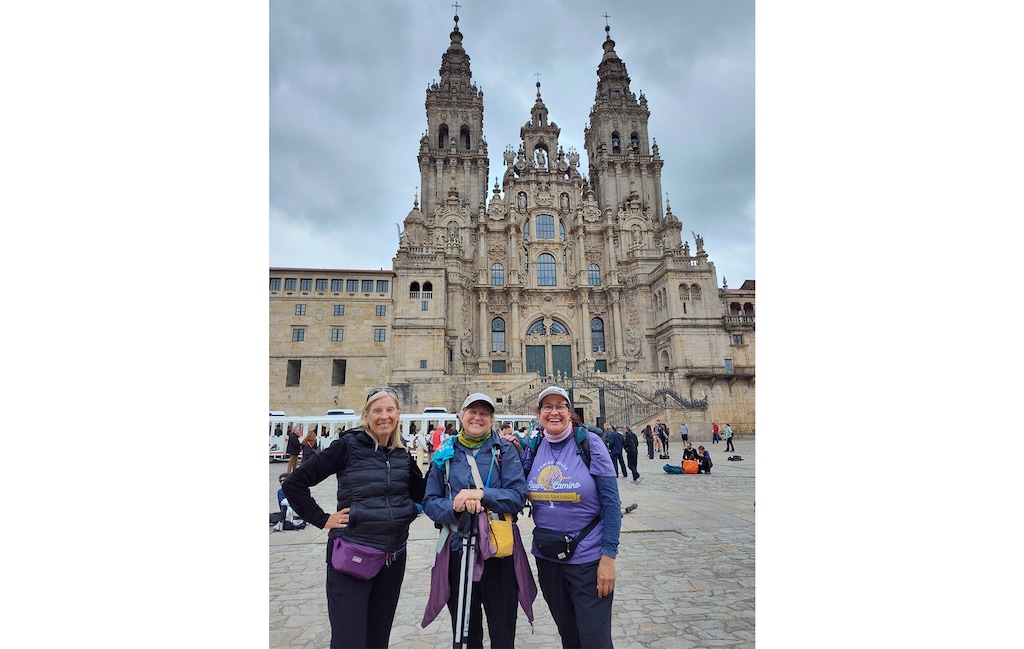
(Joyce DeToni-Hill) From left, the Rev. Joyce DeToni-Hill, Pastor Celeste Lasich and Kathy Brown take a photograph in front of a tattoo shop for pilgrims in Santiago de Compostela, Spain.
DeToni-Hill has now begun leading groups for Pilgrim Paths, a Seattle company that specializes in organizing and guiding walking tours of the Camino and other historic pilgrimage routes.
In May, DeToni-Hill led a group of 15 along the 74-mile Camino Inglés from Ferrol to Santiago. Joining her from the St. George area were two friends: Celeste Lasich, pastor at Good Shepherd Presbyterian Church, and Kathy Brown, former director of the St. George Interfaith Choir.
Lasich came to the Camino by a different path. A Presbyterian with previous experience visiting Christian holy sites in Israel and Scotland, Lasich said she had long been drawn to walking in “the footsteps of other people’s stories.” But with all her pastoral duties, she doubted she had the time or energy to plan to walk the Camino alone.
On the Inglés, the interim pastor said, she left the planning to DeToni-Hill. Her focus, she added, was not to solve problems but to walk with intention.
“It was to be present to whatever was happening, not to get ahead or behind myself, but to be physically, psychologically and spiritually grounded in where I am.” Lasich said. “For me, that’s practicing the presence of God.”
She carried her late father’s rain poncho in her pack.
“I had a very strong sense of carrying my dad with me,” she said. “I was constantly having conversations with him.”
Sometimes, she added, the Camino itself felt like a conversation.
“You are moving through little villages and farm country, hearing birds, talking to horses, walking through eucalyptus forests on ancient paths where you can see the footsteps of the thousands of pilgrims who have been there before,” she said. “You realize you are not walking alone.”
For Brown, Lasich’s roommate on the path, walking the Camino was something she opted to do on a whim. Alas, she noted, parts of it were not so whimsical. About 12 miles into the Inglés, she developed painful blisters from wearing untested insoles she hadn’t trained with back in St. George.
Near the end of the Camino, Brown fell ill with suspected food poisoning, forcing her to miss the final leg of the journey to Santiago. While DeToni-Hill stayed behind to help her find treatment, another host stepped in to lead the group forward. The Methodist minister and Brown then rode ahead in a taxi so they could rejoin the group later and enter Santiago together.
“It’s a wonderful example of how people can exist in friendship and community with really different belief systems,” Brown said. On the Camino, she added, “we were all just curious about each other and about our different beliefs, but we all respected [each other].”
Brown, a member of The Church of Jesus Christ of Latter-day Saints who sang with the then-Mormon Tabernacle Choir from 2005 to 2014, said one of her strongest spiritual moments came at the Pilgrims’ Mass at the cathedral in Santiago, where a nun sang and a priest offered his message in Spanish and English.
She said the walk changed her pace and outlook.
“I learned how important community is,” Brown said. “It slowed everything down. I had been going at such a breakneck pace for so many years that I just kind of created a sense of constant anxiety in myself, and the Camino was really good for me in that way.”
Pilgrims, not tourists
(Joyce DeToni-Hill) Pilgrims eat together on their journey of the Camino de Santiago.
Now back home, the three Utahns say the Camino continues to shape how they see and walk everyday life.
“Tourists approach travel from a ‘What’s in it for me?’ perspective and with an expectation that others will serve them — ‘I paid my money,’” Lasich said. “Pilgrims walk with intention, realizing we are walking on someone else’s land, at someone else’s home. We are guests.”
DeToni-Hill frames it in the language of Scripture, often returning to Paul’s discourse in Galatians about the fruits of the Spirit: love, joy, peace, patience, kindness, gentleness, self‑control.
“I look for them,” she said. “And I know I’m going to be tested. There is always somebody who annoys the heck out of me. Usually they are the ones who end up offering me the blessing.”
For example, DeToni-Hill remembers encountering a loud and obnoxious group of 15 Spanish pilgrims while walking the Camino Francés. She said they crowded trails, blocked paths and even pushed her out of the only patch of shade while she nursed a painful, bagel-sized blister on her foot.
The next day, she related, after a brutal mountain descent, she hobbled into a picnic area ready to fight for a seat. Instead, she found the group huddled around a friend collapsed from heat exhaustion. Her resentment vanished, the pastor said, and she offered them her electrolyte supply.
Seeing her raw foot, DeToni-Hill said the group, in turn, mobilized around her like an emergency department trauma team. Medical supplies materialized from their packs, and they expertly drained the blister and bandaged her foot. An hour later, the pastor continued, she walked into a bar to a roaring cheer from her 15 new friends.
Reflecting on the encounter, DeToni-Hill again connects the experience to the Apostle Paul. “He declared that a ‘new creation’ happens when strangers welcome one another through mutual care,” she said. “That miracle unfolded firsthand on the trail.”
In September, she’ll return to Spain again, this time to lead another group on the Camino Francés, from León to Santiago.
For now, the lessons of the Camino have followed all three St. George pilgrims home.
“Once you have walked it, you carry back into the rest of your life a sense of how much better the world would be if we were all walking as pilgrims,” Lasich said. “Looking out for each other. Being generous in our thanks. Not expecting that we are owed anything.”
Or, as DeToni-Hill puts it:
“The day is simple on the Camino. You get up and walk from A to B. You meet people. You try to be open. And somehow, the Camino provides.”