 Mark Eddington
Santa Clara • The lone remaining historic religious building in Santa Clara has stood for nearly 120 years, having weathered scorching summer heat, frequent touch-ups, periods of neglect and even an earthquake.
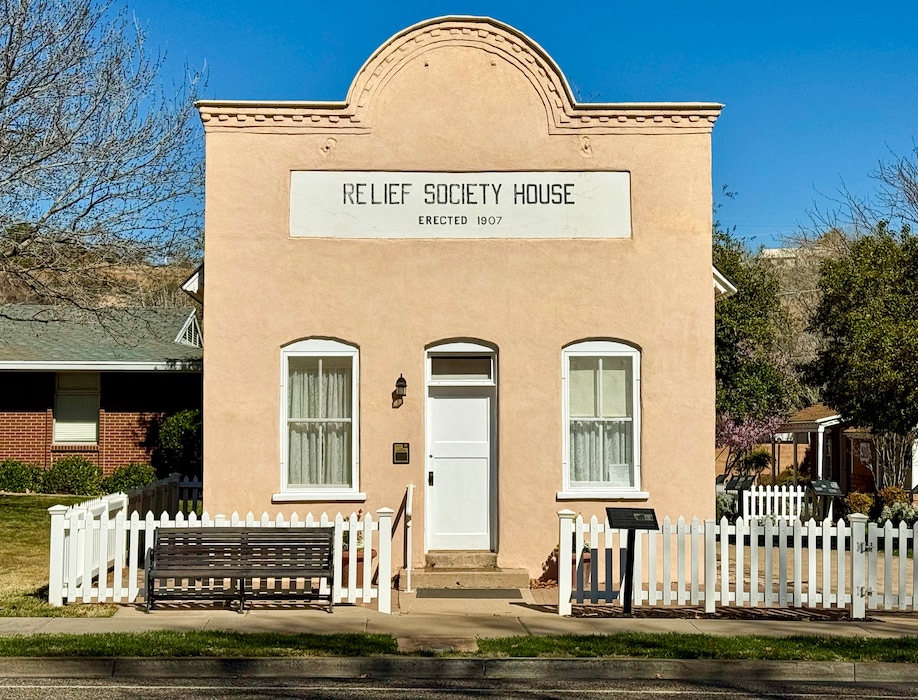
Perhaps most impressive of all is the fact that the historic Relief Society House, now part of a public park at 3036 W. Santa Clara Drive, known as Heritage Square, is still standing after being destined for the scrap heap and residents’ scrapbooks.
Sherri Anderson said she was alarmed in 1989 when her husband, the Latter-day Saint bishop of a congregation bordering the square, informed her the historic house and adjacent Hug-Gubler pioneer home would be torn down to create more parking space for ward members attending worship services.
Adding to Anderson’s angst, she said, was that many of her Swiss ancestors who helped settle Santa Clara attended meetings in the Relief Society House. Equally mortifying was the fact that her grandmother, Josephine Graff, was killed near the site in 1939.
“She was pushing a buggy up the street with her first grandchild, and a freak windstorm came up and blew a big limb off the tree,” Anderson said. “She could see it coming, so she pushed the [stroller] out of the way just before the branch hit her on the head and killed her.”
Anderson’s father was 16 at the time, so she never had the opportunity to meet her grandmother. But she felt she owed it to Graff and her other ancestors to save the buildings that played such a prominent part in the town’s history in the early to mid-1900s.
(Mark Eddington | The Salt Lake Tribune) The Hug-Gubler home at Heritage Square in Santa Clara.
Dressing the dead, ditching tonsils
The Relief Society House dates back to 1908, and the Hug-Gubler home to around 1870. In need of a new building for the Relief Society, the women’s organization of The Church of Jesus Christ of Latter-day Saints, Santa Clara church officials bought the land from the Gubler family in 1906 on condition that it would be returned to the seller once the building was no longer needed.
Two years later, the one-room Relief Society House, constructed in the Victorian Eclectic style, was completed at a cost of $800. It was used by Latter-day Saint women to hold their weekly meetings, tie quilts and raise funds for war veterans and a new chapel.
Relief Society members also used the small 20-foot-by-25-foot adobe structure to sew supplies for the Red Cross and dress the bodies of deceased church members. It further served as a school classroom and was even used in 1939 to quarantine a member who was seriously ill from an infectious disease until her death.
(Mark Eddington | The Salt Lake Tribune) Inside the historic Relief Society House at Heritage Square in Santa Clara.
When a spacious new Latter-day Saint chapel was built in 1949, the Relief Society House was given back to the Gubler family. The meeting site subsequently saw use as a makeshift medical clinic and post office.
For her part, Santa Clara resident Vicki Laswell relishes the anecdote her mother shared about the tonsillectomies that were performed at the clinic.
“My mom told me they took out kids’ tonsils and threw them in the ditch outside in front of the building,” Laswell recalled. “The kids would then get sticks to turn the tonsils and play with them as they floated down the ditch.”
Later, the church bought back both the Relief Society building and the Hug-Gubler home but allowed the Gublers to live in the latter until they died. Afterward, both structures fell into disrepair and were in terrible shape when Sherri Anderson learned about the church’s demolition plans.
(Mark Eddington | The Salt Lake Tribune) The kitchen and dining area in the historic Hug-Gubler home at Heritage Square in Santa Clara.
Preserving the past
Saddened by the loss of the old Santa Clara School, Latter-day Saint meetinghouses and other historic structures that have been razed in the past 50 years, Anderson was determined not to lose the town’s last remaining historic religious building and the Hug-Gubler house.
To rescue both, Anderson enlisted Laswell, Claudia West, Clark Ence and Pam Graf to form a committee to save the buildings and “went to war with the real estate arm of the church and won.” Before meeting with a church representative, the group armed themselves spiritually by fasting, praying and attending the temple.
“When we met with the man the church sent, he told us, ‘I can tell I’m not going to win this battle,’” Anderson explained, “and so we ended up … with the broken-down Relief Society building, home and a lot filled with weeds.”
Victory, though, came with a cost: $22,000. With no money in hand, the group obtained that total from a bank that required a balloon payment each October of several thousand dollars. To raise money, the group then launched Santa Clara Swiss Days in 1990 — now an annual celebration the town stages each September — to pay off the loan and raise money to repair and spruce up both properties.
Festival proceeds enabled the group to pay down the loan, and generous donations — most notably from Jay Ence, Quentin Ence, Floyd Ence and Bruce Stucki — and helped restore the buildings, install beautiful landscaping, place historic plaques and make other improvements to the quarter-acre site.
An earthquake in 1992 did extensive damage to the Relief Society House, which was repaired by stabilizing the building with a reinforced brick exterior and covering it with stucco. More recently, the original termite-infested wood floor was replaced by a new concrete floor.
“It took a lot of hard work to save and restore those buildings,” Anderson said.
In 2002, Santa Clara paid off the balance of the group’s loan and took over Heritage Square. Today, the Daughters of Utah Pioneers meet in the Relief Society House on occasion, and the city provides tours of both buildings on request. It is also a popular site for weddings and family reunions.
In former Mayor Rick Rosenberg’s view, Heritage Square is not only a fitting tribute to those who saved the building but also to the Swiss and other hardscrabble pioneers who settled the area in the mid-1800s
“Heritage Square reminds us of the community’s pioneer roots,” he said, “and those hardy souls who braved the heat and the floods to build this beautiful place we call home today.”