 Tamarra Kemsley
 David Noyce
This much seems clear in the recent remarks by a high-level leader of The Church of Jesus Christ of Latter-day Saints about African American spirituals: A lot of white members aren’t sure how to respectfully sing them.
Speaking in Oklahoma, general authority Seventy Kyle McKay, the faith’s official historian, reenacted a racist rendition of “This Little Light of Mine” he had overheard a lay leader perform and then attempted an accent supposedly reflective of a 19th-century Black man.
McKay has since issued an apology. But Kimberly Applewhite Teitter and Krispin Banks, two Black Latter-day Saint musicians, said in The Salt Lake Tribune’s “Mormon Land” podcast that such moments likely will continue until Latter-day Saints educate themselves about the history, power and purpose of the gospel music making its way into the church’s new hymnbook.
Here are edited excerpts from that conversation:
(Kimberly Applewhite Teitter; Jessica Afalava) Kimberly Applewhite Teitter, left, a clinical psychologist and the assistant director for the Debra Bonner Unity Gospel Choir, and Krispin Banks, a musician, songwriter and podcaster.
What went through your mind when you watched the video or read about McKay’s comments?
Banks • My jaw dropped a little bit not because of what he said but because of who he is. As church historian, he knows a lot — or at least has heard a lot — about the plight of Black and brown members of the church. To hear that come from someone of his caliber made me think we have a longer way to go than I thought we did in the leadership of the church.
But I have to tell you. I had a really positive experience in my stake [a cluster of congregations]. After the batch of songs with “This Little Light of Mine” was announced, my stake president in the South Jordan and Daybreak area invited me to perform it during stake conference however I wanted.
He said, “I want you to do it the way it’s supposed to be done.”
So I’m up there and I’m like, “I’m going to start the song off with my own spiritual interpretation of it because that’s how it would happen in Black churches. And then when we get to the part that everybody knows, the whole church joins in.”
And I told the audience, “Don’t join in like you’re reading the hymnbook and you’re trying to read the notes. I want everybody to sing as if they’re a soloist.”
So then I start my little bit and then I clap them in to start. And we’re singing and I’m like, “That is how it’s supposed to be sung. Let your light shine.”
Teitter • Thom Reed of the Genesis Group for Black Latter-day Saints asked us to go to his ward [congregation]. They had a whole race, racism and belonging Sunday, which was nice. And as a part of that, I went to teach “This Little Light of Mine” to the Primary kids.
We were having this discussion about what it means to be reverent. Initially they defined reverence, of course, as being quiet. I’m like, “You know, we think about having reverence for our country, but we set off fireworks on the Fourth of July. When we’re singing this song, ‘This Little Light of Mine,’ and we’re doing it with our full body and we’re moving along, is that reverent?’”
And at first they said no. Then they’re like, wait. If we’re holding on to the message to have a testimony-driven expression of the song, then that is reverent. And I did explain there are definitely ways that it cannot be reverent, but those happen when you lose sight of the message.
We’ve come a long, long way in terms of people understanding that gospel music is fun, gospel music is expressive, gospel music involves a lot of really dedicated artistry. I just wonder how close we are with understanding that gospel music is such a wonderful medium for expressing testimony and deepening the relationship that people have as individuals with the divine and to each other, as a collective, trying to embrace Zion.
Elder McKay’s remarks showed that people just don’t know the difference. They know that it’s Black culture, but they don’t know how to find the testimony part. It’s not necessary — as the person Elder McKay was talking to seemed to think — to adopt someone’s culture in order to be able to express testimony through the medium.
(Trent Nelson | The Salt Lake Tribune) Kimberly Applewhite Teitter directs the Debra Bonner Unity Gospel Choir.
The church has added a few African American spirituals to the hymnbook recently, including “I’m Gonna Live So God Can Use Me,” “Stand By Me, “Go Tell It on the Mountain” and others that may still come. Regardless of how they’re sung, what has it meant to both of you to see these enter the official Latter-day Saint canon?
Banks • I was actually invited with a couple of friends to be the voices for “Amazing Grace” and “His Eye Is on the Sparrow.” So if you’re on the LDS app and you listen to one of those two, I’m the bass voice.
And the church officials, especially their music department, really went far beyond my expectations. They didn’t just want Black people singing it. They made it a point to say that we’re having you sing them because we want them to be as true as possible when it comes to the cultural aspect.
It meant everything to me to know that they were adding the hymns, and when they added them, that they made a point to acknowledge the culture they come from as well.
Teitter • It says our culture belongs here. And that creates more room for us to embrace the fullness of our legacy as Latter-day Saints, as children of God. It’s a really meaningful thing.
What’s your advice to Latter-day Saints singing these spirituals for the first time? How should they be sung? How can they adopt them as part of their worship in ways that are respectful?
Teitter • I already touched on it some, but just recognizing that you don’t have to co-opt somebody else’s culture to find your story within it. It is important to be educated and understand what some of these things are rooted in. That helps you communicate the songs’ messages. Go to Black churches. Turn on Apple Music and try listening to gospel music today.
Banks • It’s not about you being like us. It’s about you getting lost in the moment and feeling the words you’re singing. That’s what soul music is. It’s not appropriation. It’s you taking the words and having a connection with God.
What other songs would you like to see the church add to the hymnbook?
Banks • There’s a song called “‘Tis the Old Ship of Zion” that was very prominent in Black churches 30 or 40 years ago.
What about instruments? What would you like to hear and see more of?
Teitter • In the Genesis Group, we’ve done a four-piece band that is a piano, bass, guitar and drums, and that has been so fun. And by fun I mean just another way for the spirit to communicate.
Whatever instruments are brought in, you can’t look at it as just noise. It’s embracing the fullness of the creation that God has given. The Mormon general populace loves a trumpet. We’re going to have a party when Jesus comes. Like, how excited are we to see him? Then we’ve got to praise him.
So much of what you’re describing is a relationship between the one leading the services and the audience that is a lot less formal than in typical Latter-day Saint congregations. Are there changes in worship generally that you would like to see the church adopt?
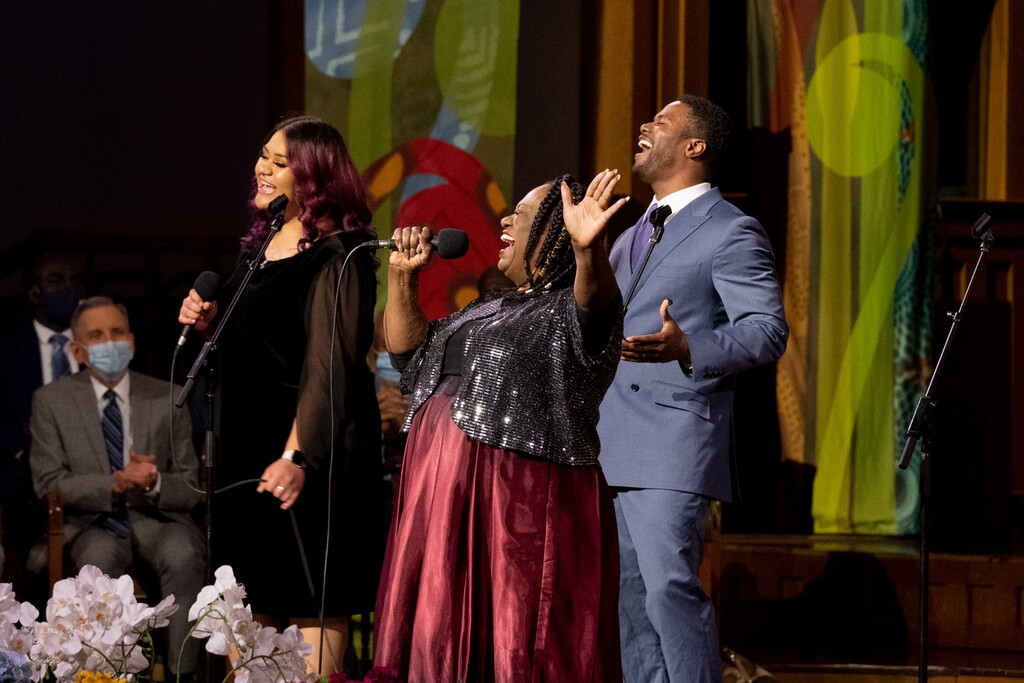
(The Church of Jesus Christ of Latter-day Saints) The Bonner Family sings together during the concert with the Tabernacle Choir at Temple Square at the Hollywood Bowl in Los Angeles on Wednesday, June 24, 2026.
Banks • If there’s one thing that I would love to see changed, as far as church culture, it would be the removal of the stigma around “call and response.” It’s called a meeting for a reason. It’s not a lecture. We are meeting one with another. The saints are edifying one another.
Teitter • It’s just different when we’re actively participating the whole time. I don’t even see people cry that much when they hear a song that touches them. How often do we feel safe to allow our emotions to show in a meeting where we trust that people are going to support us?
Banks • It’s about connecting to the people around you, feeling safe with the people around you. That’s the biggest hurdle that I think our church has with its expansion.
And I think that’s the biggest thing that we’re not talking about as well. Because culture is so different from place to place and group to group. We think if it’s not what we’re used to, then it doesn’t belong — it’s distracting. But that’s where the learning happens. We grow as a people.
Let go of that bubble and allow people to come as their whole self. Because that’s what Jesus says to all of us. Come unto me as you are, and, through your faith in me, I can make you whole — not make you this one cookie-cutter, LDS-looking thing. I can make you whole. And that’s what we all should be as a congregation.
Note to readers • To hear the podcast, go to sltrib.com/podcasts/mormonland. To receive ad-free “Mormon Land” episodes, along with our complete newsletter and access to all Tribune religion content, support us at Patreon.com/mormonland.