 David Noyce
 Peggy Fletcher Stack
The three most recent presidents of The Church of Jesus Christ of Latter-day Saints died at ages 101, 90 and 97.
In fact (not counting founder Joseph Smith) the church’s presidents live to an average age of 87. And the current leader, Dallin Oaks, is 93.
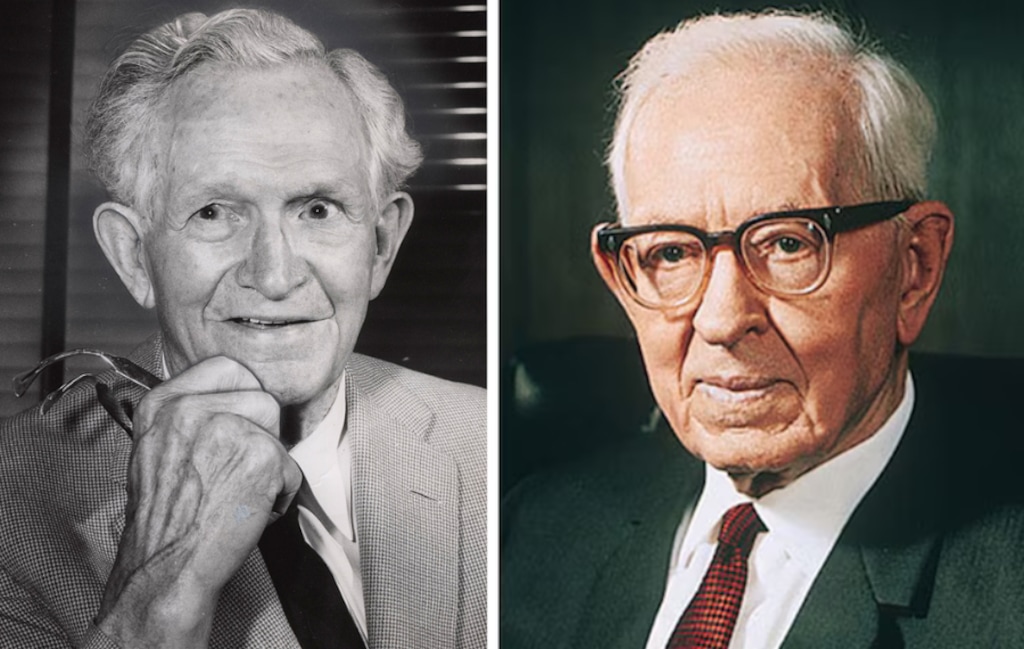
Decades ago, liberal apostle Hugh B. Brown, a self-proclaimed “rebel,” saw this emerging gerontocracy as a problem and proposed a remedy, which included granting emeritus status at age 70 to all apostles, even members of the governing First Presidency.
In addition, Brown wasn’t fond of how tradition has enshrined the process for picking church presidents and attempted to change it.
(The Church of Jesus Christ of Latter-day Saints) Church of Jesus Christ of Latter-day Saints apostle Hugh B. Brown.
In these edited excerpts from a recent “Mormon Land” podcast, historian Matthew Harris, author of “Second-Class Saints: Black Mormons and the Struggle for Racial Equality” and who is writing a biography of Brown, discusses the apostle’s views on succession and aging leaders.
Brown “had strong feelings,” Harris notes, about “old men running the church.”
When did the current practice of presidential succession — in which the senior apostle becomes the church president — become established?
(The Church of Jesus Christ of Latter-day Saints) Joseph Smith, left, and Brigham Young, the first two leaders of the Latter-day Saint faith.
You have to go back to [church founder] Joseph Smith, when he was murdered in 1844. He left a lot of different instructions depending on the context in terms of who would succeed him. Just a couple of examples would be his son as one of his successors or the Quorum of the Twelve [Apostles] or one of his special designees. I mean, there were a number of different options that he put out. It just so happened that Brigham Young, as the most senior apostle, became the leader and succeeded him. But that was not enshrined in stone in 1844. … It wasn’t until 1900 when it really became codified into what it is today. Even before 1900, there were still apostles like George Q. Cannon, Lorenzo Snow and Heber J. Grant who thought it was not doctrine. There was nothing about it in scripture. It was just a practice.
Speaking of Heber J. Grant, what did he say about the most senior apostle becoming the president?
He wrote this letter in 1887 to [apostle] Wilford Woodruff — and I think this was before Woodruff was the church president — and said that it’s not right that the most senior person should lead. It ought to be somebody who’s fit, who’s vigorous, who’s alert, and who has the full support of the Quorum [of the Twelve Apostles]. Obviously, his was a minority position, but he felt strongly about it, and he carried those views throughout his life.
Fast-forward to when Brown is an apostle, and David O. McKay is church president. At one point, Brown said he didn’t think McKay was capable of running the church anymore. Could you talk a little about that?
(The Church of Jesus Christ of Latter-day Saints) The First Presidency: N. Eldon Tanner, left, David O. McKay, center, and Hugh B. Brown.
When Brown was put into the First Presidency, he recognized right away that President McKay — who had been the church president since the early 1950s and was once vigorous and hearty and robust and anybody who’d worked with him knew about his physical stature, his mental stature — by the early ’60s, when he was approaching age 90, his cognitive abilities began to decline. And Hugh Brown recognized that he couldn’t make decisions. In that vacuum, Hugh Brown and N. Eldon Tanner, the other counselor in the First Presidency, were running the church.
After McKay, why did Brown suggest leapfrogging over 93-year-old Joseph Fielding Smith, who was next in line, and appoint Harold B. Lee as president?
(The Church of Jesus Christ of Latter-day Saints) Joseph Fielding Smith was the oldest apostle ever to become church president. Russell M. Nelson was the second oldest to ascend to that position.
(Salt Lake Tribune archives) Former church President Harold B. Lee.
He knows that Smith, as the most senior apostle, is next in line to be the president, but he doesn’t think he’s fit either, and he talks about this. He goes around to some of the other apostles and he says we can’t support this. [Smith] sleeps through his meetings, repeats himself, he forgets things and so let’s turn to 70-year-old Harold Lee. He’s the next in line for the presidency after Smith. He’s vigorous, he’s intelligent, he’ll be a good leader. This is what we need. This is the image we need to project, but the brethren veto that because they’re wedded to tradition.
In January of 1970, just a short period before [McKay died], church leaders were in a meeting with Joseph Fielding Smith, and he just fell down and conked his head on the table, passed out. … That just reconfirmed in Hugh Brown’s mind that Smith was not ready to be the president. It turns out that he became the president and, in April of 1970, when he gives his first General Conference talk, the brethren are really nervous that he is going to embarrass himself and stumble over his words. And when he makes it through fairly decently, they write in their diaries, you know, we dodged a bullet.
How did Brown want church presidents to be chosen?
(The Church of Jesus Christ of Latter-day Saints) The Quorum of the Twelve Apostles and First Presidency. Front row, left to right: Elder David A. Bednar, Acting President Dieter F. Uchtdorf, President Henry B. Eyring, President Dallin H. Oaks, President D. Todd Christofferson, Elder Quentin L. Cook and Elder Neil L. Andersen. Back row, left to right: Elder Ronald A. Rasband, Elder Gary E. Stevenson, Elder Dale G. Renlund, Elder Gerrit W. Gong, Elder Ulisses Soares, Elder Patrick Kearon, Elder Gérald Caussé and Elder Clark G. Gilbert. Photo taken March 4, 2026.
Brown thought that the apostles, by a simple majority, should be able to choose whom the president ought to be. And you can imagine there’d be a little lobbying going on to make sure that their guy is the person, that there’s enough consensus with this particular person. And so that’s what he [proposed]. He didn’t offer a ton of details about it. He just simply said that it ought to be chosen in private among the Twelve with a simple majority.
Did Brown worry that would introduce politicking into the process?
(The Salt Lake Tribune archives) Ezra Taft Benson was known for touting conservative political views.
No, because that personified who he was. He was Mr. Politics. To strip Hugh Brown away from politics would be to strip him entirely. … The biggest difference between him and [fellow apostle] Ezra Taft Benson is that Elder Benson felt no compunction about sharing his [conservative] politics in General Conferences and in stake [regional] conferences. Brown was more circumspect, only offering his views in private to Latter-day Saints. … But he was definitely political and recognized that in order to be a good leader, you have to build coalitions.
So Brown would see the debate of who should be the next church leader as healthy, right?
Absolutely, 100%. … Brown described revelation as a discussion and a debate where we thrash out principles. That’s the word he used — “thrash” out. And he said that once we reach an agreement, then we pray about it. … So the entire revelatory process was one of discussion and debate for him.
After Brown died, the church adopted emeritus status for lower-level general authorities at age 70. Would he have wanted that for apostles as well?
One hundred percent, because he tried to do that while he lived. He made that proposal after he resumed his place of seniority in the Quorum of the Twelve after he was dropped from the First Presidency. He already had strong feelings about so-called old men running the church, as he put it. … In my column [for The Tribune] I called his plan radical. I was not being hyperbolic. I mean, this was a radical thought.
(Courtesy) Historian Matthew Harris, right, is the author of this book about the former priesthood/temple ban against Black Latter-day Saints. He is writing a biography of former apostle Hugh B. Brown.
Was Brown more worried about the physical ability of aging leaders or their mental acuity or maybe both?
Definitely both. But the big one would be mental acuity. He talks often as he gets older … about feeling frustrated that he’s not as sharp as he once was.
Do you see any downsides of retiring apostles, even at age 75 or 80?
One would be institutional memory. The brethren operate sometimes like the Supreme Court, or how the Supreme Court used to operate, which is based on precedent. And so they do look at meeting minutes quite often about how prior First Presidencies governed or ruled on certain issues. And if you had younger men there, they wouldn’t have been a part of those discussions. Certainly they could read about them. But reading about them and being a part of them are two different things. We would miss that institutional memory, which I think is really valuable.
(Rick Egan | The Salt Lake Tribune) President Dallin H. Oaks waves as he enters the Conference Center at General Conference in April, followed by his counselors, Henry B. Eyring and D. Todd Christofferson. The average age of this First Presidency: nearly 89 years old.
Do you think there’s any traction today among the top leaders to apply emeritus status to the Twelve and the First Presidency?
Yeah, there is. I have a really good, well-placed source who tells me that when Pope Benedict [stepped down] in 2013, that it resumed discussions among the brethren where they talked about emeritus [status]. I don’t know all the details, but I do know that they talked about it.
Note to readers • To hear the podcast, go to sltrib.com/podcasts/mormonland. To receive ad-free “Mormon Land” episodes, along with our complete newsletter and access to all Tribune religion content, support us at Patreon.com/mormonland.