 Peggy Fletcher Stack
 David Noyce
In a move many saw as a step forward toward gender equity, The Church of Jesus Christ of Latter-day Saints recently announced that women could now serve in Sunday school presidencies, a position that has traditionally been filled by men.
The news, though, came with a caveat: If a woman were named as president, her two counselors would also have to be women. Same with men. That element caused much consternation at a change that might have brought unalloyed delight.
So was this a big stride or simply a little step? What are the implications, if any, for the global faith?
Here are lightly edited excerpts from The Salt Lake Tribune’s “Mormon Land” podcast with Emily Jensen, web editor for Dialogue: A Journal of Mormon Thought, and LaShawn Williams, a clinical social worker in Orem with a private practice and current president of the Mormon Mental Health Association. They discuss this and other women-friendly steps in the church.
What was your initial reaction to the Sunday school news?
Jensen • Excitement. I was delighted. Honestly. I was like, “This is going to be amazing.” I have friends and all sorts of people who have wanted this change for a long time, including myself.
Williams • I was surprised but not excited. It was cool to see one more layer of women’s leadership be named, but, for me, they just formalized something that already happens consistently, informally in so many [congregations].
What about the requirement that presidencies must be all one gender?
Jensen • I think the reasoning might be more strategic, kind of a trial balloon to test the waters. The reaction to the announcement all over social media was very mixed, and some of the mixture was from a more conservative side being angry that they would even allow for women to serve in a presidency over men who are teachers. There might be some hope that people can accept it. However, a lot of the reaction that I saw online showed that there was a lot of confusion, and some went so far as calling the church “woke” or “feminist” or, you know, some other “bad words.”
Williams • There are good reasons and bad reasons. We work a lot with people inside and outside of the church about listening to your internal authority. The risk of having mixed gender is that you may have women who still adhere to what a man says because a man is present. There’s still that risk of giving away your internal authority because the priesthood is present. Keeping it same-gendered, like a Young Women presidency, helps women listen to their internal authority. In mixed settings, like ward [congregation] councils, there’s the risk that the [women’s] Relief Society president will wait to see what the bishopric says. It’s this dance like Double Dutch, do I jump in now? Do I not jump in?
Could it be that the church is worried that inappropriate relationships might develop?
Jensen • I did see a lot of that reaction. That presents women as a danger to men, that men won’t be able to control themselves. So I hate that part of it. I’m not naive to the fact that these things do happen; I know of people where this has happened. However, I think that says more about the people who are uncomfortable with men and women working together than it does about the actual effect of men and women working together. Men and women are working together all across the church.
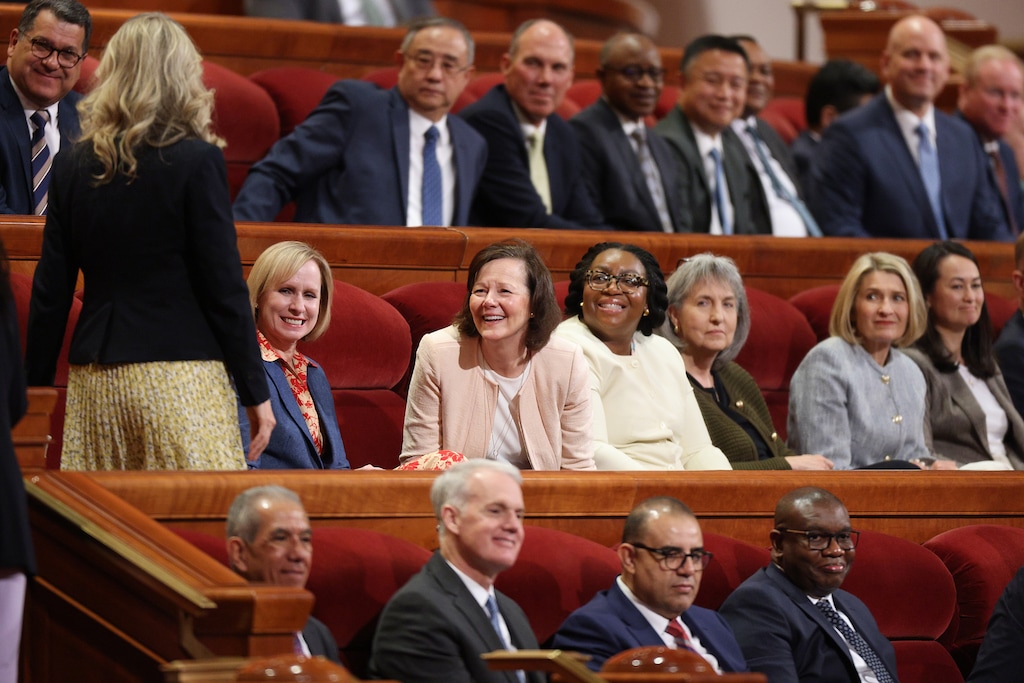
(Rick Egan | The Salt Lake Tribune) Leaders of the church are sustained by general authorities and wives of top leaders, in the April 2025 General Conference,
Does it bother you that Sunday school president is not the most visible calling in a congregation?
Williams • That’s the hard part, right? Like “we have revealed that women can be presidents of this thing that no one really knows who they are in the first place.” So it’s really cool, but then it’s like, “Oh, but wait, is this really something?” That says a lot about our attachment to symbols and the symbolism of leadership. Women lead in so many areas of the church anyway. There are so many places women are already working hard and working wonderfully. If they want leadership to be symbolic of actual power, put them where your money is — executive secretary, ward secretary and someone who’s over the budget.
What other changes could create even more gender equity?
Jensen • I would like to see more women leaders being quoted and scriptural stories about women being highlighted. Every year, we actually have some amazing opportunities to talk about women in the scriptures, and a lot of times it’s just glossed over. I would hope that we could do a lot more. Women could promote that within their Sunday schools.
Williams • I honestly think something that will give a lot more gender equity in the church is allowing people to say no to callings. If we really are caring for our members, the opportunity to say “yes,” to say “no,” to say “let me think about it,” would remove the pressure to perform. That would go a really long way toward gender equity, because we’re often taught to give and to give and to give and to be depleted in the name of service.
What effect might it have if the Sunday School General Presidency became all female?
Williams • It would be massive. There’s so much to be said about seeing and having leadership that looks like you. As a Black woman, one of our recent conferences where we felt like we had so many Black speakers — a Black person spoke in every single session — may have been one of the most powerful sessions. When you had so many Black speakers, you had so many Black experiences. We got to hear experiences that landed with us that had only happened in our own community conversations. To see more women, more Black women, more brown women, more white women, speaking in higher places — and really doing the formalized leadership of the church and not just the informal leaders, and not just the supporting actors of the leaders of the church — would be restoring the order in so many ways.
Some say this change is mainly symbolic. Others may concede that it’s symbolic but insist that it’s still meaningful.
Jensen • Symbolic changes come before meaningful changes. It’s important to have both.
Williams • If it was just symbolic and it didn’t mean anything, people wouldn’t have this many reactions to it. The symbols mean something, and all of us interact with them in a certain way. For those of us who feel like we are protecting something, the question is: Why am I reacting to this? What is my fear underneath this? Is it that you don’t trust women?
Can the church truly achieve gender equity without ordaining women?
Williams • The answer is no. We can’t. No. Full stop.
Jensen • Our prophet has said that women do things with priesthood authority, and so we’ve already had to change our ideas about what priesthood is as a power for men and women. I think it’s on the horizon that we’re going to understand that for men and women to be equal, they’re going to have equal access to the priesthood and equal keys to be able to use that priesthood.
Williams •God’s priesthood is accessible to all who are ready, who are prepared, who know what it means. Women already do so much without “it.” Imagine what else we’d be doing with it. It’s not even about us feeling stressed that we’re going to have more responsibility. This is about what it means if women have something that gives men identity. If, as a man, all I have is the priesthood, then I feel like I lose that because women have it, too. You’re not going to lose anything. You will gain so much, because you’ll know yourself differently, because you’ll know your priesthood differently. That’s the conversation we need to be having and understanding.
Note to readers • To hear the podcast, go to sltrib.com/podcasts/mormonland. To receive ad-free “Mormon Land” episodes, along with our complete newsletter and access to all Tribune religion content, support us at Patreon.com/mormonland. This story is available on Patreon and to Tribune subscribers. Thank you for supporting local journalism.