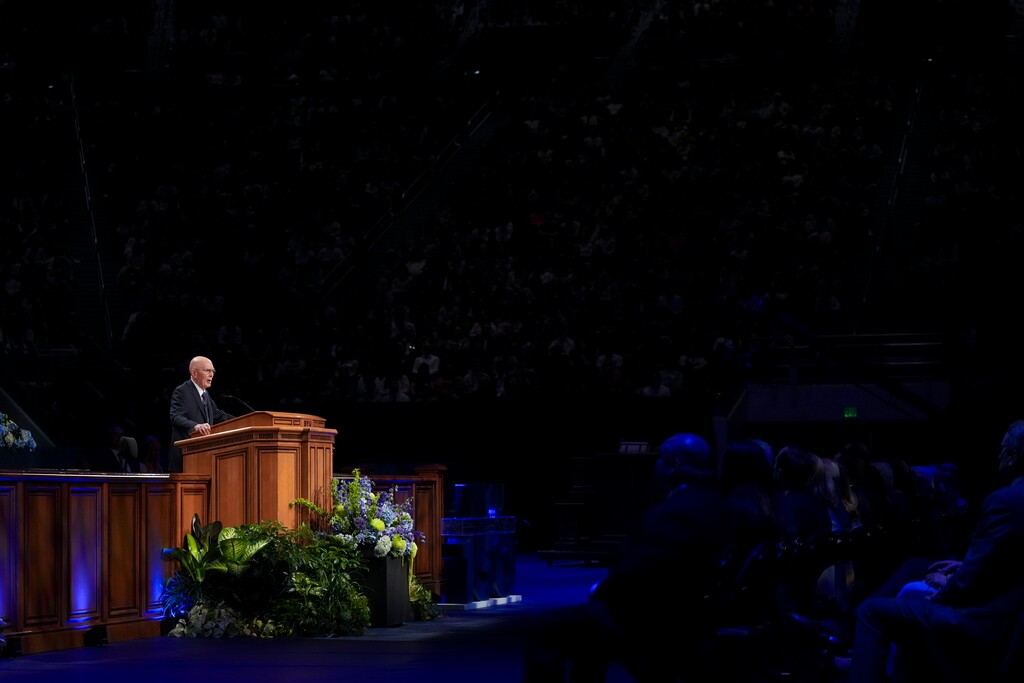
President Dallin H. Oaks recently warned about the risks of false information on podcasts and social media. While there are many media voices I admire, including content creator Emily Belle Freeman, who now serves as Young Women general president for The Church of Jesus Christ of Latter-day Saints, Oaks raised an issue that keeps me up at night.
The institutional church itself no longer controls the message as it once did. The Mormon media space has fragmented into an array of competing voices and communities that are contesting the truth, pushing various political agendas, and speaking past one another. (Yup, I’m one of them.) When The Salt Lake Tribune reported on self-proclaimed “pro-Latter-day Saint podcasts,” I was unsettled by the fact that I had never heard of many of the biggest platforms in that space.
Of course, media fragmentation within the church merely mirrors the state of the media within America and the world. As a parent of boys, I am especially alarmed by some of the content aimed at young men. The advent of artificial intelligence creates even more risk of false information.
In this environment, many people understandably feel that they do not know whom to trust. Brione Merchant of Massachusetts, a friend of a friend, provided a perspective that helped me reframe the question. “I’d argue,” he said, “that ‘looking for someone to trust’ is the problem. All I hear in that statement is ‘I’m looking for someone to tell me what to do.’” In other words, he reminded me that seeking truth takes effort. Our religious tradition provides us with tools for discerning truth if we are willing to do the hard work.
Joseph Smith’s quest
(The Church of Jesus Christ of Latter-day Saints) Latter-day Saints teach that church founder Joseph Smith looked to God and the Bible for answers to his questions.
The present environment is similar to the one that ultimately led church founder Joseph Smith to question who was preaching the truth and to receive his “First Vision.” Smith describes the competing preachers and faiths causing a “scene of great confusion and bad feeling.” He explains, “In the midst of this war of words and tumult of opinions, I often said to myself: What is to be done? Who of all these parties are right; or, are they all wrong together? If any one of them be right, which is it, and how shall I know it?”
The 14-year-old Joseph did not put his trust in any of the voices he heard. He instead sought guidance in the Bible, where he stumbled upon James 1:5, which reads, “If any of you lack wisdom, let him ask of God, that giveth to all men liberally, and upbraideth not; and it shall be given him.” Young Joseph acted upon what he read and prayed to the Lord. He did the work required to receive an answer.
Our faith provides us with multiple examples of how to discern truth. These are some of the stories and principles found within our faith that I return to when assessing information:
Experiment upon the word
(Photo courtesy of The Church of Jesus Christ of Latter-day Saints) Alma the Younger is depicted in this Book of Mormon video.
In the church’s signature text, the Book of Mormon, Alma the Younger preaches to the poor who have been cast out of the synagogue. He dismisses the idea that he should provide a sign in order for the people to believe or that they should simply take him at his word. Instead, he asks them to “awake and arouse your faculties” and “experiment upon my words.” In other words, he asks them to test what he has said. He explains that his words are like a seed that will bring forth good results if they are true.
Alma asks us to evaluate the results of the information we receive rather than merely trust in his authority. I frequently return to his advice when assessing information. Does this content lead to better relationships, better outcomes and increased understanding? Or does it lead to bad results and bad feelings?
Follow the money
There’s a reason, of course, that Alma did not want the people to simply take him at his word. He knew how to recognize a fraud when he saw one because had formerly been one himself. He had spent his youth peddling lies. Before repenting and becoming a political and religious leader, the scriptures explain that he was a “man of many words, and did speak much flattery to the people.”
Alma thus was suspicious of charismatic leaders seeking personal gain and followers. In his first year as judge, he encountered Nehor, who was preaching false doctrine. The Book of Alma draws our attention to these facts about Nehor: He sought popularity. He dismissed the consequences of moral wrongdoing. He took the people’s money for his personal use and began to wear “very costly apparel.” We can consider these same factors when assessing the voices we hear today.
Asking how people make money gives us important clues about whether they have our interests at heart and value accurate information. Credible content creators should be fairly paid. Our failure to pay for quality journalism has contributed to the increase in clickbait, misinformation, data mining and the attention-grabbing algorithms we all bemoan. It is also appropriate for the church to reasonably compensate the people tasked with running it. We should, however, be skeptical when people use their positions primarily to generate personal wealth and promote themselves. We should be especially skeptical when their content stirs up anger, creates divisions and rationalizes immoral behaviors.
Feeling is meaning
The Book of Mormon’s namesake prophet, Mormon, describes the Nephites as being “past feeling” when their civilization crumbles. Our emotions are a moral compass, and we should not allow ourselves to become desensitized. If something feels icky, then it probably is. We should not ignore warnings when something feels off. We should ask if what we are hearing is consistent with our knowledge and experience.
Feelings, of course, can lead us astray. We can be derailed, for example, by anxiety that is not rooted in reality. We can misperceive threats in people who are different and put misplaced trust in those who are familiar. As Latter-day Saints, however, we believe that we can be guided by the Holy Ghost. “You live in a season where the adversary has become so effective at disguising truth,” Oaks cautioned in his remarks on our media environment, “that if you don’t have the Holy Ghost, you will be deceived.”
The Holy Ghost can help us discern truth if we do the work to access it. I am guided by a passage in the church’s Doctrine and Covenants in which the Lord explains to Joseph Smith’s friend Oliver Cowdrey how to receive revelation:
“I say unto you, that you must study it out in your mind; then you must ask me if it be right, and if it is right, I will cause that your bosom shall burn within you; therefore, you shall feel that it is right.
“But if it be not right, you shall have no such feelings, but you shall have a stupor of thought that shall cause you to forget the thing which is wrong.”
Once again, the scriptures emphasize our need to do the work. We must study, and we must ask the Lord. We may not always feel our bosoms burn. I have found, however, that the Holy Ghost brings me clarity when I sincerely study and pray for guidance.
(Natalie Brown) Salt Lake Tribune guest columnist Natalie Brown.
Note to readers • Natalie Brown is a Latter-day Saint based in Colorado. Her book on living with faith in a time of crisis is coming from Greg Kofford Books this spring. She is speaking in her personal capacity. Her views do not necessarily reflect those of the church or her employer.