facebook-pixel

The progressive LDS leader who spent decades ‘defending something he didn’t believe in’

He pushed church leaders to drop the priesthood/temple ban, worked to elevate women’s voices and lamented unnecessary Latter-day Saint cultural traditions.
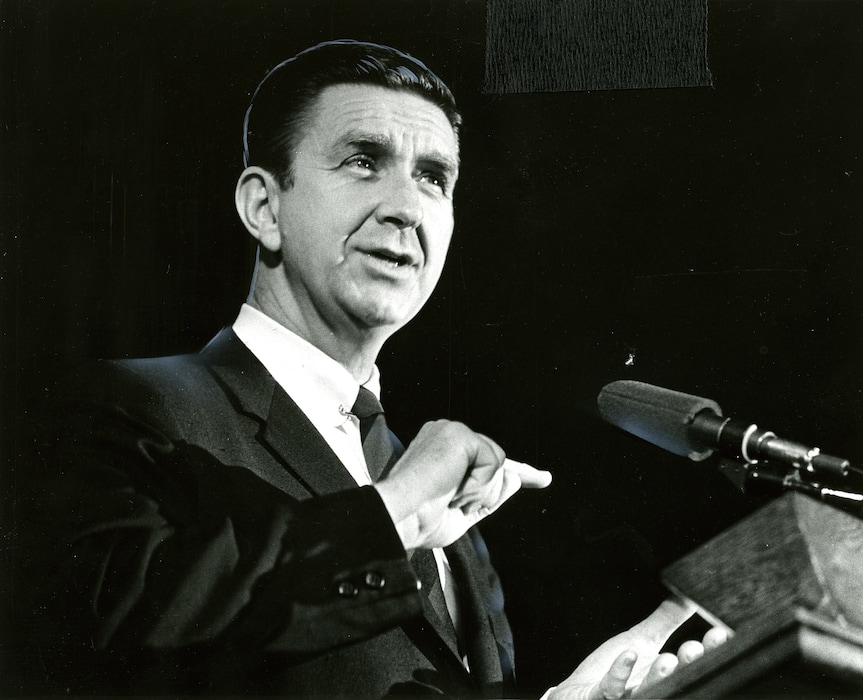
(The Salt Lake Tribune) Marion D. Hanks, who died in 2011, was seen as a champion of Latter-day Saints on the church's margins.

(The Salt Lake Tribune) Marion D. Hanks, who died in 2011, was seen as a champion of Latter-day Saints on the church's margins.

There was a time in the 1960s and ’70s, when Marion Duff Hanks was better known than almost any other Latter-day Saint leader.

The athletic, charismatic, compassionate and deeply literate Hanks was tapped in 1953 at age 31 as a general authority in The Church of Jesus Christ of Latter-day Saints and was not released from full-time service in the faith until 1992.

“Duff” (as his friends called him) was beloved for his winning ways as a speaker and teacher, his rapport with teens, and his ability to discuss Shakespeare, popular television shows, the scriptures, newspaper stories, ancient history and contemporary issues. Members also smiled at the light-colored suits he sometimes donned for General Conferences.

At the same time, Hanks, who died in 2011, was a “progressive” before many Latter-day Saints even knew what the word meant. He spoke of Christ and social justice, for example, and reached out to those on the margins of the church. Yet few modern members know of Hanks’ extraordinary life.

In 2024, Hanks’ son, Richard Hanks, wrote a biography of his father, “To Be a Friend of Christ: The Life of Marion D. Hanks,” drawing on otherwise unavailable primary sources — journals, correspondence, notebooks and recordings.

Here are edited excerpts from The Salt Lake Tribune’s “Mormon Land” podcast with Richard Hanks, who talked about his father’s life, and what his work meant for the church and future generations.

You called your dad a Renaissance man. What did you mean by that?

Everything he could do and did was just always top notch. I like starting with sports, because nobody ever talks about sports in the religion area. He was Utah’s state champion in handball, racquetball and squash, all in different decades. We go from that to Shakespeare to poetry, he wrote a hymn. He changed the church in so many ways, but the way I knew him best — he was fabulous on a court. When I was 16, I finally could beat him at tennis, or one day I thought I could beat him at tennis, and he’d say, “Hey, are your shoes untied, or is that net too short, or shall I play right-handed this game?” He was just good at everything.

What were some of his unusual strengths? What made him stand out?

No matter what I say here, I will sound like a starry-eyed son. [Laughs.] He was just different, really one of a kind in a world at that time that was maybe more into black and white — “we’re right and you’re wrong.” He believed strongly in mercy. He believed strongly in the individual, and, at a time when repentance meant maybe punishment and suffering, he fought against that. He really hated things like “church courts” [membership disciplinary hearings]. He fought for young single adult wards [congregations], which he helped create. He was trying to be positive and upbeat rather than to try to find something wrong.

For example, his belief in the Lord Jesus Christ was soundly based on stories like the lost sheep, the lost coin, the prodigal son. They were all saying, “Come back, you know. You’ve got this,” as opposed to “let’s catch you doing something wrong again.” He was the beacon for those on the fringes of the church. I really wish that all the folks with faith crisis issues who are making headlines today could have known him. I think a lot of these folks leaving the church would have felt differently if they’d have spent a couple of hours with Marion D. Hanks.

His belief came from the scriptures. We wouldn’t have a Christus [statute], we wouldn’t have the church logo. He got tired of trying to explain us being Christians, which is in the news today, right? And he and [apostle] Richard L. Evans and [church] President David McKay’s son went into the First Presidency and said, “We need to have something that will show people we’re Christians.”

(Chris Samuels | The Salt Lake Tribune) A Christus statue is on display at the visitors’ center at Temple Square in Salt Lake City. Marion D. Hanks lobbied for the statue to be displayed on the square.

(The Church of Jesus Christ of Latter-day Saints) The church symbol now incorporates the Christus.

Your father grew weary of some Latter-day Saint cultural traditions that aren’t necessarily rooted in the faith’s theology. Which ones spring to mind?

He called certain things we do in the church “nonessential insistencies.” In other words, there are things that are nonessential, but we’re insistent that we do it. When I was a 12-year-old boy, I went to Aspen Grove in Provo Canyon, and I was asked to help bless, or to help pass the sacrament, and I said to Dad, “Hey, they don’t cut the crusts off the bread like they do in the Federal Heights ward where we live.” He said, “Well, Rich, let me describe to you the nonessential insistencies.”

That was the first one I learned, but there are hundreds. Can a boy wear a blue shirt to pass the sacrament? How many times should we have a boy say the [sacrament] prayer over and over and over? And who sits where? All this kind of stuff just bugged him. He had another favorite saying, which was, “The things that matter most should not be at the mercy of the things that matter least,” and those were the things that mattered least to him.

(The Church of Jesus Christ of Latter-day Saints) Young Latter-day Saint men administer the sacrament, or Communion. Hanks was uncomfortable with some of the cultural traditions surrounding this religious rite.

Why do you think he was so ahead of his time on women’s issues?

His mother was probably the main cause of that. Maude, my grandmother, died in 67 when I was 7, but her husband, my dad’s dad, my grandpa, died when my dad was 2. So Maude raised these six kids all by herself. She was a strong, powerful woman. She was a ward and stake [women’s] Relief Society president. He learned at her knees. She was his main hero. He lived in a time when [many people] were sexist, and so I don’t want to make his openness to be more than it was, but he did things like he always had women on his committees. I never thought of any difference in our family between men and women. I remember I got called on the stake [regional] high council of the Washington, D.C., stake, and I called him up and I said, “Dad, they have the stake Relief Society president sit right next to me at high council meeting,” and he said, “Hurrah.”

Were there mostly women in his refugee efforts in Hong Kong?

He was sent to Hong Kong, and the first thing he saw were all these refugee camps, and he basically came back to the brethren and said, “I have an idea. Why don’t we spend less time aggressively proselyting and spend more time aggressively being Christians?”

[As a church authority in Hong Kong], he oversaw 18 missions, and he went to every one and pulled out two or three or four sisters and put them in the refugee camps. It was the first time the church had ever done that. [Latter-day Saint proselytizing missionaries] were not welcome in the refugee camps; they were all women. He just said the Savior would do this. This is what we’re going to do, and they hated us, you know. He had to fly to the refugee camps with United Nations [officials] to tell them, “Look, I live in Hong Kong. If there’s a problem. I will fly here tomorrow. You can trust me. We will not proselytize.” That was the issue, right? Nobody wanted the Mormons. “The Mormons are just proselytizers. That’s all they do. They don’t really care about us.”

So he went and handpicked all these sisters, and I really believe the Lord picked these sisters. This is the first time the church had done anything like this. He flies back to Salt Lake and presents it to, I think, the welfare committee. One of the brethren asked, “How many baptisms is this going to cost us?” And my dad said, “All of them.”

What other issues caused him to wrangle with church leaders?

(The Salt Lake Tribune) Hanks had his share of battles with apostle Boyd K. Packer.

Dad was a believer. That’s very important, but it’s not what you’d think necessarily. He believed the church was a scaffolding. I can remember coming home one time when I was about 18 and saying, “Dad, you are upset with [apostle] Boyd Packer,” and he’d say, “Yeah, I’m always upset with Boyd Packer.” They were always wrangling over something, and I’d say, “I’m supposed to go out and teach the world that this is an apostle,” and he said, “Well, he’s just a man who happens to be in a calling.” That’s really important in today’s world. Some people are leaving the church when they have this comparison between expectations and reality. When we find out that the expectations don’t match the reality, we feel betrayed, and so a lot of people have left.

You asked for some specific examples. He fought hard for young single adult wards, but some of the other brethren were saying “no way.” He fought for Scouting. Another thing he was responsible for specifically: missionaries doing 10 hours of work of service a week. Now, it would have driven him crazy to know people who beat their chests and say we’re at 17 million members. He would much rather say, “How is this individual doing? Can I help this person?” And he lived his life like that, too.

What did he think of the former priesthood/temple ban against Black members?

He just would go down to the prophet and say, “Can you go back over and pray, please?” There’s so much I’ve written in the book about these sweet, sweet people who would come to Salt Lake. This choir had three Black young men and a Hispanic fellow, and no hotel in Salt Lake would put them up, and so they’d sleep at my grandma’s house. That came from his going on a mission to Cincinnati and dealing with some families there. He didn’t think God would hold back anybody or any group of people for something that a group of people had, like the color of their skin. But he was a believer, and so he had to spend 28 years defending something he didn’t believe in.

Some historians have said that he appeared to be on track to becoming an apostle, but several conservative higher-ups blocked that. Do you know anything about that?

I do. I know a lot about that. I won’t comment on it here. … He would have been the prophet if he’d been called as an apostle and maybe kept his head down a little more. He would have been the prophet right after Ezra Taft Benson and before Howard Hunter.

What do you wish today’s members knew about your father?

(The Salt Lake Tribune) Marion D. Hanks was seen as a powerful speaker.

When my dad started teaching at West High seminary, the church did not have a formal program for teaching the Book of Mormon. He wrote all of the early documents and teaching aids. There’s nothing that’s being spoken now by people leaving the church that he didn’t know. He knew all of that. He was open and honest and transparent, yet he stayed in. I heard him say, “Stay inside and lift. You can get out of the church and poke holes and point fingers, but there’s so much inside the church that you individually can add.” Sometimes I would watch him in sacrament meeting, and I’d ask, “What are you doing?” He’d say, I’m writing this talk better than that guy’s giving it, but he wouldn’t be critical. He wouldn’t go up and tell the person, he just said he was just there, trying to get us all to improve.

What do you miss about him?

I miss his voice. I miss his clarity. I miss his fighting for the underdog everywhere.

Note to readers • To hear the podcast, go to sltrib.com/podcasts/mormonland. To receive ad-free “Mormon Land” episodes, along with our complete newsletter and access to all Tribune religion content, support us at Patreon.com/mormonland.

Support free news for Utah

sltrib.com is now free to access — no subscription required. We made this decision because we believe access to trustworthy, independent news shouldn’t depend on what you can afford — especially as misinformation and AI-generated content continue to rise.

Free to read doesn’t mean free to produce. Our reporters show up every day to ask hard questions and hold powerful institutions to account. That work takes resources. As a nonprofit newsroom, we rely on support from people who believe it matters. Make a donation today to fund local news that serves Utah communities.

You can help us bring more local news to more communities today.