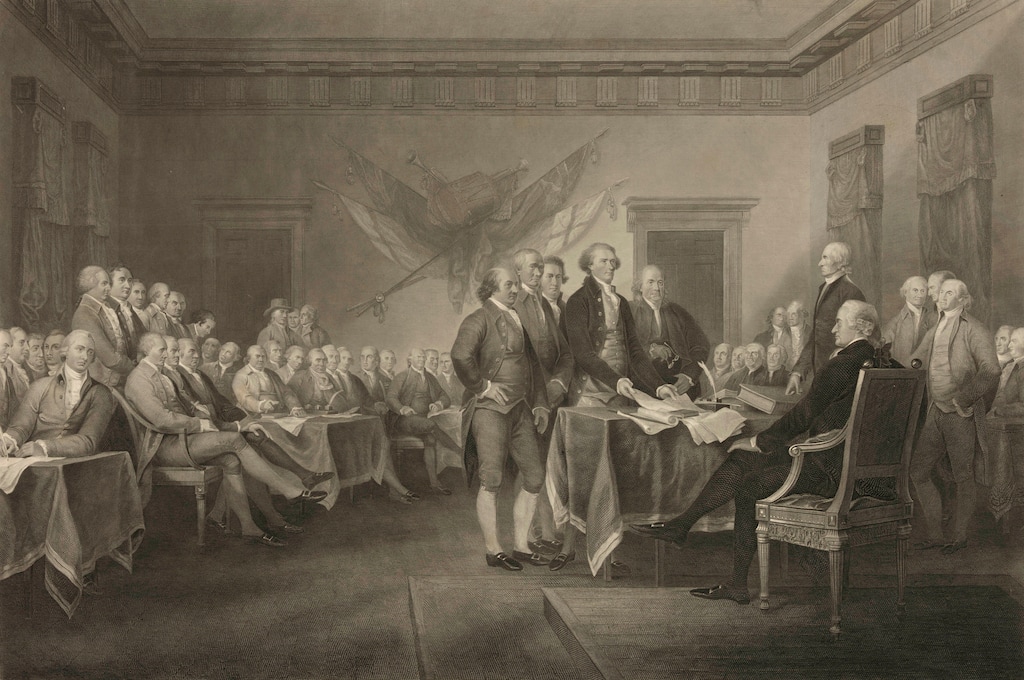
Take some time, amid the pancake breakfasts and parades and sunscreen and displays of colorful celebration, to remember exactly what America is celebrating the 250th anniversary of.
July 4, 1776, was not the day we declared our independence. That was two days before. It wasn’t the day we won a battle or signed a treaty or established a capital. It wasn’t the birthday of anybody important.
It was the day America set down its principles.
And, despite the fact that those principles were written in cursive, in pen and ink, on parchment, signed by a bunch of men who wore fake hair and short pants, who wouldn’t let their wives vote, bought and sold human beings and thought tobacco was good for you, those values still matter.
Everyone should read, and deeply ponder, our Declaration of Independence, because it still has much to teach us. And some warnings to give.
The Declaration values (and this is really important to editorial page writers) “a decent respect to the opinions of mankind.”
It puts forward a view of our nation, expressed in what historian Walter Isaacson recently labeled “The greatest sentence ever written.”
“We hold these truths to be self-evident, that all men are created equal, that they are endowed by their Creator with certain unalienable Rights, that among these are Life, Liberty and the pursuit of Happiness.”
We all know that Thomas Jefferson and his fellow founders didn’t fully mean what they said. But it does not follow that we can’t mean it for them. We can mean that basic human rights extend to all people, of any gender, race, religion or place of origin.
Realize, also, that the Declaration — written by a committee of five that included four lawyers — is drafted in the form of an indictment, with charges and specifications filed against the tyrant that the king of Great Britain had become.
Some of them sound ominously familiar.
Among the complaints of the colonists against the king:
— He has refused his Assent to Laws, the most wholesome and necessary for the public good.
— He has endeavoured to prevent the population of these States; for that purpose obstructing the Laws for Naturalization of Foreigners; refusing to pass others to encourage their migrations hither.
— He has made Judges dependent on his Will alone.
— He has kept among us, in times of peace, Standing Armies without the Consent of our legislatures.
— For Quartering large bodies of armed troops among us.
— For protecting them, by a mock Trial, from punishment for any Murders which they should commit on the Inhabitants of these States:
— For cutting off our Trade with all parts of the world:
— For imposing Taxes on us without our Consent:
— For depriving us in many cases, of the benefits of Trial by Jury:
— For transporting us beyond Seas to be tried for pretended offences.
These charges against George III echo, for example, Donald I’s imposition of illegal tariffs, both a harmful restraint of trade and a tax not enacted by Congress.
His deployment of armed ICE agents and National Guard troops, arguing that they have immunity even as they gun down innocent citizens. His illegal rendition of alleged illegal migrants to third countries or foreign concentration camps.
His launching foreign wars in Venezuela and Iran, with no authorization from Congress.
His attempts to sweep aside any number of court rulings and to intimidate judges.
And, most recently, his refusal to sign a popular, bipartisan housing bill, an issue widely considered a crisis across America, because he is miffed that Congress has not — and probably will not — pass his anti-democracy, voter-suppression SAVE America Act.
The Declaration of Independence is not, or should not be, a musty relic that we honor without really knowing what it is. It is a mission given to us by those who thought up America, and who went to some lengths to give us principles to live by.
Editorials represent the opinions of The Salt Lake Tribune editorial board, which operates independently from the newsroom.