It’s about history and humanity.
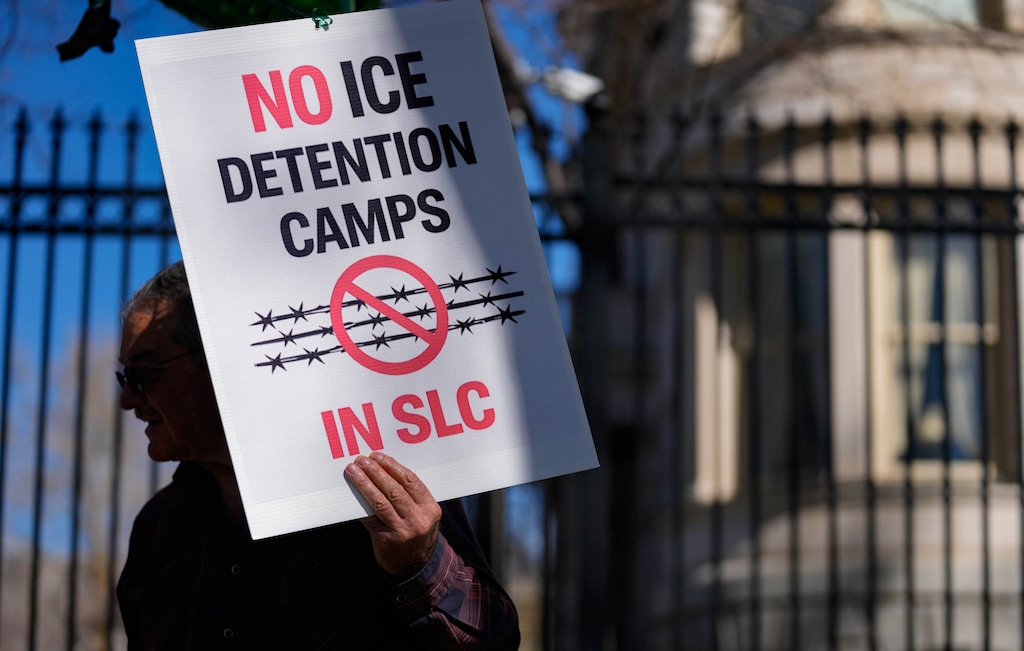
A murderously rogue federal agency known as Immigration and Customs Enforcement has bought an 833,000-square-foot warehouse in western Salt Lake City with the apparent intent of turning it into a holding facility for people it intends to deport.
That, as local officials and activists have rightly said, is a really bad idea. Utahns, in office and on the street, should be using every legal, nonviolent tool in the kit to stop it from happening.
And, if it does happen, to bear witness to whatever goes on.
Utah, of all places, should be wary of federal action aimed at disfavored minority groups. The origins of our state, its 1847 settlement by the serially persecuted Church of Jesus Christ of Latter-day Saints, should see to that.
The feds even sent the Army to Salt Lake City in 1857, a foolish response to a rumored LDS rebellion that came to be known as [President James] “Buchanan’s Blunder.”
Today, if there were any reason to credit ICE with an intent to follow the rule of law and only be rounding up seriously dangerous criminals who also happen to be in the United States illegally, this news might be tolerable, even welcome.
But, then, were that ICE’s goal, it wouldn’t need a 25-acre plot on which to hold a rumored 7,500 or more humans at a time. A property on which it spent $145.4 million of your money in a transaction that followed a circuitous path involving murky relationships with questionable German banks and promising millions in benefits to the local economy without providing any credible documentation.
Utah Gov. Spencer Cox Thursday, the very day he announced the publication of his book on how to turn down the level of political toxicity in America, was given the chance to exert some much-needed leadership on this issue.
But he weaseled out by offering a weak protest that the feds should do a better job of coordinating such projects with state and local government. He is right about that, and Utah’s U.S. Sen. John Curtis has raised the same point.
But then Cox went on to blame the Biden administration for the nation’s immigration woes and to echo the xenophobic MAGA contention that, “We have to process millions of people.”
No, we don’t.
There are some bad people out there. But ICE only thinks it needs that much space here — and at other locations across the country — because it envisions rounding up thousands of people on slim or no legal grounds. Such as being in possession of a substance that turned out to be pinto beans.
As of early February, some 74% of those in ICE or Customs and Border Protection custody have no criminal convictions, and many of those who do have a record are guilty only of traffic violations or other minor infractions.
Once such a facility is up and running, however, you can be sure it will be filled, one way or another. There is too much money on the line to do otherwise.
The result, the point, will be to instill fear throughout the community. To terrify not only those who are indeed here without authorization, though they pose no threat to anyone, but also those with legal permission to remain, permission that ICE and its parent agency, the Department of Homeland Security, has shown it is eager to ignore.
Also cowering in Utah homes will be anyone with undocumented relatives, people with dark skin, heavy accents, foreign-sounding names and anyone — even white natural-born citizens — who have exercised their First Amendment rights to speak out and protest.
(The First Amendment, no one should need to be reminded, applies to all human beings who happen to be standing within the borders of the United States, whether they have authorization to be here or not.)
Fear such as this cannot help but reverberate throughout the community. Children won’t come to school. Employees won’t show up for work.
Victims and witnesses will shy away from reporting incidents to police, making the streets more dangerous for all of us. Which is why most responsible law enforcement officials — including, most recently, University of Utah Chief Safety Officer Keith Squires — want nothing to do with ICE operations in their jurisdictions.
Salt Lake City Mayor Erin Mendenhall rightly has moral and practical objections to the planned detention center that go well beyond ICE’s deserved reputation as a lawless agency.
The mayor notes that a warehouse designed to hold goods, repurposed to hold so many human beings, will place a heavy burden on city services, from water and sewer to police and fire and EMS, as well as potentially poisoning the area’s potential for economic development.
Someone needs to remember that we are talking about human beings here.
Perhaps Cox and Curtis are trying to keep their powder dry and hope to have some influence with the administration in making the ICE project less terrible.
Either way, it is time for Utah’s historic resistance to federal overreach to come out of its Trump-era slumber and make it clear that a giant ICE prison is not something we want built in our community or operated in our name.
Editorials represent the opinions of The Salt Lake Tribune editorial board, which operates independently from the newsroom.