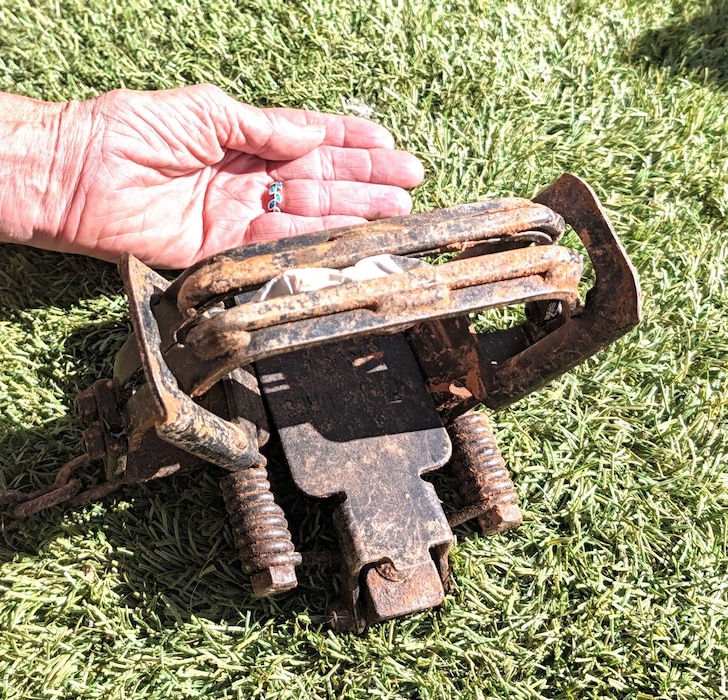
My dog was recently caught in a steel-jawed coyote trap near Kanab. Fortunately, after a great deal of effort — and some injuries to my hand — I was able to release him unharmed.
Until this near tragedy happened, I was unaware of trapping laws and how they impact some of the most cherished members of our families: dogs.
Dogs are at risk of being trapped, and you have no way of knowing which trails have traps by them.
Let’s look at one example. The primary impetus for trapping coyotes is your tax-funded bounty of $50 to $100 for each dead coyote. According to the Utah Division of Wildlife Resources’ Furbearer Guidebook, a trapper should “avoid setting traps near trails that are frequently used by people and dogs.” This is ambiguous, nonspecific and promotes zero accountability. In other words: It’s up to an anonymous trapper, driven by a bounty, to determine which trails on our public lands will have concealed traps and how far they should be from a trail.
It’s not up to the public — the hikers, horseback riders, nearby communities and people who pay state taxes. They have no say. The state language has no oversight, no penalties and is conveniently vague. Trapping laws are dictated by the Utah Wildlife Board. Members are appointed by the governor.
Furthermore, the Utah Division of Wildlife Resources does not track where traps are placed. And then there’s the non-target animals that put their foot in the wrong place and die in anguish.
Incidentally, trappers buy a lifetime trapping license for $10.
Predator traps of different kinds can be set along trails, and you won’t know about it. You might already have walked past some. These traps are, at times, “scented” to attract predators, including dogs. Traps are not required to have the trapper’s name or phone number attached to them, only an identification number that might be traceable to the trapper. I have no doubt that there are traps on public lands with no identification.
Traps should not be permitted near recreational trails on public lands. For example, some public trails in the Kanab area are adjacent to residential areas where people hike, ride horses and walk their dogs. Last year, there was a case near Kanab where a woman’s dog was trapped because it had been attracted to the trap by electronic bird distress calls. In the process of trying to wrestle her crying dog from a big steel trap, she said in a video posted to Facebook, the woman’s hand got caught in another steel trap. One can only imagine the pain and chaos. Dogs have been caught near trails along the Wasatch Front.
If there is a coyote or other predator that is a risk to people on trails, UDWR should resolve it.
Dogs aren’t just dogs, they are special family creatures. An amputation of a leg or death of a dog would be devastating. If your dog is an escape artist — some of mine are — and likes to explore the countryside after their escape, be aware that UDWR regs only require a trapper to check his traps once every two days. The implications are obvious.
I have lived on two big ranches and I used to hunt. I’ve been around lots of predators in my travels in Alaska (mostly by parachute into fires), the Southwest and South America (piranha and crocodiles were my least favorite). I’ve been attacked by a bear (didn’t enjoy it much) and threatened by a mountain lion (it was interesting). However, I would never use traps because of the misery they inflict. I know ranchers who would never use them.
We must keep pets and kids safe on public trails where there are specific, well-defined, enforceable laws.
Trapping on recreational trails is a clear and present danger. Montana requires that traps along commonly used trails and trail heads have a minimum set back of 500 to 1,000 feet. For less used trails, the setback is 50 feet. Utah should adopt these setbacks.
Additionally, some areas should not permit trapping at all, especially those near residential areas. I don’t want to walk down trails with my friends, their kids and our dogs, or even ride a horse down a trail that has traps adjacent to it. I have found traps immediately next to trails that were marked with red flagging in the tree above them; this so the trapper could find them. Red flagging is a curiosity magnet for kids.
I can tell you from my own experience that some people may not be able to remove themselves or their dogs from a big, powerful steel trap. My dog was caught in a heavy, four-spring trap that is supposed to be “avoided” by trappers — it was used anyway, and I found another nearby.
There shouldn’t be traps that maim and kill animals near trails.
(Bill Mader) Bill Mader, Ph.D., did pioneering raptor research in South America supported by The National Geographic Society and The American Museum of Natural History.
Bill Mader, Ph.D., did pioneering raptor research in South America supported by The National Geographic Society and The American Museum of Natural History. He was also the first Administrator of the Red Cliffs Reserve (now a National Conservation Area), a senior scientist at Lockheed environmental, a pilot-biologist and Alaskan Smokejumper. In his last chapter, he was an associate professor of environmental science at Navajo Technical University.
The Salt Lake Tribune is committed to creating a space where Utahns can share ideas, perspectives and solutions that move our state forward. We rely on your insight to do this. Find out how to share your opinion here, and email us at voices@sltrib.com.