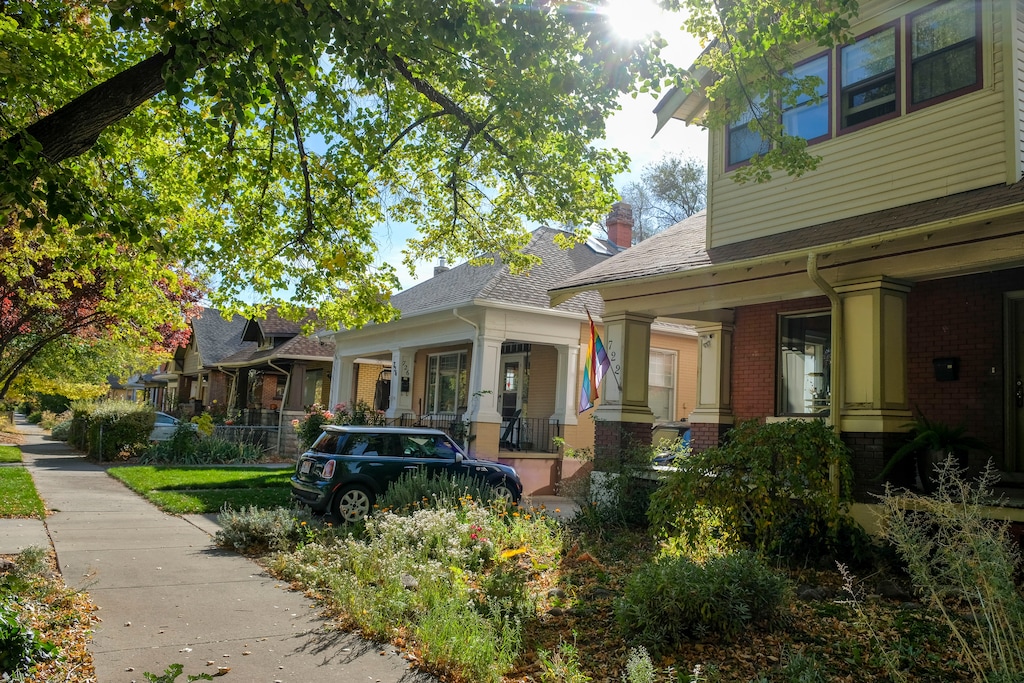
I can still remember the trepidation I felt almost 23 years ago sitting in the driver’s seat of the U-Haul and traveling across the country from Minnesota to Utah in March of 2004, en route to our new home in Salt Lake City. The cab was a mayhem: my wife, Cari, our 1-year old daughter, Georgia, our 50-pound dog, the cat whining constantly in her crate and me sweating about towing our 1996 Nissan pickup truck behind an under-powered U-Haul.
That 1996 four-wheel drive Nissan truck cost $17,000 when it was new and, when we got to Salt Lake City, we found housing equally affordable.
Only Cari was employed at the time but, with a 1-year old kid, a combined student loan debt of $120,000 and a single income of $65,000 — $116,000 in 2026 dollars — we managed to buy a bungalow near Liberty Park for $194,000. Our payment was $900 a month, not including utilities, about 16% of our household’s monthly income.
Due to stable housing, I was able to start my own business, and we had a bedroom waiting for our new son Ronan in 2005. Two years into our new life in Utah with a household income of $80,000 — $138,000 in 2026 dollars — we were spending about 14% of our monthly income on housing and still driving that beat up (but paid-off) Nissan truck.
In 2007, our affordable housing situation enabled Cari to take leave of her job and raise our two kids full time during the preschool years. This affordability wasn’t merely convenient: It reverberates through my family’s Utah experience in a way such that I am compelled to support the Expanding Housing Options zoning reform currently being proposed by the Salt Lake City Planning Department.
Affordable housing came to the rescue again in 2010 as the kids started grade school when Cari decided to take a 60% pay cut and become a middle school science teacher in order to give back the amazing gifts that her teachers had given to her in the 1970s and 80s. And we have countless family memories of exploring the Uintas camping out of the back of the Nissan truck with the kids strapped into the two tiny jump seats of the King Cab.
Fast forward: The 2026 Nissan 4WD King Cab truck costs 7% less than the 1996 version after adjusting for inflation. Why? Supply and demand. More than 96 million motor vehicles were manufactured in 2025 alone.
The house that we bought near Liberty Park for $194,000? It was listed for sale in April of 2026 for $950,000. If sold for that amount, that’s 175% more than 2004 after adjusting for inflation.
Why? Antiquated zoning rules literally prohibit common sense growth. This intrusive government regulation severely limits supply, driving up costs.
An astounding 77% of Salt Lake City’s residential land is zoned for single family neighborhoods. My kids, now in their 20s, will have families and buy their own housing in the next 10 years. The median home price in Salt Lake City is $635,000. The median household income in Salt Lake City is $77,186 per year. With a 6.5% 30-year mortgage and 20% down, the monthly home payment is equal to 50% of income, not including utilities.
Huge apartment buildings next to rail stations are necessary but not nearly sufficient to bring down costs. And that strategy does not address the need for a diversity of urban housing options at different scales and in different neighborhoods. We need more small scale housing: two-family, three-family, townhouse and four- to six-unit apartment buildings.
Salt Lake City loses its soul when we preserve 77% in aspic, shutting out low- and middle-income buyers. By default, only the lucky and wealthy (like me) remain. Welcoming the next generation of residents makes us stronger and increases economic activity, and it makes neighborhoods more vibrant, walkable, livable and fun.
If a family wants to have another child, if a parent wants to stay home and take care of the kids, or if a parent wants to pursue a more meaningful or community-oriented career pathway, we all benefit from the flexibility of Salt Lakers to make those choices.
I want to live in a place where my children and the other members of their generation can live affordably on the same streets that they grew up on. The only way that this happens is by expanding housing options in all of our neighborhoods.
I want to share the wealth of what Salt Lake City has meant to my family and provide new families of all income levels and backgrounds, whether born in Salt Lake or moving here, the opportunity to have an affordable neighborhood to call home.
(Dave Brach) Dave Brach is the Principal at Brach Design Architecture in Salt Lake City and a fierce champion of livable cities and Passive House design.
Dave Brach is the Principal at Brach Design Architecture in Salt Lake City and a fierce champion of livable cities and Passive House design.
The Salt Lake Tribune is committed to creating a space where Utahns can share ideas, perspectives and solutions that move our state forward. We rely on your insight to do this. Find out how to share your opinion here, and email us at voices@sltrib.com.