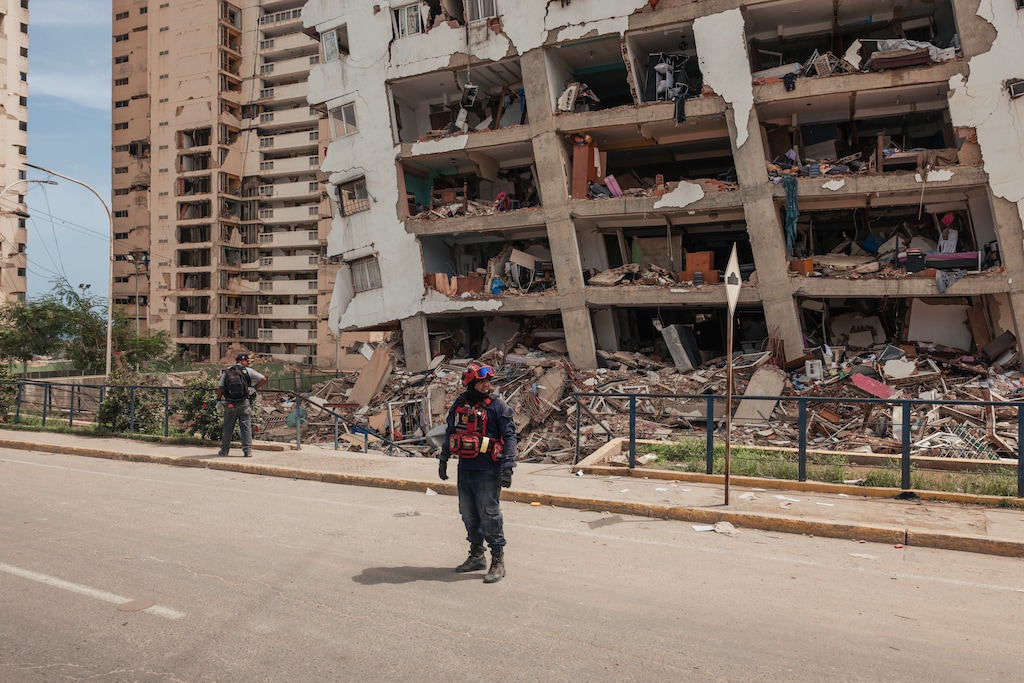
The twin earthquakes that struck Venezuela on June 24 killed more than 6,100 people, injured about 61,000 and left between 18,000 and 50,000 missing — after six weeks with no clear government accounting. They also damaged essential infrastructure and created a recovery that will take years.
Utah should treat that catastrophe as a warning.
Earthquakes are natural events, but vulnerable buildings and utility systems (water, sewer, natural gas, electricity, etc.) are the result of human decisions. Deaths, injuries and prolonged disruptions depend largely on where and how we build, whether we strengthen at-risk structures, and whether critical public services can continue operating after the shaking stops.
Our perspective is informed by complementary expertise: Meaghan McKasy, an associate professor, lecturer, of communication at the University of Utah, specializes in science communication, while Robert Grow, Grant Willis, and Trae Boman bring extensive experience in seismic safety, geology and geotechnical engineering.
The scenario in Venezuela is uncomfortably like what the Earthquake Engineering Research Institute — Utah Chapter models say to expect in Utah after an earthquake. About 80% of Utah’s population and 75% of its economy lie within 15 miles of the Wasatch Fault Zone. Scientists estimate a 43% chance of a magnitude 6.75 or greater earthquake in the region within 50 years. Unlike the Venezuelan earthquakes, which occurred roughly 108 miles from Caracas, the Wasatch Fault runs beneath Utah’s largest population centers. The sediment beneath the Wasatch Front, much like that in Venezuela, can amplify earthquake shaking, while much of the state’s vulnerable infrastructure sits directly in harm’s way.
Utah also has roughly 147,000 unreinforced masonry (URM) buildings, many of them homes, apartments, schools, churches and businesses built before modern seismic codes. Modeling of a magnitude 7.0 earthquake on the Salt Lake City segment projects as many as 2,500 deaths and more than 10,000 serious injuries in the Salt Lake City area alone with those numbers rising as shaking propagates beyond it.
Even buildings that remain standing may be unusable. Venezuela showed how foundation cracks, failed interior walls and other damage can force demolition or major reconstruction. Many of these “apparently good” buildings still have to be demolished or have major rebuilds. Utah has already seen a smaller version: West Lake STEM Junior High had to be demolished and replaced after the 5.7 Magna earthquake in 2020.
The threat extends beyond buildings. I-15 and I-80 cross or run near the fault. Water, sewer, natural gas and power systems also cross it, and only some have been upgraded. A failed overpass could close a major transportation corridor. Broken water lines could leave firefighters without water as fires spread. Models suggest more than one million Utahns could remain without water for over 90 days, with sewer recovery taking even longer.
Utahns have made progress in preparing for “the big one”. But, we as individuals, communities and governments are not doing enough. Excellent resources are available through the Utah Division of Emergency Management, the Utah Geological Survey, the Utah Chapter of the Earthquake Engineering Research Institute, Envision Utah, FEMA and U.S. Geological Survey among others. Effective preparedness should focus on three key priorities.
First, Utah should invest in earthquake early warning. Warning time would be shortest near the fault, which is heavily populated here in Utah, but even seconds can stop trains, shut valves, isolate power lines and allow people farther away to take protective action. Venezuela lacked a formal system, yet Google’s phone-based alerts reached more than 11 million Android users within 15 seconds. Unfortunately, legislative support in Utah for developing a system has been limited. Utah should pursue a coordinated system rather than treating phone alerts as a substitute for public infrastructure.
Second, state and local leaders should accelerate retrofits of vulnerable buildings and public systems. The cost is substantial, but the cost of collapse, displacement and years of economic disruption will be far greater.
Third, Utah should strengthen neighborhood-level response in tandem with government-level planning. One of the most striking lessons from Venezuela was the importance of community action. With limited state capacity in Venezuela, WhatsApp networks of spontaneous volunteers and private citizens supplied food and water for rescue efforts before any government resources arrived on the scene. Strong community ties, combined with forward-looking state planning, could strengthen Utah’s disaster response.
Individuals also have responsibilities. Utahns should assess the seismic safety of homes and frequently occupied buildings; ask insurers about earthquake coverage; secure heavy furniture, water heaters and breakable items; make a family emergency plan; learn when and how to shut off utilities; and keep supplies in a place that will remain accessible after a quake.
Utah does not lack knowledge or expertise. What it lacks is urgency. Preparation costs less than recovery, and the choices we make before the ground moves will determine how many lives are saved and how quickly our economy recovers. The question is not whether Utah can prepare. It is whether we will act while we still have time.
(Meaghan McKasy) Meaghan McKasy is an associate professor, lecturer, of communication at the University of Utah. The views expressed here are her own and do not represent the official position of the university.
Meaghan McKasy is an associate professor, lecturer, of communication at the University of Utah. The views expressed here are her own and do not represent the official position of the university.
(Robert Grow) Robert Grow is the former chair of the Utah Seismic Safety Commission and the founding chair emeritus of Envision Utah.
Robert Grow is the former chair of the Utah Seismic Safety Commission and the founding chair emeritus of Envision Utah.
(Grant Willis) Grant Willis is retired from the Utah Geological Survey.
Grant Willis is retired from the Utah Geological Survey.
(Trae Boman) Trae Boman is an engineering geologist with Applied Geotechnical.
Trae Boman is an engineering geologist with Applied Geotechnical.
The Salt Lake Tribune is committed to creating a space where Utahns can share ideas, perspectives and solutions that move our state forward. We rely on your insight to do this. Find out how to share your opinion here, and email us at voices@sltrib.com.