I am part of a pickup soccer group that goes back more than five years. It is easily the most diverse group in my Salt Lake life, though diversity isn’t the point. We just love to play.
I believe that groups like this represent the best of our community. The challenge for our group has always been finding a field that is consistently available.
Over the years, we have been kicked off many fields, which are typically owned by educational institutions. Rowland Hall sicked its friendly, but firm, security guards on us years ago. More recently, Murray High School locked its gates.
Why do public institutions — or private ones with DEI statements — exclude public pickup groups? It could be the inconvenience, fear of legal liability or even just a less understanding new staff member. In some cases, it is also that we are competing for space with affluent soccer teams who can afford field rentals. While our local group may have value, it doesn’t bring in dollars.
“Pay to play” has become the watch word for U.S. soccer failure after we crashed out of the World Cup in undignified fashion against Belgium last week. Why can’t we compete at the highest level? For one thing, the game is more accessible to children whose parents can afford it. American parents pay thousands of dollars yearly for their children to play on travel soccer teams in a privatized model. Passionate and talented children without the means to pay or travel are frequently left behind.
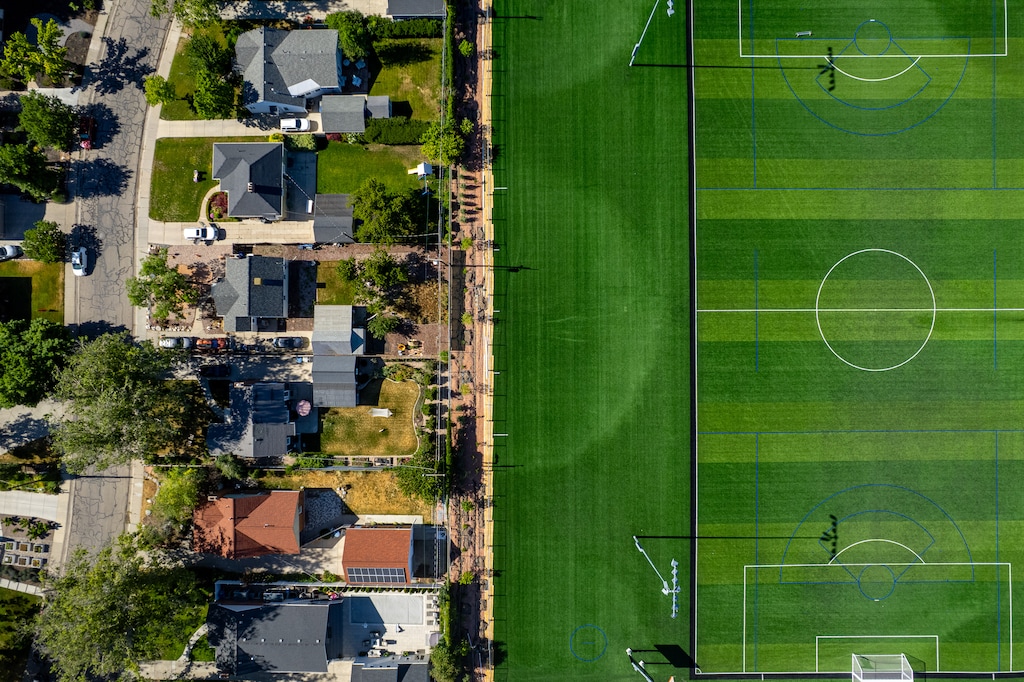
Our pickup group recently landed at Rosslyn Heights Athletics Complex, the site of a different kind of controversy. Here is where global warming comes in.
A recent Salt Lake Tribune article highlighted how the field’s closest neighbors are feeling the heat (and odor) of the newly installed turf field. Naturally, they are not pleased. At a recent morning pickup game, the air temperature hit 90 degrees before 10 a.m. The dark rubber pellets that give the field its cushion soaked in heat to the point where we could feel it through our cleats.
This is when some of the other drawbacks to the newly designed park started to be felt. Could we find shade next to the field? Only by crouching near the bleachers. Was water available? No, the fountain was off, no water bottle station existed and the shiny metal buttons on the fountain burned to the touch. These are the kinds of details that can easily escape a planner’s notice, but, in this era of heat records, they are obvious to the user.
As school districts, city governments and counties across the valley plan for future infrastructure, can they do it in a way that is both equitable and well-adapted to our scorching hot new temperatures? Clearly the Salt Lake City School District missed a few tricks with Rosslyn Heights, but I hope that the right lessons will be learned.
There are plenty of solutions that promote soccer accessibility and climate adaptation. In Salt Lake, Hartland Community for Youth and Family is a group that offers a solution to the youth soccer affordability problem. This small neighborhood nonprofit offers low cost afterschool soccer practice to Glendale youth of all ages. This is a program Salt Lake and others across the valley should support and look to replicate. In South Salt Lake’s Fitts Park, sunshades cover the entire playground. And, so far, the Rosslyn Heights field is open to all
This new complex remains a bright spot for our pickup soccer group. Maybe this is the one where we don’t get kicked off by teams renting the field. Maybe they will build some shade structures and turn on the water. Maybe the city will invest in a rec department coach to offer soccer play time to youth.
However, as we wrapped up our game, I couldn’t help but notice the professional coaches setting up drills for children on the other side of the field. If Salt Lake gets this wrong, then it won’t be long before these coaches are given priority, our group will encounter another locked gate and we will be back on the hunt for a reliable field to play the beautiful game.
(Seth Cauman) Seth Cauman is a lifelong soccer fan and nonprofit employee whose work touches on advancing access to safe cycling for youth across the state of Utah.
Seth Cauman has a professional science master’s in climate science and solutions from Northern Arizona University. He is a lifelong soccer fan and middling player. He is also a nonprofit employee whose work touches on advancing access to safe cycling for youth across the state of Utah.
The Salt Lake Tribune is committed to creating a space where Utahns can share ideas, perspectives and solutions that move our state forward. We rely on your insight to do this. Find out how to share your opinion here, and email us at voices@sltrib.com.