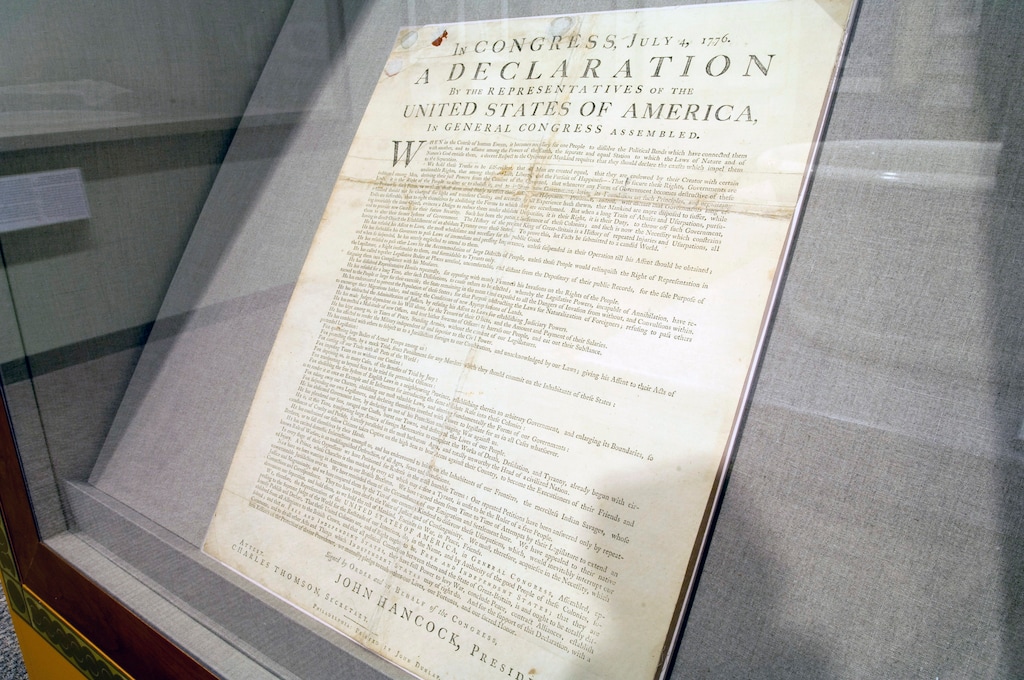
Americans rightly celebrate the Declaration of Independence as a statement of natural rights. Its most famous words still define our national creed: “all men are created equal,” and all are endowed with unalienable rights to “Life, Liberty and the pursuit of Happiness.” Those words deserve their place at the center of American memory.
If we read the Declaration only as a rights document, however, we miss something essential. Before it lists grievances, before it invokes rights, before it announces independence, the Declaration begins by identifying a corporate political actor, a unity – “one People.”
“When in the Course of human events, it becomes necessary for one People . . .”
This first sentence forms, names and authorizes a people to act. It also justifies their act of political separation by appealing to both reason and a higher moral law, and it concludes with a solemn oath of deep dedication to this new community. In this sense, the Declaration is a covenant document.
That word may sound archaic, even theological. Yet covenant was a familiar political idea in colonial America.
In my graduate courses on the American founding for Utah’s K-12 teachers, the idea that many of my students find most novel, intriguing and insightful is the covenant roots of America’s system of government.
Long before independence, Americans had practiced government through solemn agreements that joined people together for common purposes while limiting the power of rulers. The Mayflower Compact is the best-known example, but it was hardly alone. Towns, churches, colonies and civil associations repeatedly used written agreements to establish authority, define obligations and bind communities together.
This covenant tradition matters because it helps explain what the Declaration is doing.
This is more than a contract. A contract is usually a transaction among separate parties, each protecting individual interests. A covenant is different. It forms a relationship. It creates a people bound by shared purposes, mutual obligations and a moral standard above mere will or power.
The Declaration follows that pattern. It appeals to a higher law. It gives a public account of the breach committed by the king. It declares a new political status. It invokes divine judgment. And it ends with a pledge: “we mutually pledge to each other our Lives, our Fortunes and our sacred Honor.”
That final sentence is not ornamental. It is the language of covenant. The signers do not merely assert rights. They bind themselves to one another.
This changes how we understand American citizenship.
A purely rights-oriented reading of the Declaration tends to produce a thin account of citizenship. On that view, government exists to protect individual rights. Citizens obey the law, vote occasionally, claim their liberties and turn to courts or elections to protect their liberties and advance their political interests. There is value in that view. Rights are indispensable. A free society must protect the individual against arbitrary power, majority domination, and government abuse.
But rights alone cannot sustain a republic.
If citizenship is reduced to rights-claiming, then political life becomes transactional. Government owes me protection. Other citizens become competitors, obstacles or temporary allies. Public argument becomes less about our shared obligations and more about securing my preferred outcome. The common good fades. Civic trust weakens. Membership thins.
The covenant tradition offers a thicker account. It does not deny rights; it gives them a broader home. Rights exist within a political community whose members owe something to one another. Citizens are not merely rights-bearing individuals standing over against government. They are members of a people who share responsibility for sustaining the constitutional order.
That responsibility runs both directions. Rulers are obligated to govern within limits, respect the people, hear minority voices and pursue the public good rather than private power. But the people are also obligated. They must remain engaged, deliberate with one another, hold their leaders accountable and cultivate the habits of the heart that make self-government possible.
This is why the Declaration’s covenantal structure remains important. It reminds us that America was not founded simply on individual autonomy. It was founded on ordered liberty: liberty joined to responsibility, rights joined to membership, self-government joined to mutual obligation.
The covenant tradition also helps explain the American commitment to divided authority. The Declaration speaks in a layered way. It names “one People,” but it also declares the colonies to be “Free and Independent States.” Unity and plurality appear together. That structure would later become central to American federalism: a constitutional order in which the people act through multiple governments, each limited, each accountable and each responsible for different kinds of public work.
This was not accidental. Covenant politics rejects the idea that all authority must be concentrated in one sovereign ruler or one supreme institution. It assumes that free people can join together for common purposes without surrendering all local independence, institutional pluralism or personal liberty. That assumption became one of America’s great contributions to constitutional government.
Today, our politics often oscillates between two inadequate alternatives. One side treats national unity as requiring uniformity from the center. The other treats liberty as if it requires radical autonomy from common obligations. The Declaration points to a better path. It joins liberty and membership. It affirms rights, but also forms a people. It authorizes independence, but through mutual pledge.
Recovering the covenant beneath the Declaration does not require turning American politics into theology. Nor does it mean diminishing the importance of natural rights. It means recognizing that rights were embedded in a thicker moral and political tradition than we often acknowledge.
The Declaration is a rights document. But it is not only a rights document. It is also a covenantal act of peoplehood. It teaches that free government depends not merely on what individuals may claim, but on what citizens owe — to one another, to their constitutional order, and to the common project of self-government.
As we celebrate the 250th anniversary of American independence, that may be the part of the Declaration we most need to recover.
(Utah Valley University) Troy E. Smith is a professor and Director of the Constitutional Federalism Initiative at the Center for Constitutional Studies at Utah Valley University.
Troy E. Smith is a professor and director of the Constitutional Federalism Initiative at the Center for Constitutional Studies at Utah Valley University.
The Salt Lake Tribune is committed to creating a space where Utahns can share ideas, perspectives and solutions that move our state forward. We rely on your insight to do this. Find out how to share your opinion here, and email us at voices@sltrib.com.