We’re living through suffocatingly violent times. I say this despite the fact that my personal history as a child of Holocaust survivors reminds me that I emerged out of a world-at-war.
I was born (though my mother initially opposed having children) a few years after the war ended. The battlegrounds of that six-year bloodletting (1939-1945) were in Northern, Central, Eastern and Southern Europe; through a portion of the Middle East; across North Africa; and across portions of Asia. Merely itemizing the geographic areas is terrible.
Yet I repeat: We are living through suffocatingly violent times.
In 1991, the Soviet Union collapsed, bringing nearly a half-century long cold war (some of it fought against supposed proxies like Cuba, Korea and Vietnam) to an apparent end. It was a heady moment, and people across Eastern and Western Europe erupted with joy that the awful repressions of the Soviet state would now cease. My country of origin, Hungary, was jubilant, and eagerly proclaimed its embrace of a democratic future. Yet the end of that “cold” war, despite all its hoped-for freedoms, gave rise to nearly 30 years of continuous, and smaller, “hot” wars.
In September 2001, for example, al-Qaida destroyed New York City’s Twin Towers, triggering an American-led response that grew into a regional conflict, taking 20 long years to resolve. Only when President Joseph Biden withdrew U.S troops from Afghanistan in 2021 did the conflict end.
In Feb. 2022, citing the fabrication of defeating resurgent Nazism, Russia invaded Ukraine, its neighbor. That new conflict, the worst in Europe since WWII, is now in its fourth year and has drawn NATO into its clutches.
The following year, on Oct. 7, 2023, Hamas, the Palestinian entity governing Gaza, attacked southern Israel. Curiously, during the Oct. 7 attack, Hamas posted short videos of their infiltration. The social media videos — proclaiming Hamas’ initial success — were horrifying, yet strangely instructive. In the first video I watched, three or four Hamas fighters crouched in the bed of a fast-moving pick-up and fired machine gun bursts into a crowd of unarmed Israeli youth attending an overnight concert. Hundreds were trapped by what appeared to be a cross fire. Many Israeli youth were killed; some were captured and taken hostage.
In a second video I saw, masked Hamas fighters infiltrated a kibbutz. Gunmen sliced window screens, fired machine gun bursts through walls, killing individuals and families. They forced a terror-stricken teenage boy to coax his neighbor to leave the “safe” room. “It’s okay,” the mesmerized youth told his neighbor, “You can come out.”
In the final video I watched, a husky Hamas fighter stood upright in the back of a black pick-up that was slowly cruising Gaza City. His face was deliberately concealed. In his right hand, he clutched the long, dark hair of a partially naked Israeli woman. Teenage boys walked by the slow-moving spectacle and spat on the helpless (likely dead) victim.
I watched in disbelief. Never in my lifetime did I expect to see unarmed Jews hunted in their communities, while their executioners, their neighbors, exulted and displayed their trophy dead. Joy in snuffing Israeli lives, and the revulsion displayed by Hamas fighters and Gaza citizens at the spectacle of injured or dead Jewish people, shocked me even more than the taking of Jewish life.
As I watched, I also realized that a fragile Israeli-Palestinian status quo was being obliterated, and I sought an explanation — anything, really. How could Hamas carry out such an action? Didn’t they know their rampage would trigger the most savage reprisal? In the days and weeks following the attack, Israel’s destruction of Gaza was still in the future — yet it was clear that Hamas had exposed a national nerve. Hamas was not a military threat to Israel, yet their acts exposed Israeli vulnerability, or, put in another way, Hamas momentarily shattered Israel’s illusion of invincibility and safety. And for this development, they would pay.
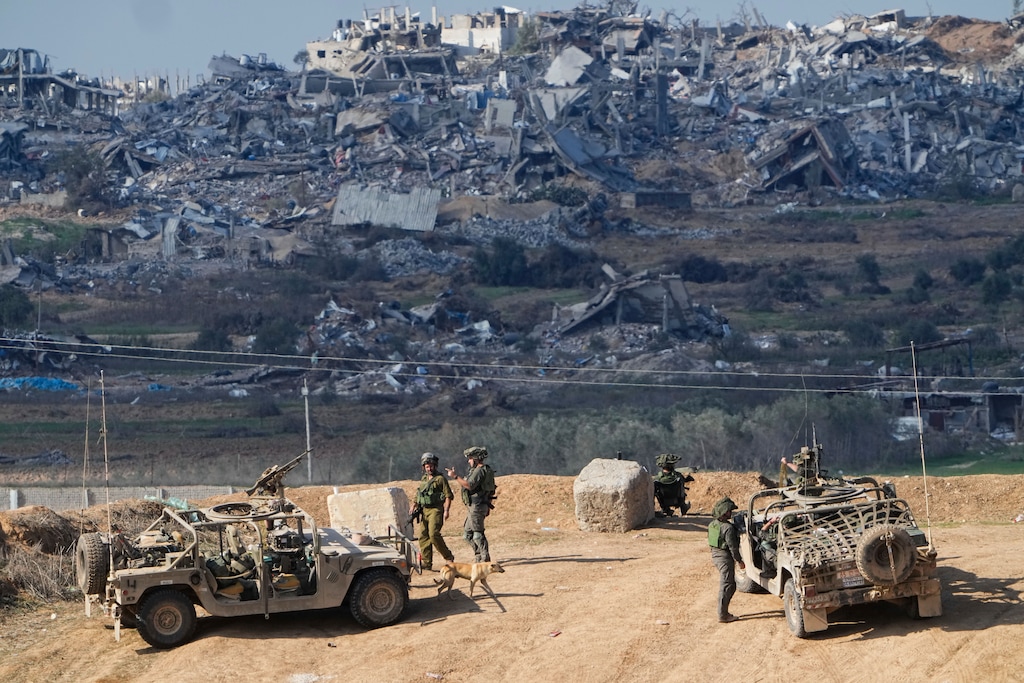
But it wasn’t Hamas alone that would pay; civilians in Gaza — women, men and children — would pay. I couldn’t believe what was transpiring. Hamas presented murders of unarmed Israelis as a triumph, yet any sane observer could see it was a national suicide. Alongside it, in Israel, the deaths of unarmed Israelis was being transfigured into an all-out moral campaign to destroy the enemy. The region’s most powerful and effective military was about to go to war against lightly armed, and largely defenseless, Gaza. This was an unbelievable scenario: inevitable physical destruction on one side, and moral deformity on the other.
Where were Egypt’s, Qatar’s and Jordan’s peacemakers? Why couldn’t President Biden see beyond “support” for Israel? Why were Israel’s opposing parties largely silent? A slowly unfolding moral catastrophe was in progress. The situation begged for a ceasefire, a way to address the 75-year long conflict that was approaching this sickening cul-de-sac, yet nothing materialized.
Where do we go from here? Somehow we must ask more of ourselves.
Capitulation to violence as the solution to conflict — especially stubborn, apparently-intractable conflict — must end. Urge your congressional representatives and religious leaders to support accountability, diplomacy, open dialogue and life-affirming solutions, so we can all start to breathe again.
(Leslie G. Kelen) Leslie G. Kelen is a child of Hungarian Holocaust survivors and the author/editor of five non-fiction books.
Leslie G. Kelen is a child of Hungarian Holocaust survivors and the author/editor of five non-fiction books, including the recently republished “This Light of Ours: Activist Photographers of the Civil Rights Movement (University Press of Mississippi).” He and his wife moved to Utah in the mid 1970s and raised their family in Salt Lake City.
The Salt Lake Tribune is committed to creating a space where Utahns can share ideas, perspectives and solutions that move our state forward. We rely on your insight to do this. Find out how to share your opinion here, and email us at voices@sltrib.com.