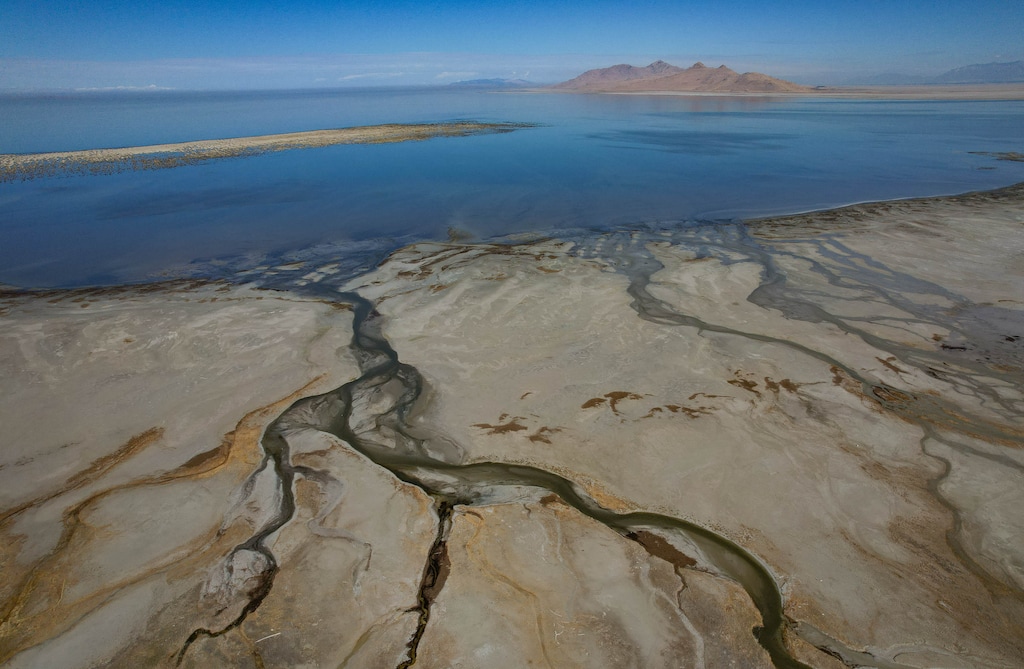
In February, to the great surprise of Utahns and environmentalists everywhere, Donald Trump posted to Truth Social that he will make the Great Salt Lake “great again.” After years of inaction from local politicians — including an explicit moratorium on Great Salt Lake legislation in 2025 — Trump’s post catapulted Great Salt Lake back into the national spotlight.
So far, political leaders, conservationists and mainstream media have largely treated Trump’s announcement as hopeful and heroic — an inspiring example of bipartisan collaboration to solve what he calls a “real environmental problem.”
Shortly after Trump’s post, a prominent conservation organization penned a fawning op-ed in the Deseret News with Republican politicians and billionaires that called on Utahns’ to show solidarity and support for the president. “This is what leadership looks like,” they wrote. “This is how government should work.”
Days later, the state Legislature codified their “praise” for Trump in a concurrent resolution that passed both chambers with only two nay votes.
Some environmentalists have adopted Trump’s slogan to “Make Great Salt Lake Great Again,” and some media outlets have even described him as an ally in the movement.
We have spent years organizing to save Great Salt Lake. We’ve joined hands with community members and organizations to build a movement that fights for the lake and the people who depend on it. We intimately understand the importance and urgency of saving the Great Salt Lake, but how we do so matters.
If we get it wrong, we won’t just lose the lake — we’ll lose everything that made it worth saving.
Last month, Trump included a $1 billion request for the Great Salt Lake in his budget proposal to Congress. In the same proposal, he requested $1.5 trillion to wage war abroad and $10 billion to ramp up ICE detentions at home, which will be paid for by hundreds of billions of dollars in cuts to vital healthcare, food assistance, education, housing, childcare and environmental programs.
When a leader who shows such blatant disregard for human life and dignity says that the people of Utah "deserve to be helped" and his allies call the Great Salt Lake a priority of the "MAGA right," we have a responsibility to ask — why?
This is not the first time a far-right political party has claimed concern for the environment. In fact, fascist regimes have a long tradition of co-opting and weaponizing environmental concerns to further their white-nationalist agendas and to justify the use of authoritarian tactics against marginalized communities.
In Germany, for example, the Nazi party championed clean energy, created nature reserves and institutionalized organic farming — not out of genuine concern for the people or the land, but rather to recruit conservationists and establish an ideological link between racial and environmental purity. This link was fundamental to the expansionist and genocidal politics of World War II, and rationalized the mass murder of Jewish people who Nazis blamed for overcrowding and polluting the Aryan “homeland.”
While it is far easier to analyze historical eco-fascism than to recognize it as it unfolds in real time, we cannot ignore that Utah is emerging as a focal point for the administration’s broader efforts to forcibly detain and remove populations it deems undesirable. Plans are currently underway for a massive homeless “mega-shelter” where advocates warn that up to 1,300 residents could be involuntarily committed and potentially compelled to work. Meanwhile, just weeks after Trump’s Great Salt Lake announcement, ICE purchased a warehouse in Salt Lake City and announced plans to convert it into a detention center capable of holding 7,500 people.
Utah is ground zero for an authoritarian project that cannot succeed without widespread collaboration, and securing complicity through both coercion and incentive follows a classic fascist playbook.
Many institutions, including higher education and mainstream media, have already been intimidated into relinquishing their power to Trump, and now we are seeing the early warning signs of an environmental movement that is willing to exchange silence (and even praise) for a $1 billion payday.
As national attention turns to Utah, we face a critical question that could shape the future of environmentalism: How do we restore the lake without sacrificing the movement itself?
We must find the answer to this question together, and we must do so with the clarity that our solidarity is not for sale.
(Maria Archibald) Maria Archibald is an organizer with the Sierra Club Utah Chapter who lives in Salt Lake City.
Maria Archibald is an organizer with the Sierra Club Utah Chapter who lives in Salt Lake City.
(Autumn Featherstone) Autumn Featherstone is an organizer with UYES who lives in South Jordan.
Autumn Featherstone is an organizer with UYES who lives in South Jordan.
The Salt Lake Tribune is committed to creating a space where Utahns can share ideas, perspectives and solutions that move our state forward. We rely on your insight to do this. Find out how to share your opinion here, and email us at voices@sltrib.com.