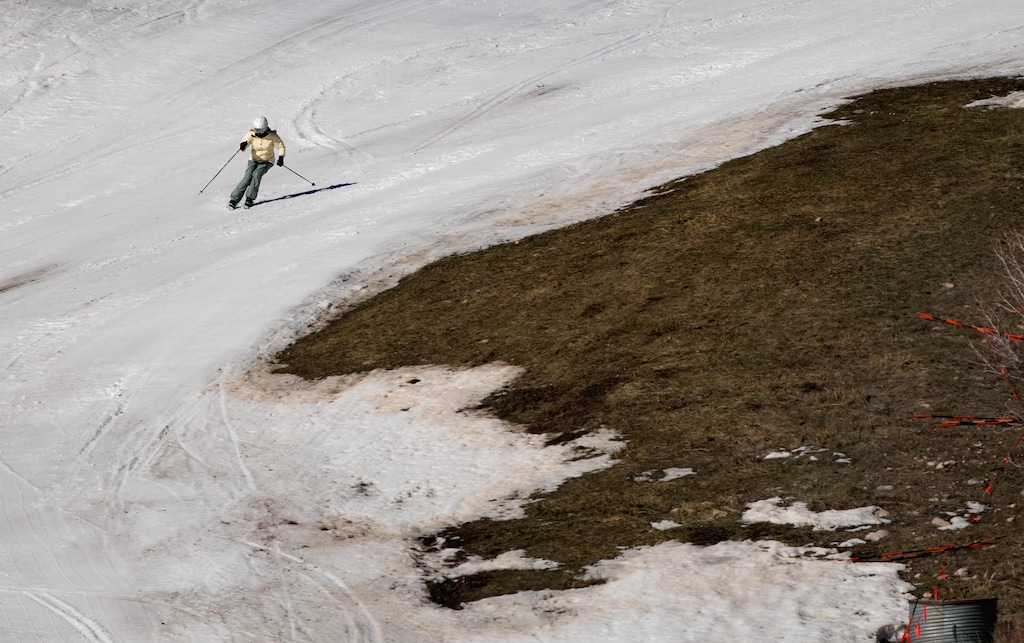
Like a lot of people who’ve grown up skiing in Utah, I don’t take our winters for granted. This place shaped my career, my lifestyle and who I am. Now, as a dad, I want my kids to fall in love with skiing, and to experience the mountains the way our family always has.
Lately, though, heading to the mountain doesn’t look or feel the same — and not in a good way. I know what healthy winters look like. And what we’re seeing isn’t it.
We know what’s driving it. The climate is warming faster than expected. And a big reason is right in front of us: We’re still relying on fossil fuels at a massive scale, especially coal, one of the dirtiest energy sources we have. Here in Utah, that includes millions of tons burned every year at plants like Hunter and Huntington, operated by Rocky Mountain Power.
With renewable energy often being the cheapest option and with Utah sitting on incredible solar and geothermal potential, you would think that we’d be moving toward cleaner solutions. That would be the logical move, both economically and environmentally.
So the question becomes: Why are we still heading backward to more coal and gas when we know where we need to go?
A lot of it comes down to decisions most people never see. Rocky Mountain Power, owned by PacifiCorp, is the state’s monopoly utility. Every couple of years, they put forward a long-term plan that basically maps out Utah’s energy future — what we’ll use, what we’ll build and whether we transition toward cleaner, forward-looking energy or stay tied to outdated sources.
Rocky Mountain Power just filed its updated energy plan, and it takes us backwards, doubling down on old, polluting fossil fuel energy sources while leaving out new renewable energy … for the next 20 years. No meaningful additions of wind, solar or storage in Utah, or the jobs those industries create, for two decades. Instead, it leans further into coal and gas, locking in more emissions at a time when we need to be cutting them.
Then there’s the Utah Public Service Commission, a three-person body that reviews those plans. They’re supposed to ask the hard questions: Is this the best option? Is it cost-effective? Does it reflect where energy is going, not where it’s been?
The good news is, this plan isn’t a done deal. The Utah Public Service Commission still has the authority to accept it, reject it or require changes. That decision is expected in the coming months, and it will shape the direction of Utah’s energy future in a very real way.
Right now, there’s an open proceeding on Rocky Mountain Power’s long-term plan, and anyone can weigh in by emailing psc@utah.gov. If you care about winters in Utah — if you ski, work in the industry, want cleaner air, or just want your kids to experience winter the way you did — it’s worth joining me and speaking up.
This isn’t just about energy policy, it’s about whether future generations get to experience Utah the way we have. And that’s something worth protecting.
Over the holidays this year, when our mountains should’ve been coated in white, most of the state got rain. Rain in the middle of winter across elevations where you’d expect consistent snowfall. That’s not something I ever thought would feel normal in one of the busiest times of the year for our mountains. And it’s not just locals who notice, people who plan trips months in advance, who fuel Utah’s winter economy, are asking: “Is there going to be snow when we get there?”
That question matters more than people realize. Snow sports are a cornerstone of Utah’s economy, generating about $2.5 billion in annual skier and snowboarder spending, contributing more than $340 million in state and local tax revenue, and supporting roughly 31,800 jobs across the state. When winters are strong, that means thriving small businesses, full hotels, bustling resorts and stable jobs. When they’re not, the impact is immediate and it puts a huge part of Utah’s economy at risk.
There’s a bigger picture here, too. Utah is set to host the Winter Olympics again in 2034, but that doesn’t guarantee there will be reliable snow. Former Salt Lake Mayor Rocky Anderson has publicly questioned whether future conditions will support the 2034 Games as we know them. Research backs that up. A study from Dr. Daniel Scott shows that under high-emissions scenarios more than half of the former winter Olympic host regions could lack sufficiently reliable natural snow and cold conditions for elite snow sports by 2080. And that likely includes Utah.
From a skier’s perspective, and as a dad, that’s hard to wrap your head around. My kids are just getting started. If this plan is adopted, renewable energy won’t even have a shot at making up an impactful share of Utah’s energy mix again until they’ve graduated college. Think about that for a second.
After one of Utah’s warmest and driest winters on record, we’re being told to wait 20 years to move forward? That’s extremely out of touch with what we are all experiencing on the ground.
Clean, renewable energy can’t be an afterthought or something we revisit decades from now; it has to be a leading part of the energy mix today. The economics are there. The technology is there. And the stakes couldn’t be clearer.
(Steven Nyman) Steven Nyman is a former Olympian, alpine skier and father who is part of the Protect Our Winters Athlete Alliance.
Steven Nyman is a former Olympian, alpine skier and father who is part of the Protect Our Winters Athlete Alliance.
The Salt Lake Tribune is committed to creating a space where Utahns can share ideas, perspectives and solutions that move our state forward. We rely on your insight to do this. Find out how to share your opinion here, and email us at voices@sltrib.com.