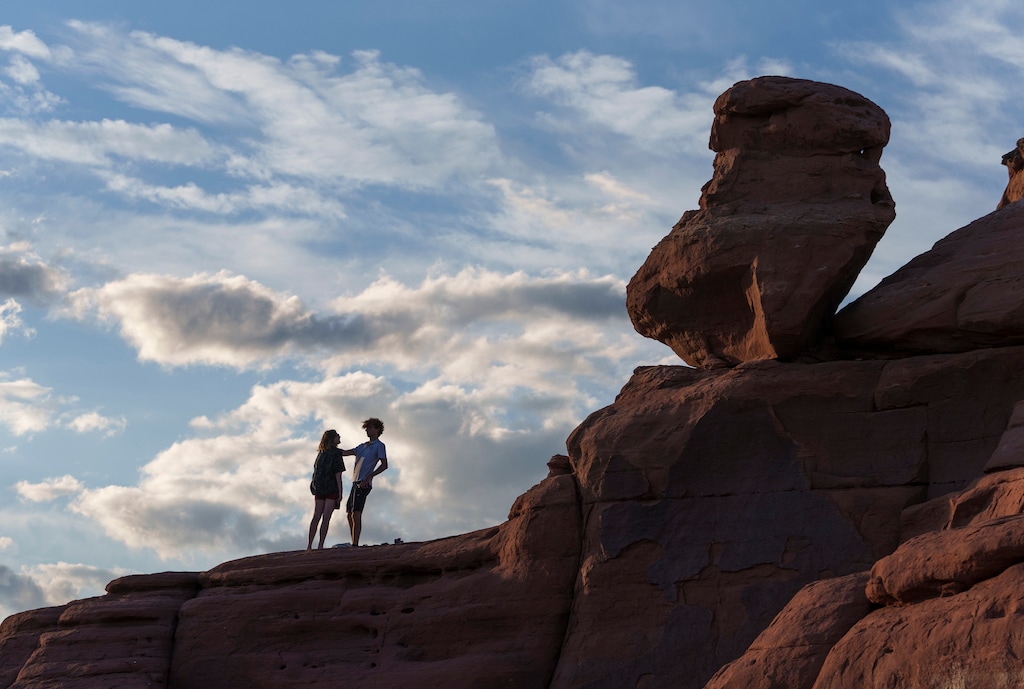
Arches National Park still holds a 4.8-star rating on TripAdvisor — for now. But warning signs are emerging. Moab’s growing reputation for overcrowding and rising costs poses a real risk to the region’s long-term economic health.
The Grand County Commission — supported by the Governor’s Public Lands Office, Utah’s congressional representatives and the Trump administration — has worked together to eliminate the Arches timed-entry reservation system.
My last eight years (1991–1999) of a 30-year NPS career were spent as the NPS superintendent for the Southeast Utah Group of Parks, including Arches, Canyonlands, Natural Bridges and Hovenweep. We worked constantly to address burgeoning visitation to the parks, especially Arches. During that time and subsequently, the park paved the road to the Delicate Arch Trailhead at Wolfe Ranch, constructed hardened trails in high-use areas, significantly increased available parking and built a new visitor center.
I later had to deal with this same issue of overcrowding when I went to Texas for 11 years as the state park director.
Reservation systems for parks and park facilities are being implemented in park systems and outdoor destinations all over the country. Visitors want to go to these places, but most realize they cannot all fit at the same time and are used to making reservations to ensure they can complete their planned trips.
More fundamentally, transportation alone cannot resolve overcrowding. Regardless of how visitors arrive, excessive numbers in concentrated areas reduce safety, enjoyment and the overall experience. In addition, the Utah Department of Transportation and the Utah Highway Patrol retain authority over highway operations, and any closures of the Arches entrance road would be based on safety considerations, often due to waiting lines extending onto the highway.
Meanwhile, the conservative majority on the Grand County Commission, influenced by the views of a relatively small but vocal group of residents, has decided that reservations suppress economic growth. This perspective tends to oversimplify visitation trends during the pandemic era and does not fully account for broader economic forces shaping tourism. It also gives less weight to input from business owners, park management professionals and formal research efforts. In addition, the Grand County Commission recently delayed the publication of a $60,000 study conducted by the Kem C. Gardner Institute. Without access to its findings, it is difficult to evaluate how — or whether — it supports current policy decisions.
The commission’s approach appears to rest on two primary assumptions: first, that Arches faces a simple transportation problem rather than an overcrowding problem; and second, that funding is available for various solutions, but park management has simply been “unwilling” to use it. This assertion overlooks a fundamental reality: Public lands have been chronically underfunded for years.
Reservation systems are working well at Rocky Mountain National Park and at a growing number of destinations around the world whose economies depend on well-managed visitation. As outdoor recreation continues to grow, Moab faces increasing competition from other Western communities that are actively investing in visitor experiences. To remain competitive, Moab must adopt best practices across the board, paired with strategic infrastructure investments to spread visitation and increase capacity.
Grand County possesses exceptional natural assets and the potential to build a resilient, high-performing recreation economy — one that supports residents and strengthens community well-being. To realize that potential requires leadership that understands the complexity of visitor management and the value of evidence-based decision-making. Oversimplified narratives and the dismissal of expert guidance risk undermining that effort.
Fortunately, the Moab Tourism Advisory Board is taking a different approach. Guided by professional branding consultants, they are embracing visitor-centric strategies proven to increase both customer satisfaction and economic resilience. Families with young children can be directed toward Sand Dune Arch or dinosaur track sites; older visitors can enjoy short hikes or scenic overlooks; and experienced adventurers can pursue world-class climbing, biking and OHV opportunities.
This tailored approach encourages longer stays and repeat visitation — boosting economic stability while easing pressure on overcrowded locations. It stands in stark contrast to the “cram-everyone-into-the-park” mentality, which fosters competition among visitors, may lead to single-night stays, and does little to inspire return visits.
The coming year will be critical in shaping Moab’s reputation, despite significant investments in tourism marketing. If the visitor experience at Arches declines, it will reinforce perceptions of overcrowding and reduce the area’s appeal.
The path forward is clear: Incorporate expert input, invest in public lands and apply proven management tools. These steps are essential not only to preserve the visitor experience, but also to sustain the economy and community that depend on it.
(Walt Dabney) Walt Dabney is the retired superintendent of Canyonlands National Park and director of Texas State Parks.
Walt Dabney is the retired superintendent of Canyonlands National Park and director of Texas State Parks.
The Salt Lake Tribune is committed to creating a space where Utahns can share ideas, perspectives and solutions that move our state forward. We rely on your insight to do this. Find out how to share your opinion here, and email us at voices@sltrib.com.