 Addy Baird
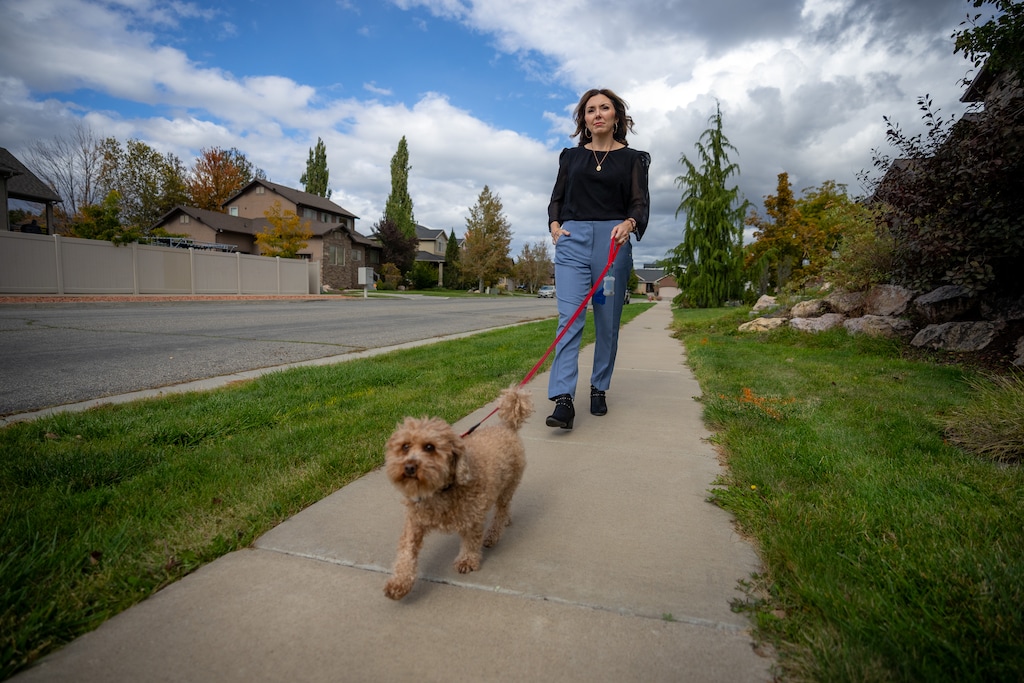
While walking her dog recently in her hometown of Syracuse — just east of the Great Salt Lake — attorney Nancy Sylvester got caught in a windstorm. She woke up the next day to find she’d lost her hearing in one ear.
It seemed like part of a trend: She’s noticed recently that her friends, her children and her neighbors are getting sick more often, she said, and that respiratory illnesses tend to last longer. “It’s a growing concern for me and my family that the Great Salt Lake is drying up,” Sylvester said. “It’s toxic to all of us.”
The windstorm led to a moment of reckoning: “My husband and I kind of looked at each other like, ‘Is Utah gonna work out for us?’”
For now, at least, they plan to stay, but Sylvester — who describes herself as conservative and has usually voted for Republicans — has been reconsidering how she plans to vote.
She’s “seriously considering” voting for a non-GOP candidate, she said, in the newly drawn 2nd Congressional District, where incumbent U.S. Rep. Blake Moore faces Democratic challenger Peter Crosby and three third-party candidates.
“We have to have somebody who’s actually willing to listen to real constituents’ concerns,” she said, “not where the money is coming from.”
(Trent Nelson | The Salt Lake Tribune) Nancy Sylvester in Syracuse on Friday, Oct. 23, 2026.
At least some other traditionally Republican voters in northern Utah seem to be reconsidering as well. A recent poll for the Utah Debate Commission found Moore leading Crosby by five points, closer than expected in a the new district that — in theory — leans more Republican than his current 1st District boundaries.
Claudia Bigler, a Box Elder County resident and Democratic candidate for the state Senate in District 1, said she’s sensed a shift.
When she ran for the state House two years ago, she said, she felt like no one in the county wanted to talk to a Democrat. But recently, she staffed the Democratic party booth at Brigham City Peach Days.
“[I was] in a booth at Peach Days for two days and listening to people as they walked by and having people come up and say, ‘How can I get involved? I want to do more,’” Bigler said in an interview.
“We had all the literature about data centers, about the Democratic Party,” she said, “and … I didn’t feel quite as much on the outside as I had two years ago.”
‘It does beg some questions’
Utah State University social sciences professor Damon Cann — who previously served as the mayor of North Logan and was a founding member of the Debate Commission — cautioned that the commission’s polling offers an early snapshot of support for the purposes of debate eligibility.
It found Moore leading Crosby by 39% to 34%; while Independent American candidate Carlton Bowen garnered 4.1% support. Libertarian Daniel Cottam and unaffiliated candidate Robert Moesinger both earned 4.9% support among those polled.
While the poll is not necessarily predictive, Cann said, “it does beg some questions.” The nearly 15% of voters who supported a candidate other than Crosby or Moore was significantly higher than nontraditional candidates have historically received in Utah elections.
“Whether this election turns out to have substantial third party support or not is one thing that I think we’ll want to be watching on Election Day,” Cann said.
It’s possible that Crosby may outperform expectations, he added. There’s evidence that at least some Utah Republicans are “expressing fatigue” with President Donald Trump, Cann said — and this may in part be why there is more support for third party and unaffiliated candidates.
Additionally, the professor said, he’s been impressed with Crosby’s ground game.
“He’s been campaigning very aggressively,” Cann said. “He’s been spending a lot of time meeting with people, holding town halls, knocking on doors and really putting in a level of effort that we don’t normally see from Democratic candidates in Republican-leaning districts in Utah.”
Crosby himself is cautious.
“I think the new [2nd Congressional District] is definitely the most interesting of the existing congressional races,” he said in an interview. But, he said of his chances, “I would still say that we’re probably one in five.”
(Eli Lucero | Pool) Candidates for UtahÕs 2nd Congressional District, Democrat Peter Crosby, left, and Republican Blake Moore participate in a debate at Utah State University, Tuesday, Oct.13, 2026, in Logan, Utah.
In the redrawing of his district, Moore lost a portion of Salt Lake City, the most Democratic leaning bit of his current district. A Salt Lake Tribune analysis found the new 2nd District is solidly Republican by a measure of 33.5 points, and Moore says his internal polling shows him leading by double digits.
‘Growing appetite for change’
Kimberly Harris Wagner, a resident of Fruit Heights and a constituent of Moore’s, grew up in a strongly Republican household and worked at one time for former U.S. Sen. Orrin Hatch, R-Utah.
She left the Republican Party, she said, when President Donald Trump first ran for office. She felt like something of an outlier until earlier this year, she said, as the furious response to a proposed massive data center campus in Box Elder County collapsed the usual party alliances.
“I think there is a pretty broad consensus that the process with which those [data centers] are being rolled out, or, rather, almost forced upon the public, is not acceptable,” Harris Wagner said in an interview.
The data center plan increased awareness about state politics for many in her community, she said, and she’s seen many residents in the area increasingly paying attention to national politics, too.
“I still think there is a tremendous and growing appetite for change,” she said. “People are recognizing that the status quo is not working for them, and I think that Republicans, some at least, for perhaps the first time in their lives, are saying, ‘Maybe I can support a Democrat.’”
(Trent Nelson | The Salt Lake Tribune) Kimberly Harris Wagner, with Honey, left, and Ginger, in Fruit Heights on Thursday, Oct. 22, 2026.
She’s been holding voter parties at her home and recently hosted a group of women to talk about what’s on their ballots this fall. She’s been trying to spread the word about why she thinks Crosby is a good candidate to represent the area, focusing on his efforts to listen to constituents and his relatively moderate Democratic platform.
“I’m just hoping for this word-of-mouth campaign that might result in a miracle,” she said.
As Sylvester considers her options, she said, she wants to elect someone who is willing to engage with “the constituent who lost her hearing in a windstorm next to the Great Salt Lake, the constituent who has real concerns about government ethics and keeps calling and saying ‘This is all really problematic.’”
As that constituent, she said, she feels like her concerns have “been landing on deaf ears.”
‘It’s a huge frustration’
Crosby said he also sees northern Utah residents as frustrated with the Trump administration, concerned about ethics in government and struggling with rising costs in their day-to-day lives.
“People’s core concerns are affordability and public transparency and accountability in their government,” Crosby said. “They’re worried about corruption, and they’re worried that that corruption is directly making their lives more expensive — and I think they’ve got good cause to feel that way.”
Crosby pointed to the Iran war — which remains unauthorized by Congress — rising gas prices, which are higher in Utah than the national average. He said he’s also hearing concerns about health care and housing costs.
“All of those broader national trends are also felt pretty distinctly here locally,” he said.
Moore largely agrees with his rival’s assessment of Utahns’ concerns. Trump is unpopular among many in Utah, he said, and gas prices in particular are too high.
(Bethany Baker | The Salt Lake Tribune) Congressman Blake Moore speaks during an official closing ceremony for Fort Douglas at the University of Utah, following a historic land swap, in Salt Lake City on Saturday, Aug. 8, 2026.
“My own family feels it,” Moore said in an interview. “Everybody’s feeling it, and it’s a huge frustration, rightfully so.”
The connection to the war in Iran is clear, he added.
Trump’s approval rating in rural Northern Utah is under water, and has fallen significantly over the last year, according to two Noble Predictive Insights polls from last October and this October. Last year, it was 55%. Now, just 39% of people polled in the area approve of the president. (It’s worth noting, however, that the polls’ sample sizes of about 600 voters, further narrowed by focusing on rural Northern Utah, is small.)
At a town hall in Box Elder County in August, many in the crowd groaned when Moore said he doesn’t believe Trump has done anything impeachable.
Moore pointed out to the audience times he has disagreed with Trump, and said in the interview that he doesn’t want voters to conflate him with the president.
“I want to be viewed as the guy that has the support of the president, but also people understand I am willing to push back,” he said.
“From Greenland to overriding a veto to voting against President Trump’s push for a debt ceiling increase without any real spending reform,” he said, “ … There’s some substantive things that I push back on where I don’t agree, and I hope people are paying enough attention to recognize that.”
Crosby said he doesn’t buy this argument, noting that Moore, who serves as the vice chair of the House Republican caucus, is Utah’s only member of congressional leadership.
“He is in Republican House leadership at a time when Republicans control the House and the Senate and the White House and the Supreme Court,” Crosby said. “He should be the one that gets to make decisions about what happens, and if he is making those decisions, we’re certainly not seeing positive effects here in the district.”
‘Uncomfortable with change’
Bob Stevenson, a Republican who recently beat former Utah House Rep. Trevor Lee in the primaries, said he thinks Moore will win handily on election night. Most voters in the area, he said, simply align more with Moore’s politics.
It’s also important, he cautioned, not to underestimate the power of habit — and northern Utah has long voted en masse for Republican candidates.
“We as people really are uncomfortable with change,” Stevenson said in an interview. “Unless somebody is totally convinced that there is a reason to vote for the other person, when it comes time to mark it, they go, ‘Yeah, you know what? I’m just going to squeeze my nose shut, and I’m going to mark the incumbent down.’”
Stevenson also said he’s felt like the general election campaign for Congress has been fairly quiet. He isn’t seeing TV advertising for either candidate, not hearing radio ads and generally not feeling like he’s hearing significant discussion about the congressional race while he’s out campaigning. Instead, he said, people want to talk to him about housing, about water resources, about taxes — not Trump.
Land in the Bar H Ranch in the Hansel valley in Box Elder County, Utah, on Tuesday, June 9, 2026. Kevin O’Leary of “Shark Tank” fame hopes to build a sprawling data center on the parched shores of the Great Salt Lake. It has become a burning issue in Utah’s looming primaries. (Kim Raff/The New York Times)
Recently, The New York Times chronicled the frustration some U.S. farmers are feeling with Trump — but voting for Democrats, many said, is a bridge too far. Instead, some told The Times, they just plan to stay home.
Stevenson said that’s not something he sees happening in northern Utah. Voters understand, he said, how hard it is to get things done on the federal level, and they won’t blame Moore.
But Cann, the USU professor, thinks the question of whether residents will vote is the key to the congressional race.
“I don’t know how to think about politics without thinking of turnout as being an essential component of an election strategy,” he said. “Trump’s strongest supporters … may not be as energized or mobilized to come out and participate — or in some instances may even be frustrated and may not be as likely to come out and participate.”
To the extent that’s true, he said, “it can change outcomes.”
Some Utahns are anxious to draw conclusions about the state’s future from these midterm elections, he said, including the ultimate outcome of the 2nd District race. But he remains cautious.
“I think we’re probably four to eight years out before we’ll have a good sense of how the Republican Party settles,” he said — and, in turn, if Democrats can build real power in Utah.
For now, he added, “The tea leaves are still steeping.”