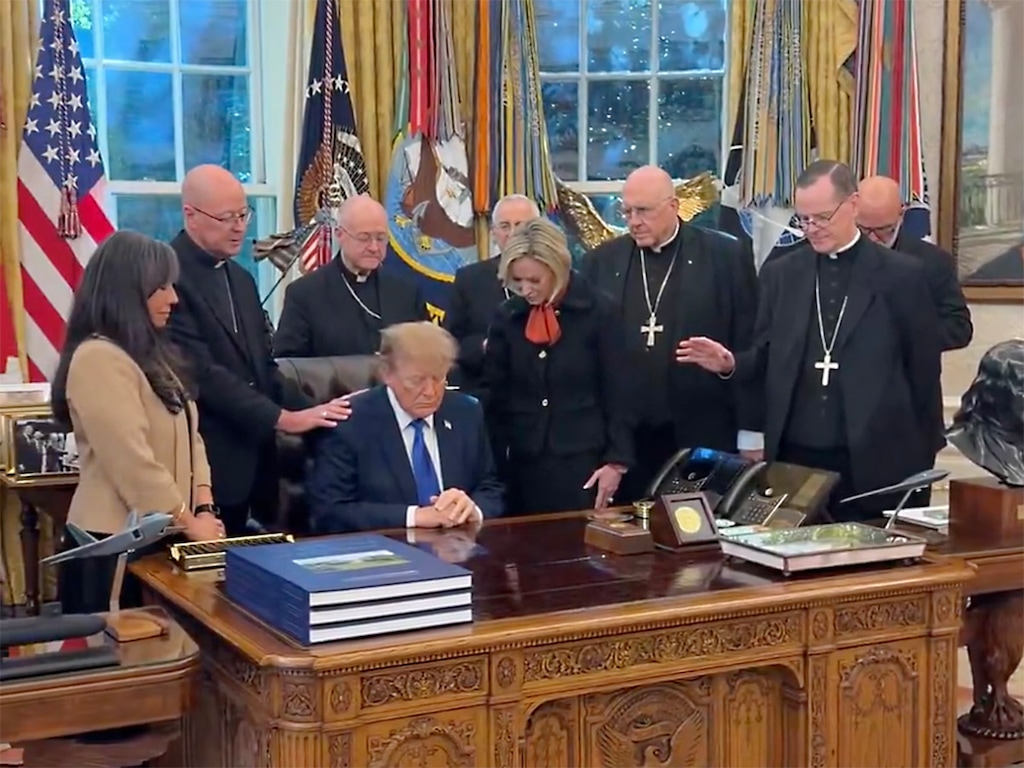
Multiple Catholic bishops who were seen praying over President Donald Trump in a widely shared video last week now say they felt manipulated by White House officials, with one Iowa prelate citing Scripture to compare the experience to being sent as “sheep in the midst of wolves.”
A spokesperson for Archbishop Joseph Naumann, who retired in 2024 as head of the Archdiocese of Kansas City, Kansas, and was seen in the Oct. 22 video, told Religion News Service on Monday, “The bishops were assured that no photographs would be made public. They came to have a discussion on important policy matters.”
The pushback comes in the wake of widespread criticism that emerged after the video was shared on social media by White House staff showing 12 Catholic bishops praying over Trump as he sat in the Oval Office. The prayer — which visually resembled similar instances when the president was prayed over by evangelical pastors who have backed him — was criticized by some as a de facto endorsement of the president and his agenda fewer than two weeks before the midterm elections.
The bishop seen praying in the video, Denver Archbishop James Golka, defended the prayer in an interview with his archdiocesan newspaper, insisting it was not an endorsement and that “there are people intentionally using this moment to sow disunity.” He seemed to blame the media for that disunity, saying, “We’re called to look beyond the headlines, which are often crafted to provoke, towards the full truth.”
“I was being a Catholic priest,” Golka told the Denver Catholic. “We pray for people. We bless people who need blessing. And we all need blessing, every single one of us. That’s what we do.”
But Milwaukee Archbishop Jeffrey Grob struck a different tone in his own statement published on Sunday. In a letter titled “A Public Apology,” Grob said he and other bishops met with White House officials for roughly 90 minutes in a gathering organized by the Heritage Foundation, a leading conservative think tank. A spokesperson for the Heritage Foundation denied to RNS that the group organized the meeting.
After the meeting, Grob wrote, the group of prelates was led into the Oval Office, where they were greeted by the president and “directed to stand behind him and pray.” A video was taken, he said, “unbeknownst to the group of bishops.”
As a result, Grob wrote, he has been beset with a “heavy sadness, not only over the pain I caused, but also for the fact that something so sacred to a group of religious leaders, prayer to our Heavenly Father, would be manipulated in that way.”
He added: “We came in good faith to try to work for the betterment of our fellow human beings, to ease their suffering, to build up the common good, and to pray with a president, not to pose for a political photo opportunity to benefit the few. We should never have been put in that position by the White House. I did not go without reservations. I wish I had heeded them.”
Grob was echoed by Suzanne Hammons, a spokesperson for Gallup, New Mexico, Bishop James Wall, who was also part of the prayer. Hammons told RNS that Grob’s statement “reflects Bishop Wall’s experience,” and that he was unaware a video was taken.
“Most of the day was taken up with talks between the bishops and the administration on things like immigration and matters of human dignity,” Hammons wrote. She added that Wall would accept an invitation from any politician at any time to discuss these kinds of matters and “to pray that they would serve as leaders of integrity, not division and harm.”
The White House did not directly respond to questions about the bishops’ suggestion that they were manipulated by White House staff. Instead, officials sent a statement from White House spokesperson Taylor Rogers, who wrote, “There has never been a greater president for Catholic Americans than President Trump,” citing examples such as the administration’s opposition to gender-affirming care for transgender children and the president’s decision to pardon activists convicted for blockading abortion clinic entrances.
Trump and other members of his administration have repeatedly clashed with Catholics at all levels of the church’s hierarchy — including the late Pope Francis and Pope Leo XIV — over myriad issues, particularly the president’s immigration policies.
Naumann’s office told RNS the meeting lasted for three hours and included Jennifer Korn, director of the White House Faith Office; Paula White-Cain, a senior adviser to Trump; and Vince Haley, director of the White House Domestic Policy Council. Among the topics discussed, according to the bishops who were present, were immigration enforcement, religious worker visas, exploitation of poor people, stricter regulation of abortion medication, concerns about in vitro fertilization, the promotion of reproductive medicine that addresses root causes of infertility, protecting children from pornography, federal tax credits for private education and religious freedom.
Naumann’s office wrote that the archbishop appreciated “the generous time and attentiveness the staff gave to the bishops’ concerns.” The office indicated that Naumann challenged the president on some policy issues. “While commending the administration’s intent to help couples struggling with infertility, he stressed that IVF involves the destruction or freezing of countless human embryos,” the office wrote, saying the archbishop advocated for increased support for an approach that treats the underlying root causes of infertility.
Current Kansas City, Kansas, Archbishop Shawn McKnight issued his own statement alongside Naumann’s: “Archbishop Emeritus Naumann’s attendance at the White House on October 22 was in his own individual capacity. His actions and presence at that event were not on behalf of, or representative of, myself or the Archdiocese of Kansas City in Kansas.”
Des Moines, Iowa, Bishop William Joensen, who was also present for the prayer, published a statement on the gathering. Joensen argued that there “are many things tied to this present administration that are blatantly at odds with our Catholic faith” and seconded others in noting that their visit was never meant to be an endorsement of “any political party or any individual candidate.”
The Iowa bishop then cited a passage of Scripture.
“That said, in retrospect, I would have done well to be more mindful of Jesus’ admonition: ‘Behold, I am sending you like sheep in the midst of wolves; so be shrewd as serpents and simple as doves,’ (Matthew 10:16),” Joensen wrote. “I wish I had been more shrewd and less simple, like those who exploited our meeting for partisan political purposes.”
Diocesan communications officials for the other bishops present, including Dallas Bishop Edward Burns; Birmingham, Alabama, Bishop Steven Raica; Baker, Oregon, Bishop Thomas Hennen; Oakland, California, Bishop Michael Barber; Rapid City, South Dakota, Bishop Scott Bullock; Bishop Francis Kalabat of the Chaldean Catholic Eparchy of St. Thomas the Apostle in Detroit; and Bishop Elias Zaidan of the Maronite Catholic Eparchy of Our Lady of Lebanon of Los Angeles, did not respond to RNS requests for comment.