 Emily R. Anderson
 Robert Gehrke
A federal judge Friday tossed out a monthslong effort by President Donald Trump’s Justice Department to obtain Utah’s entire, unredacted voter database — for now.
In his ruling dismissing the lawsuit against Utah elections chief Lt. Gov. Deidre Henderson, Judge David Barlow said the Civil Rights Act does not make the federal government entitled to all of Utah’s election records, contrary to the DOJ’s arguments.
Utah’s voter database is “not a record or paper which ‘comes into [the Utah Lieutenant Governor’s] possession,’ so she need not make it ‘available for inspection, reproduction, or copying’ by the Attorney General under Title III [of the Civil Rights Act],” Barlow wrote.
The DOJ will likely appeal the ruling.
It filed the lawsuit earlier this year after Henderson rejected a request to hand over the entire voter database. Doing so, she has contended, would violate state privacy laws.
The database contains voters’ sensitive personal information, including addresses, birth dates and the last four digits of their Social Security numbers.
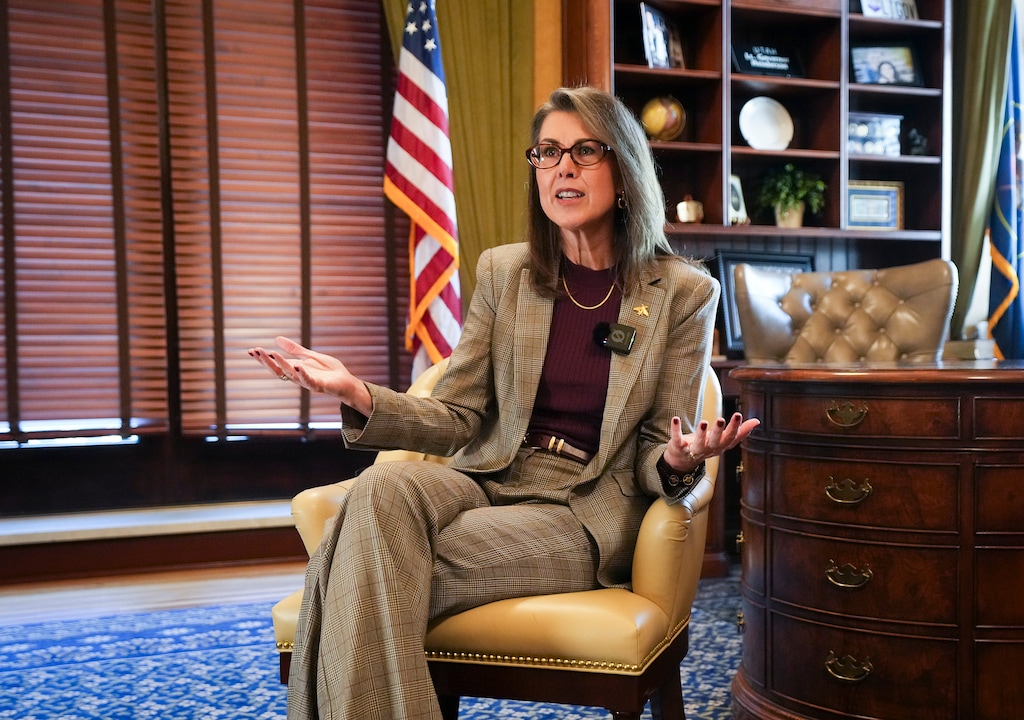
“We appreciate Judge Barlow’s ruling dismissing the Department of Justice’s lawsuit that sought to force us to disclose the private data of every Utah voter,” Henderson said in a statement to The Salt Lake Tribune. “Our office will continue to uphold the rule of law and safeguard the fundamental right to free, fair, and secure elections for the people of Utah.”
Last month, the DOJ disclosed in a letter to Henderson that she was under investigation for her refusal to share that data.
Some Utah officials, including Gov. Spencer Cox and U.S. Rep. Blake Moore, have criticized such an investigation, with the latter saying it has “the potential to set a dangerous precedent of overreach to obtain unnecessary private information.” Henderson, Cox and Moore are all Republicans.
A spokesperson for the department told The New York Times that it sent similar letters to “the states we are in active litigation against regarding their failure to provide the full” statewide registered voter list.
The federal government has sued 30 states, plus Washington, D.C., seeking their voter databases. The case against Utah is the 27th to be dismissed by a district court.
Trump’s DOJ has appealed most of those losses. The one appellate court to reach a decision so far upheld the district court’s rejection of the case.
The nationwide effort to collect voter data is led by the department’s civil rights division. It argues that a portion of the Civil Rights Act of 1960 barring destruction of “all records and papers which come into [an election official’s] possession relating to any application, registration, payment of poll tax or other act requisite to voting” allows the federal government to compel states to share their voter rolls.
Representing Henderson, the Utah Attorney General’s office argued that Utah’s voter database is not a record that has come into the lieutenant governor’s possession, but one that her office has compiled, so the Civil Rights Act does not justify the demand.
Barlow agreed with Utah’s reasoning. Addressing the DOJ’s claim that the state’s interpretation of the act would “undermine the CRA’s purpose,” Barlow said if the court considered the legislative purpose of the Civil Rights Act, the department’s claim “would not grow stronger.”
“If congressional purpose were the decisional lens,” Barlow wrote, “it is clear enough that Title III [of the Civil Rights Act] was intended to address voter suppression.”
Earlier in the case, Barlow allowed the NAACP — which helped advocate for the 1960 law — to formally intervene in opposition to the DOJ’s case.
The nation’s oldest civil rights organization said in its request to do so that it has a responsibility to help Utahns “register to vote free from fears of intimidation, harassment, or federal intrusion.”
Two days before Barlow’s ruling, the department notified Henderson it will send election monitors to Utah to observe the election next month.
She told reporters that any election monitors must comply with all state laws, and they are not allowed to interfere with anyone attempting to cast ballots. Election Day is Nov. 3.
The Trump administration has sought states’ voter records in an attempt to expand its campaign to crack down on widespread voter fraud, despite no evidence that it exists.
Auditors have repeatedly concluded — including in a review of the June primary — that they “did not observe significant fraud” in Utah’s elections. A recent Legislature-commissioned study by Utah Valley University said the state’s elections are “highly secure.”