 Emily R. Anderson
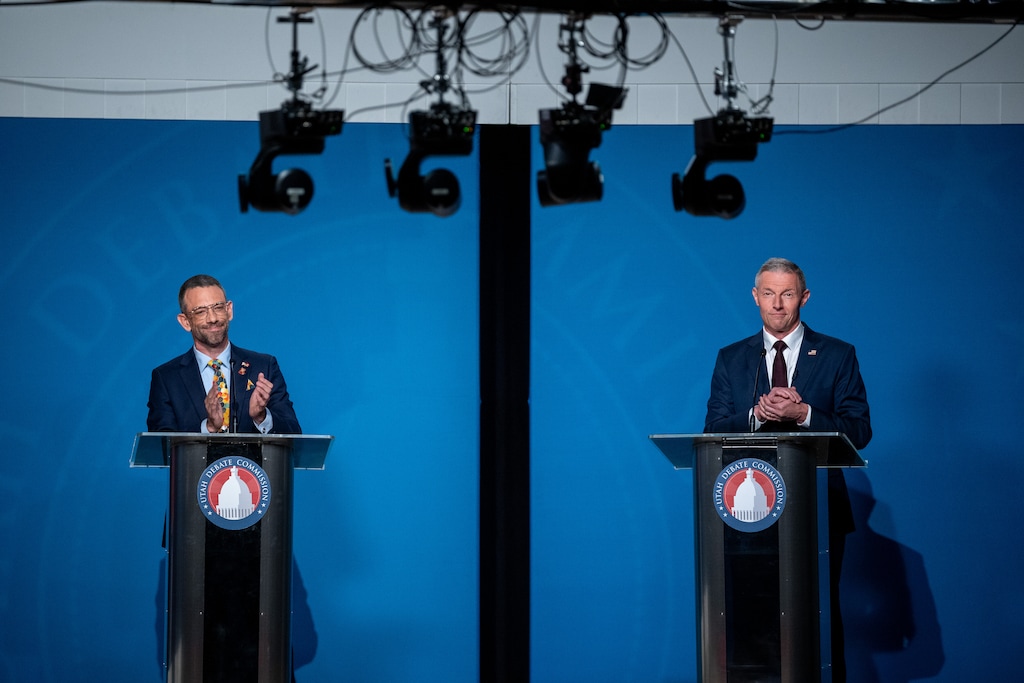
Several months into the Iran war, an incumbent and a combat veteran vying to represent Utah’s new 4th Congressional District clashed Thursday night over the ongoing fight and its impact on voters.
As U.S. Rep. Mike Kennedy, a Republican, and Democratic candidate Jonny Larsen met at Snow College in Ephraim for the only televised debate in the race, they disagreed on a range of issues from public lands to immigration. But when answering the first question on the rising cost of living, both candidates pivoted to Iran.
“What would you do to help bring down gas prices, if anything? Can the federal government do anything?” asked moderator Doug Wilks, executive editor of Deseret News.
“I, along with many others, fill up the tank just like you, and recognize how difficult it is,” Kennedy responded, speaking to voters. “I recognize also the fact that we have an Iranian regime that chants, ‘Death to America,’ on a regular basis.”
The first-term congressman, who previously held a seat in the Utah Legislature and is both a doctor and a lawyer, said he supports President Donald Trump in continuing the war. Instead of ending the conflict, Kennedy said, the U.S. should make it easier to drill for oil and gas domestically.
(Trent Nelson | The Salt Lake Tribune) Candidate for Utah’s 4th Congressional District Republican Mike Kennedy participates in a debate with Democrat Jonny Larsen at Snow College in Ephraim on Thursday, Oct. 8, 2026.
The House of Representatives has passed multiple nonbinding resolutions urging the White House to end the war. Kennedy has voted “nay” each time.
Tying “the president’s hands in the middle of a national security crisis is not the right thing for us to do,” Kennedy said, adding, “I believe this war will be resolved in a quick fashion after this election. Right now, Iran is playing with our politics.”
Larsen, who is a U.S. Marine Corps combat veteran, said Kennedy taking that position as the war continues without congressional approval amounted to Kennedy giving his “constitutional duty up.”
“We absolutely need to end this illegal war to bring order back so that the price of a barrel comes down,” Larsen said.
Thursday’s event was the third of four debates — one for each congressional district — scheduled by the Utah Debate Commission. Candidates in the 2nd Congressional District will debate Tuesday at Utah State University. The election is Nov. 3.
People and land
The two candidates also talked about healthcare costs — a topic they each tied to their personal lives.
Larsen, a cancer survivor, described how he relied on the Department of Veterans Affairs to cover the costs of his treatments.
“The VA healthcare system may not be perfect, but I’ll tell you what — it’s better than what most everyone else has right now,” Larsen said, continuing, “I know it’s something that we can bring to every American to make sure that they have the same kind of healthcare at a lower cost.”
Kennedy said he sees the high cost of U.S. healthcare as a result of the Affordable Care Act, a bill that he described as “written by insurance companies for insurance companies.”
As a doctor, Kennedy said, he believes the increasing costs can be solved with pricing transparency and more access to telehealth and primary care doctors.
The sizes of Bears Ears and Grand Staircase-Escalante national monuments in Utah have oscillated from administration to administration. Both candidates said presidents are abusing their power.
But as Larsen urged continued conservation of federal lands, Kennedy called for more local control.
“I love our public lands. I’ve walked those trails and I’ve climbed those mountains,” Kennedy said, continuing, “There is an opportunity for us to use those lands in a responsible fashion.”
That use, he argued, would include passing a proposal from Utah Republican Sen. Mike Lee to sell off some of those lands to build housing.
(Trent Nelson | The Salt Lake Tribune) Candidate for Utah’s 4th Congressional District Democrat Jonny Larsen participates in a debate with Republican Mike Kennedy at Snow College in Ephraim on Thursday, Oct. 8, 2026.
Larsen contended the forfeiture of federal land would result in the endangerment of natural and cultural resources through irresponsible mining and drilling. He also pointed to the money rural communities would lose from the federal Payment in Lieu of Taxes program — a point Kennedy scoffed at.
“In the state Legislature, I learned that PILT, P-I-L-T, stands for pennies in lieu of trillions,” Kennedy said. “The reality is, the federal government will never give a sufficient amount of money to these counties.”
On immigration, Kennedy continued to support the Trump administration’s actions.
“I’m proud of President Trump and the current administration for securing our borders such that the criminals, the gangsters, are not coming across our borders,” Kennedy said. “Our citizens are safer.”
Larsen, meanwhile, described ICE raids as “very sinister.”
Both agreed, however, that Congress needs to reform the process for becoming a U.S. citizen to make it easier.
Other candidates in the race
This is Kennedy’s first reelection bid since he was elected to represent the 3rd Congressional District. In that 2024 race, he received two-thirds of votes.
But as he scrapped with Larsen, two candidates were absent from the stage. Also running are unaffiliated candidate Steven Burt and libertarian Taylor Wright.
Burt issued multiple news releases protesting his exclusion from the debate, writing, “More and more Utahns are choosing not to affiliate with a political party, and a record share of Americans identify as independent. The Utah Debate Commission should recognize that reality rather than assume that meaningful political competition exists only between the two major parties.”
Using independent polls of voters it commissioned, the debate commission requires that candidates reach a 10% threshold of support to participate.
While Kennedy received 41.7% and Larsen 32.9% in 4th Congressional District polling, Burt and Wright saw 5.7% and 5.3%, respectively. Other respondents indicated they were undecided.
The organization opted under its current rules not to allow candidates who fell within the 4.3% margin of error, such as Burt, as it has in previous years.
In a news release last month, Burt’s campaign urged the commission to include both him and Wright in the televised debate.
“Polling is an imperfect snapshot of public opinion, particularly for candidates running outside the two major parties,” Burt said in a statement. “A debate should be an opportunity for voters to learn about their choices, not simply a reflection of what voters already knew before the debate took place.”
[1st District: Ben McAdams, Riley Owen focus on high prices, AI policy in first policy clash]
Emily is a statewatch reporter at The Salt Lake Tribune, where she has worked since 2022. She received her master's degree in journalism from Northwestern University. There, she worked on investigative projects for The Washington Post and ProPublica. While writing, she's probably spinning something from her ever-expanding shelf of punk records.