 Emily R. Anderson
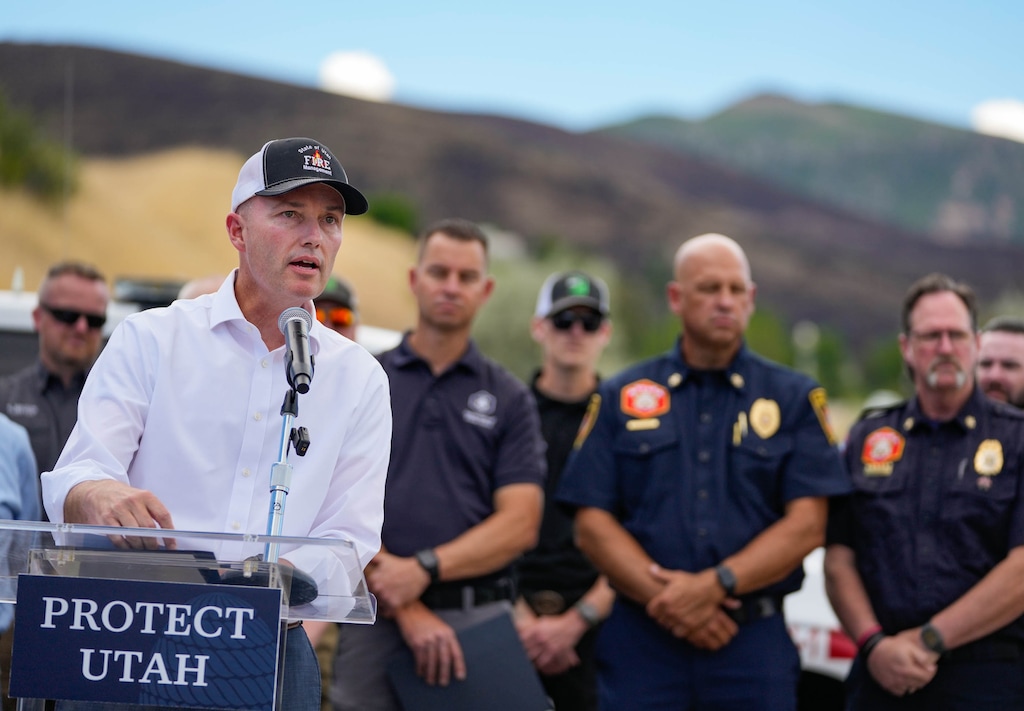
Standing in front of the charred Salt Lake City foothills left behind by the human-caused Bonneville Fire, Utah Gov. Spencer Cox announced Thursday that the state will restrict fireworks statewide over Independence Day weekend.
The executive order grants temporary authority to the state forester to prohibit fireworks from July 2-5, while allowing cities and towns to designate areas where fireworks may be used in consultation with local fire officials.
The order also gives state leaders the leeway to weigh whether additional restrictions should be put in place later next month for the July 24 Pioneer Day holiday.
In typical years, Utahns may only legally ignite fireworks between 11 a.m. and 11 p.m. during the three days surrounding the two July holidays, as well as during two-hour windows on New Year’s Eve and Lunar New Year.
“As I’ve seen these fire officials who aren’t scared of anything, I’ve seen real fear for the first time in my time working with them,” Cox told reporters, with firefighters and city officials standing alongside him. “When people who have dedicated their lives to protecting Utah tell us this year is different, we desperately need to listen.”
Utah Forestry, Fire and State Lands Director Jamie Barnes said at the news conference that the state will move into Stage 2 fire restrictions Friday, meaning no open fires of any kind are allowed on state and private, unincorporated lands.
“Most of the fires we are fighting this year did not have to start,” Barnes said. “We are pushing nearly 80% of human-caused fires. We track ignition causes closely, and we see the same patterns year after year.”
A couple of hundred miles south of Salt Lake City, the Cottonwood Fire outside Beaver has grown to more than double the size of San Francisco proper and is 0% contained. The fire may be the “most destructive” in Utah history in terms of property loss, Cox said at a separate news conference Wednesday.
“I hope that every city will designate a spot where people can come and light off their fireworks and do so safely,” Cox said of the order. “We want the professional shows to go forward — we want people to come together again.”
The extent to which municipalities adhere to the state’s advice will vary from locale to locale, Cameron Diehl, the head of the Utah League of Cities and Towns, said in an interview.
“I think you will see some cities that will follow the state forester’s direction, you’ll have other cities who, working with their fire chief, will say it’s allowed in these areas, and you’ll see a spectrum,” Diehl said, noting he has spoken with mayors and fire chiefs “all day, every day for the last couple of days.”
The Utah Department of Public Safety is instructing law enforcement throughout the state to amplify its efforts to safeguard against violations of the restrictions — especially in areas deemed high-risk.
When fires do start, Public Safety Commissioner Beau Mason said, Utah “will put every resource toward catching and screening charges against those individuals responsible.”
“It’s just not worth it,” Mason continued. “You can be held criminally liable, you can be held financially liable, and parents — you can be held liable for the actions of your children."
‘This is not just big government’
Under laws passed by state lawmakers limiting firework prohibitions, Thursday’s executive order is one of the most severe fireworks-related actions Cox has the authority to take.
“The state forester may not restrict or prohibit the discharge of fireworks within the municipal boundaries of a city, town, or metro township,” a bill introduced in 2018 by longtime Rep. James Dunnigan, R-Taylorsville, and signed by former Gov. Gary Herbert reads.
(Francisco Kjolseth | The Salt Lake Tribune) The burn scar from the Bonneville Fire is pictured behind fire captains as state public safety and fire officials provide an update in current wildfire conditions across the state on Thursday, June 25, 2026.
Cox’s order temporarily suspends that statute, but state law allows him to do so only for 30 days.
The governor said he spoke with top lawmakers Wednesday and told reporters their response to his planned order was “generally very supportive.”
“Now, there are some legislators that disagree with this. ... They don’t want any restrictions anywhere,” Cox added, continuing, “I would not do this if it wasn’t the worst possible situation that we’ve ever seen. And to anybody who pushes back on that, all I can say is, go out to one of these fires and talk to one of these firefighters, look them in the eye, and then come back and talk to me.”
The cost of fighting and recovering from fires is expensive, but Cox said the state will be able to cover that cost by dipping into a $121 million fund set aside “to prepare for the worst year.”
Utah leaders will assess what needs to be done to rebuild that fund at the end of the fire season.
Diehl said some municipalities have previously expressed frustration that state law is not clear enough on the extent to which cities and towns can restrict fireworks. But amid the more than 350 wildfires that have raged in Utah this season, even the largest local governments are feeling their resources stretched.
Gesturing to the mountain behind him, Cox said it was “a miracle” the Bonneville Fire did not damage the University of Utah’s massive hospital campus.
“Thankfully, we had a line of firefighters who could do that,” Cox said. “The problem is we don’t have that now with these other fires burning across the state.”
As a half-dozen larger wildfires burn throughout Utah, Cox said fire departments from all over the state have had to transport portions of their crews to help. That meant those cities saw their own firefighting force depleted.
“So, if on July 3, 4 or 5 we have multiple starts in this valley, we’re screwed, OK? That’s it — nobody to respond,“ Cox said. ”This is not just big government, this is like life or death stuff.”