Mark Mackiewicz has been voting since he was 18. Now 72, the registered Democrat from Carbon County has never had a problem at the polls — until a letter arrived telling him he may need to prove he’s a citizen before casting his next ballot.
“Every time I vote I have to show my ID anyway,” he said. “What irritates me the most is this was a law that was totally unnecessary.”
Mackiewicz, who was born in Colorado, appears to be one of more than 5,000 Utah voters whose citizenship status could not be confirmed by a recent statewide audit that Lt. Gov. Deidre Henderson’s office conducted.
Unconfirmed voters like Mackiewicz must now present documentation to their county clerk or risk losing eligibility for state and local elections under HB209, a new law passed this year.
A disproportionate share of these flagged voters live in rural counties, where residents face practical obstacles to compliance, like how long it can take to travel to county clerk offices. Carbon County, where Mackiewicz lives, relies heavily on mail-in voting, according to County Clerk Seth Marsing.
(Francisco Kjolseth | The Salt Lake Tribune) Mailed-in ballots speed through a ballot-sorting machine in Salt Lake County.
While Marsing is sympathetic to the frustration of voters like Mackiewicz, he said he supports the effort to verify voter identity.
“I do think it’s great that anyone who’s voting in any election should have shown that they are a citizen,” said Marsing. “There was definitely not an issue [with voter fraud] in the first place — I think the lieutenant governor’s audit showed that very clearly."
What the audit found
The audit found that 99.72% of Utah’s roughly 2.07 million registered voters could be verified as citizens, Henderson’s office announced last month.
Only 27 records were removed on suspicion of being noncitizens, the audit concluded; another 25 were flagged as “probable noncitizens.”
All 52 of those people were given 30 days to provide proof of citizenship. According to the audit, nearly all were lawful permanent residents or individuals who had entered the country legally as children but hadn’t obtained citizenship. Just six were not listed in the Department of Homeland Security’s Systematic Alien Verification for Entitlements database.
“The goal is none, right?” Henderson said in May. “But this aligns pretty well with what other states who have taken this task on have found.”
Henderson’s office could not verify the citizenship status of another 5,007 voters, like Mackiewicz. Officials believe those unconfirmed voters likely registered before the state began requiring a driver license number or the last four digits of a Social Security number, leaving those records without the data needed for cross-verification.
That theory may explain why rural counties with older populations seem to be bearing a disproportionate share.
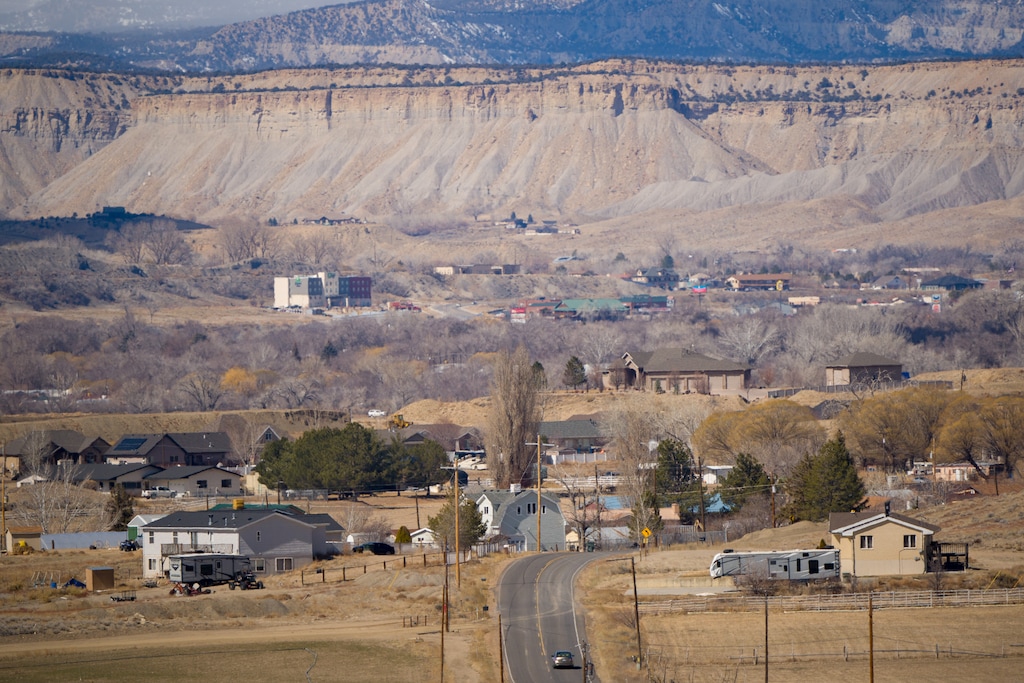
(Trent Nelson | The Salt Lake Tribune) The city of Price, where Mark Mackiewicz lives.
More than 700 of those flagged voters have already updated their registration. Henderson’s office said it plans to work with county clerks after the Tuesday primary to reach anyone who still hasn’t responded before the general election.
Voters like Mackiewicz who do not provide proof of citizenship by then will still be able to vote in federal congressional and presidential races, but HB209 requires proof of citizenship to vote in all other local and state races.
The sponsor of that bill, Rep. Cory Maloy, R-Lehi, previously told The Salt Lake Tribune he is satisfied with how the law is working.
“HB209 does what it is supposed to do — protects eligible voters while enforcing citizenship requirements," Maloy wrote.
Correction, 12:25 p.m. • This story has corrected the spelling of Lt. Gov. Deidre Henderson’s name.