 Megan Banta
Box Elder County • On the road to the proposed Stratos data center project, you will see more cows than people.
From Interstate 15 near Brigham City and Corinne, it takes more than an hour traveling on mostly dirt and gravel roads to get to the edge of the site where Kevin O’Leary intends to build a massive data center campus.
Nearby, the Salt Wells — an area where the developers had applied for but since withdrawn an application for water rights — are a quiet, wide open space where birds flit around grasses and swim in streams, dragonflies dance above springs and water bubbles up from the ground.
Rhonda Lauritzen, whose family owns property nearby for the business her parents founded, describes western Box Elder County as the “mythical American West.”
“It’s wide open spaces, it’s clean air,” she said. “It’s birds and open range, and it’s that kind of open space that you don’t find other places in the world. And once it’s gone, it’s gone forever.”
Lauritzen’s family owns property a handful of miles from the western portion of the data center project area approved by the Utah Military Installation Development Authority in April. The project was initially planned for 40,000 acres, but O’Leary has said he will cut that by roughly half after public backlash.
The family’s property is also within 10 miles of the remaining roughly 20,000 acres on which O’Leary’s company plans to build a hyperscale data center, likely covering about 10,000 acres with buildings.
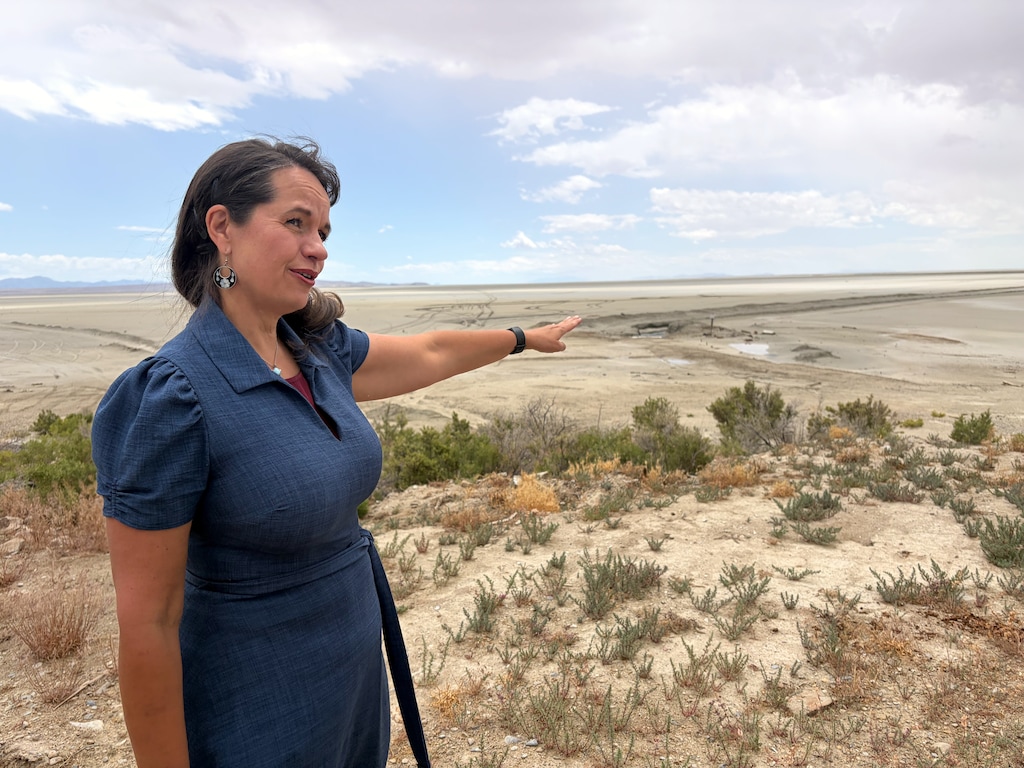
Lauritzen took The Salt Lake Tribune on a tour of western Box Elder County to show parts of the project area as well as the surrounding wetlands and the dried lake bed that abuts those habitats.
Lauritzen is among the local landowners and residents who have spoken out against the proposed data center project through protests, a possible referendum and a lawsuit. For her family, concerns about the development are rooted both in their personal history and in the future of the family business.
(Megan Banta | The Salt Lake Tribune) Sagebrush covers the northern part of the project area for the proposed Stratos data center during a tour of multiple sites in Box Elder County on Tuesday, June 9, 2026.
The family has decades of memories in the area. In the mid-90s, you could hear the shoreline lapping. The family would camp on the beach around their property and swim near Lone Rock, about a mile away. One of her six brothers would kayak out to an island on the lake.
Her father would whistle to the meadowlarks, and they would call back — one of her favorite things.
After decades of decline in Great Salt Lake water levels, their property overlooks a lake bed instead of the lake itself.
(Megan Banta | The Salt Lake Tribune) Lauritzen's family kept extending this canal until it no longer reached the water. The water in it on June 9 was from recent rains.
The water is miles away, and a canal they dug and extended for years no longer reaches it, meaning the family’s company — Mineral Resources International — has to get its brines from elsewhere.
They tried to measure the distance by drone last year, Lauritzen said, and turned it around right at the water line about four miles in when they got an alert the battery was going to die.
The nearby wetlands are under “extreme pressure,” she said, as the aquifer that feeds them is down significantly.
“This is literally an oasis in the high desert, but it’s not unlimited,” she said during a stop at Locomotive Springs.
(Megan Banta | The Salt Lake Tribune) Bar-M Springs, part of Locomotive Springs, is pictured during a tour of multiple sites near or in the project area for the proposed Stratos data center on Tuesday, June 9, 2026.
Mineral Resources is one of the companies that entered into a voluntary agreement with the state to use less of their allowed capacity when the lake is at certain levels below the established healthy line.
Bruce Anderson, the company’s CEO and one of Lauritzen’s brothers, said they estimate they will be able to use 30% of their allotted 125 acre feet – about 40.7 million gallons – next year based on where the lake is likely to be on June 15.
“So yes, when we’re only able to use 30% of our water rights, we have a concern about new development that wants to come in and utilize huge, huge quantities of water rights,” he said.
After some heart-to-heart conversations, Lauritzen said, the family decided that speaking up was part of their duty as property owners in the area.
People in Box Elder County and the state as a whole have also taken up the fight even though they don’t personally own land, she said, because it’s their home in a broader sense.
“They value this land, and they value this way of life,” she said of the mostly agricultural and agrarian community. “It’s not all just about more jobs and more money. We want a place where we want to live.”
That means open spaces to enjoy, she said, and to support birds and other wildlife, as well as hunting, camping, recreation and agriculture.