 Emily Anderson Stern
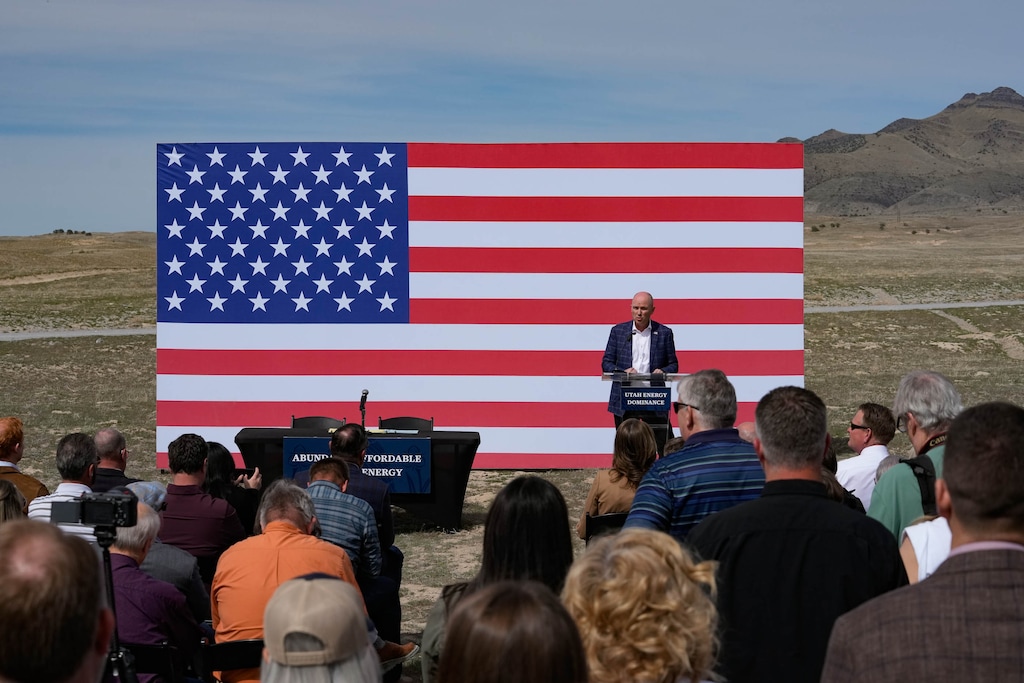
Just over the Lakeside Mountains from the Great Salt Lake, Utah leaders stood before a giant American flag off a dirt road on Friday to announce their strategy to attract a massive nuclear energy hub to the state.
Utah will compete to be the site of a federal nuclear campus in Tooele County, Gov. Spencer Cox said, describing it as a project that could rival the impact of Hill Air Force Base, “supporting tens of thousands of jobs and generating billions of dollars in economic activity for Utahns.”
The plan comes in response to a January call from the U.S. Department of Energy for states to submit their visions for hosting “nuclear lifecycle innovation campuses” and how their state is equipped to welcome one.
“The proposed campuses could support activities across the full nuclear fuel lifecycle, including fuel fabrication, enrichment, reprocessing used nuclear fuel, and disposition of waste,” the announcement said.
And, depending on a state’s “priorities and regional capabilities,” the DOE said, locations could also host “advanced” reactor deployment, power generation and manufacturing, or be co-located with data centers.
Tooele County, Cox said, is “uniquely suited” to host such a campus.
“The geology, the arid climate, existing infrastructure, distance from major population centers and some of the very best people on planet Earth,” he said, “make it one of the most practical locations for this kind of work.”
Several states, led by both Republicans and Democrats, have signaled they are considering entering the competition before the April 1 deadline.
Utah has not finalized its proposal for what it wants to include in a potential campus, Cox said, but he expects the DOE to move quickly after the deadline to select one to three states as sites.
Emy Lesofski, who heads the Utah Office of Energy Development, said the state will likely receive an answer within the next six months.
“I think it’ll be sooner than later,” she told The Salt Lake Tribune. “There’s a sense of urgency to get it right and to get moving on it, because it is so important from a geopolitical perspective.”
(Francisco Kjolseth | The Salt Lake Tribune) Emy Lesofski, Director, Utah Office of Energy Development, talks about plans for a nuclear campus in north central Tooele County, during a ceremonial signing of bills to pursue nuclear development in the state on Friday, March 27, 2026.
The site of the news conference was a dusty Bureau of Land Management grazing allotment in the West Desert, roughly 10 miles from the Great Salt Lake and few miles off of Interstate 80.
The spot was “very close” to the area proposed for the campus, Cox said, which would be located on property owned by the state Trust Lands Administration.
(Francisco Kjolseth | The Salt Lake Tribune) People begin to gather in north central Tooele County for a news event in which Gov. Spencer Cox will join state and local leaders for an announcement related to Utah’s ongoing work to develop long-term strategic opportunities in nuclear energy, on Friday, March 27, 2026.
“If you’re serious about saving the Great Salt Lake,” the governor said, “we have to be serious about how we produce energy. Technologies that use less water directly support the long-term health of the lake.”
Earlier this week, the Tooele County Council passed a resolution declaring its intent “to pursue the development of a nuclear lifecycle innovation campus,” with the support of the four council members who were present.
“We’ve probably exchanged hundreds of emails between us [and state officials], and texts, and everything else just trying to work through the logistics of this,” Tooele County Manager Andy Welch said at the meeting. “We’ve been receiving letters of support from other community partners as well.”
How Utah prepared to compete
Lawmakers passed several bills this year to position the state and make it a more attractive site for a potential campus.
They authorized the Utah Office of Energy Development to pursue a nuclear lifecycle innovation campus and explore development of a nuclear fuel recycling facility in the state.
The Legislature also agreed to spend $1.2 million to establish a Nuclear Energy Regulatory Office meant to streamline licensing for nuclear projects, and gave it the authority to enter cooperative agreements with federal agencies.
And with bipartisan backing they passed a resolution formally expressing Utah’s interest in a nuclear campus.
Cox signed all three pieces of legislation Wednesday, and signed additional copies in a ceremony during the Friday news conference. The aggressive pursuit of nuclear energy development is one focus of his second term, as part of his “Operation Gigawatt” plan to increase Utah’s energy capacity. Last year, his administration put nearly $2 million toward a public relations campaign to get Utahns on board with nuclear development.
The state’s new Nuclear Energy Regulatory Office plans to immediately begin seeking additional oversight authority from the U.S. Nuclear Regulatory Commission, said Ted Sonnenburg, who directs the Utah Division of Waste Management and Radiation Control.
Utah is one of 40 “agreement states” that partner with the federal agency to oversee nuclear materials within their borders.
Utah is still hiring staff for the new office, Sonnenburg said, but its assistant director has an academic background in health physics — the science of protecting people and the environment from radiation. It also has hired a nuclear engineer who has studied how to safely design systems that emit radiation.
‘It’s incredibly safe’
Nuclear fuel has been transported on Utah highways “for decades,” Cox noted. And low-level radioactive waste is regularly delivered to EnergySolutions’ Clive disposal facility, a half-hour drive from where Cox made the announcement.
“The reason you don’t hear about it is that it’s incredibly safe,” Cox told reporters.
“Safety matters, and we want people to understand that we care about safety too — we’re not minimizing those concerns at all," the governor continued. “What we’re doing is we’re taking those concerns and we’re addressing those concerns.”
Lt. Gov. Deidre Henderson led a mission touring nuclear fuel processing and production facilities in the United Kingdom last year, and described seeing “towns, communities, playgrounds right next to” them.
“It just demonstrated to me that the technologies, the advancements that have come are so safe that there are communities throughout the world that love having facilities next to them,” she said.
(Francisco Kjolseth | The Salt Lake Tribune) Gov. Spencer Cox and Lt. Gov. Deidre Henderson speak at a news conference to announce Utah will seek a federal nuclear campus in Tooele County, on Friday, March 27, 2026.
State Sen. Derrin Owens, R-Fountain Green — who stood alongside Cox at the Friday news conference — had floated the possibility of a campus in Millard County in a mass email earlier this year. A handful of local officials pushed back.
“I don’t want it anywhere close to us,” Millard County Commissioner Vicki Lyman told the Millard County Chronicle Progress and The Tribune.
While public opinion on nuclear power has trended upward in recent years, many Utahns retain concerns about whether they will be adequately protected from radiation.
Hundreds of thousands of the state’s residents, known as “downwinders,” were exposed to radioactive fallout as a result of nuclear weapons testing in the 1950s and 1960s, causing cancer and other illnesses.
Millard County was one of seven Utah counties to be included in the original 1990 Radiation Exposure Compensation Act, due to the severity of nuclear fallout health impacts there. The program has since expanded to cover all of Utah.
(Francisco Kjolseth | The Salt Lake Tribune) Gov. Spencer Cox talks about plans to pursue a nuclear campus in north central Tooele County, on Friday, March 27, 2026.
Emily is a statewatch reporter at The Salt Lake Tribune, where she has worked since 2022. She received her master's degree in journalism from Northwestern University. There, she worked on investigative projects for The Washington Post and ProPublica. While writing, she's probably spinning something from her ever-expanding shelf of punk records.