 Robert Gehrke
When the expert hired by the Legislature drew the new congressional districts adopted by lawmakers, he did so on a platform that showed him partisan data as he went.
Attorneys for the plaintiffs opposing lawmakers’ proposed congressional map argue that the use of election results violates Proposition 4 — the 2018 voter-passed initiative that set limits on the redistricting process — and is a primary reason that they want Judge Dianna Gibson to reject the Legislature’s proposal and choose an option they submitted.
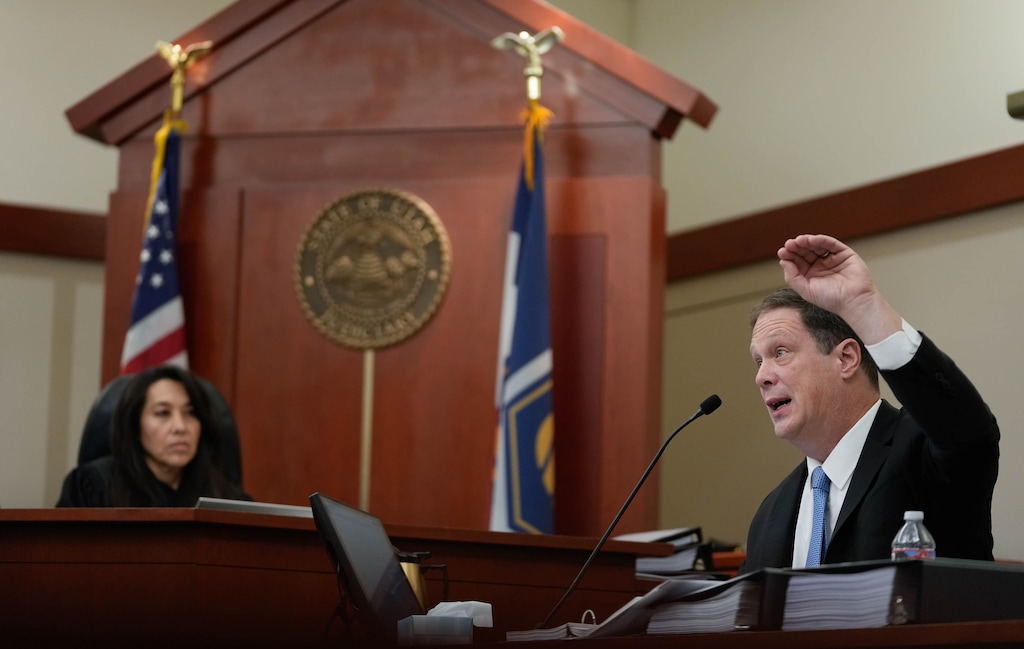
Testifying in court last week, Sean Trende, an elections analyst and redistricting expert hired by the Legislature, said he used Dave’s Redistricting App, a common tool for drawing boundaries, to design the map lawmakers eventually picked.
As he did it, Trende told the court, he had not checked a box that turns off the display of the projected partisan makeup of the districts he was drawing.
Trende dismissed the significance at the time, saying the data displayed was a “worthless composite” of election results going back to 2012 and “it wouldn’t have told me anything.”
But Proposition 4 says that the Legislature and the independent redistricting commission created by the initiative may not consider “partisan political data and information, such as partisan election results, voting records [and] political party affiliation information.”
(Rick Egan | The Salt Lake Tribune) Sen. Scott Sandall, R-Tremonton, defends the Congressional map chosen by the Legislative Redistricting Committee, as Rep. Candice Pierucci, R-Riverton, listens, on Monday, Oct. 6, 2025.
Sen. Scott Sandall, R-Tremonton, the co-chair of the Legislative Redistricting Committee, has said on multiple occasions that maps drawn using partisan information could not be considered. At a committee meeting in September said publicly submitted maps likely could not be adopted unless every person who submitted a map swore they had not considered partisanship in drawing their boundaries.
The attorneys for the plaintiffs — the League of Women Voters, Mormon Women for Ethical Government and several individual voters — contend that the fact that the election data was “displayed prominently on the screen using the very program that Sen. Sandall had considered disqualifying when used by others” violates the prohibition on considering partisan data.
Lawyers for the Legislature argued that the data displayed only consisted of elections from 2012 to 2020 and would not have been informative about the state’s current political landscape.
“It did not (and could not) allow him to draw the map with the purpose to favor any political party,” the legislative attorneys wrote.
Beyond the use of the partisan data, the plaintiffs’ lawyers contend that the map the Legislature adopted is a partisan gerrymander that benefits Republicans and that when the tests prescribed by the Legislature are applied to almost any of the submitted maps, those that have competitive or a Democratic-leaning district will fail while those that ensure four safe Republican seats will pass.
They want Gibson to strike down the criteria the Legislature set to judge the maps and discard the map that Republican lawmakers adopted.
The lawyers for the Legislature say that would be an overreach. They point to the testimony of Trende and two other experts that the legislative map satisfies the standards established in Proposition 4, it is not a partisan gerrymander, and there is no other reasonable justification to not approve the Legislature’s submission.
Actually, the lawmakers’ attorneys argue, the two maps submitted by the plaintiffs are the partisan gerrymanders, drawn to benefit Democrats, and do not comply with the standards in Proposition 4 and the Legislature’s criteria.
Gibson has scheduled a hearing for Nov. 4 to hear arguments from the parties on whether the Legislature’s metrics for judging the maps should be allowed to stand — a critical juncture, since it will determine what standards she applies when judging the competing maps’ compliance with Proposition 4.
The lieutenant governor’s office told Gibson that a map needs to be in place no later than Nov. 10 so county clerks can begin preparing to conduct the 2026 election.
Gibson voided the congressional boundaries that had been in place since 2021, saying they could not be used in the 2026 midterm election. She did so following a ruling by the Utah Supreme Court that the Legislature’s repeal of the 2018 Better Boundaries initiative violated the citizens’ constitutional right to make law through the ballot initiative process.
The process has taken on heightened national significance since Republicans hold a narrow majority in the U.S. House of Representatives, and as red and blue states have begun the process of shoring up congressional districts for their own advantage.
Meantime, the Utah Republican Party has launched an effort to gather enough signatures to block the Legislature’s map — the one that they encouraged members to support — as a protest over what they see as the courts meddling in the Legislature’s policymaking power.
They have also launched a ballot initiative aimed at repealing Proposition 4 in the 2026 election.
Lt. Gov. Deidre Henderson, a Republican whose office oversees state elections, has said the GOP tactics have added even more “chaos and confusion” to an already chaotic process.
Note to readers • This story is available to Salt Lake Tribune subscribers only. Thank you for supporting local journalism.
Robert has spent more than 20 years primarily covering government and politics in Utah and the West, including seven years in Washington, D.C.