 Addy Baird
Every August, Congress recesses and lawmakers head back to their districts. The break has traditionally been a time for town halls, where members gather with constituents to meet face-to-face and answer questions.
But this summer, most of Utah’s federal lawmakers have scheduled no in-person town halls. Instead, members of Congress are increasingly opting for telephone town halls, which allow them to reach wider groups of constituents — but also screen questions and avoid raucous crowds.
As of Thursday afternoon, among Utah’s all-GOP congressional delegation, 3rd District Rep. Mike Kennedy was the only member of Utah’s congressional delegation to host in-person town halls during the recess, having held three between July 29 and 31 in Dutch John, Vernal and Roosevelt. The rest of Utah’s delegates have no in-person town halls listed on their websites or social media, and none have advertised forthcoming in-person town halls on X or Instagram.
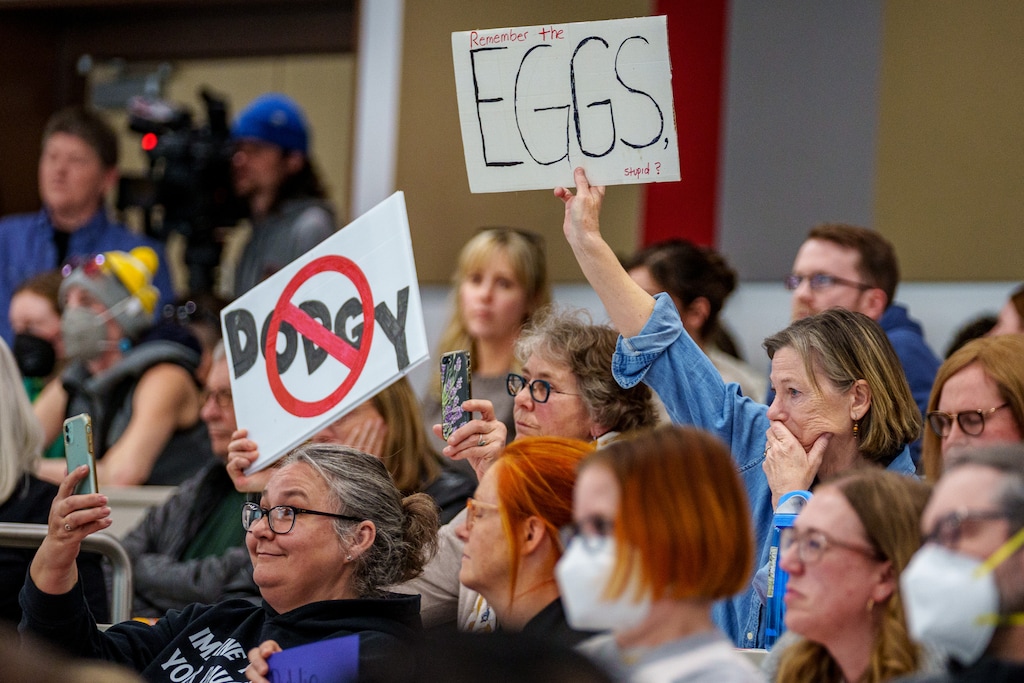
(Trent Nelson | The Salt Lake Tribune) Audience members listen to a joint town hall with U.S. Reps. Celeste Maloy and Mike Kennedy in Salt Lake City on Thursday, March 20, 2025.
A spokesperson for Kennedy, who took office earlier this year said the congressman has done eight in-person town halls so far and one telephone town hall, and that they plan to hold more of both in the future.
“With tele-town halls, we are able to reach a much greater number of constituents,” the spokesperson wrote in an email. “The one we had on July 25th had over 15,000 people in attendance.”
A spokesperson for 2nd District Rep. Celeste Maloy said the congresswoman had two town halls scheduled in August, one telephone town hall held earlier this week, and another set for August 11. The spokesperson did not respond to follow-up questions about whether the August 11 town hall — which the lawmaker is not yet advertising on social media — will be held in person or via phone.
Sen. John Curtis’s office pointed to an op-ed the senator authored and podcast interview he gave about his changing approach to town halls. The senator does not currently have any town halls scheduled for August — but he is trying to reinvent the town hall, aiming for short one-on-one meetings with constituents, rather than large group gatherings.
Spokespeople for 4th District Rep. Burgess Owens and Sen. Mike Lee did not respond to questions about whether they plan to hold any in-person events with constituents over the break or about their approach to town halls, although both have historically run virtual town halls.
Rep. Blake Moore, who represents Utah’s 1st District, said he sees similar benefits to the telephone town halls.
A spokesperson for Moore said in an email Thursday that the lawmaker has held one in-person town hall this year and three tele-town halls, and that the office works to schedule the tele-town halls at various times throughout the day in an effort to reach different groups of constituents.
“The House calendar has been very DC-heavy this year, and tele-town halls allow Congressman Moore to connect with constituents remotely when he is unable to be in the district,” the spokesperson said. “In-person town hall events can be challenging for constituents to attend with family schedules, work conflicts, and location constraints. Tele-town halls can be attended via phone from anywhere, increasing accessibility for all constituents.”
And, she added, the tele-town halls limit disruptions.
“There has been an uptick in protestors at in-person events this year, and attendees who want to have a civil dialogue with the Congressman are often unable to do so because of these disruptions,” she wrote. “The tele-town hall option allows Congressman Moore to address a variety of topics without the potential for disruption that makes attendees uncomfortable.”
GOP leaders say no more in-person town halls
(Trent Nelson | The Salt Lake Tribune) U.S. Reps. Mike Kennedy and Celeste Maloy host a joint town hall in Salt Lake City on Thursday, March 20, 2025.
The shift away from in-person town halls comes after a series of tense in-person events and at the direction of Rep. Richard Hudson, R-NC, who serves as the chair of the National Republican Congressional Committee. In March, Hudson told GOP members to stop holding in-person town halls, according to Politico.
Despite Hudson’s directive, Kennedy and Maloy held an in-person town hall in Salt Lake City in March, where they faced boos and shouting from participants. The event grew so unruly that Kennedy asked police present at the event to begin removing disruptors, although no one actually was.
“There are people who do this as a profession, they’re professional protesters,” House Speaker Mike Johnson told reporters earlier this year, adding that he thought it was “wise” to not “play into that.” Telephone town halls, he said, were a good option for members to hear from their constituents.
The tele-town halls ultimately give lawmakers and their staff more control over the conversation and can prevent unauthorized speakers or questions. But they also, as Kennedy and other lawmakers noted, allow members to speak to much wider swaths of the public.
Moore told The Salt Lake Tribune in April that about 14,000 people had joined his recent telephone town hall (whether all of those people stayed for the full hour, he said, they didn’t know), and Maloy posted on X following a tele-town hall in June that 8,000 people had tuned in.
In both of these cases, according to the numbers reported by lawmakers, each tele-town hall was attended by more Utahns than the in-person event Maloy and Kennedy held in population-dense Salt Lake City earlier this year.
Part of the reason these events draw so many Utahns is that most people who join are getting a call inviting them to listen, not because they purposefully dialed in. With the help of a third-party company, and under the direction of the House Communications Standards Commission, members of Congress can “dial out,” calling constituents directly to bring them into the town hall.
According to a spokesperson for Moore’s office, the vast majority of people who join the tele-town halls receive a call and join that way. Although, they said, “several hundred dial in via the number we share in our newsletter and on social media.”
How many people are called is up to the individual members of Congress, as each call costs money, and the cost for making outgoing calls comes out of the member’s “MRA,” or “member representational allowance,” which each lawmaker receives to fund official duties.
“Per House rules, we cannot reach constituents based on their political party affiliation,” a spokesperson for Moore wrote. “We access constituent data through a platform that houses voter information, excluding party affiliation.”
Should a constituent answer the call, they will hear a recorded message from their congressional representative with information about the town hall, and then can stay on the line to listen to the event. From there, they are directed to press *3 should they like to ask a question and *6 to sign up for the congress member’s newsletter.
Questions are then screened by staffers, who choose which people to send through to the lawmaker. Moore’s spokesperson said the staff worked to call constituents back who didn’t get an answer to their question during the event.
(Rick Egan | The Salt Lake Tribune) Rep. Blake Moore speaks at a town hall meeting at the Weber County Library North Branch, in North Ogden, on Tuesday, June 1, 2021.
Moore, in April, said he tells the staff screening calls to let Utahns ask hard questions.
That same month, he held a telephone town hall where he addressed questions about the illegal deportation of Kilmar Armando Abrego Garcia, tariffs and cost-of-living concerns for Utahns and federal employees, among other issues.
“These are all tough questions,” Moore said, “and I just want people to get a chance to ask them.”
One issue, however, is that an update to Apple devices coming this fall may filter calls and give constituents a chance to decline it. And an update to text message filtering, the National Republican Senatorial Committee said earlier this year, could cost them more than $25 million in text message-based fundraising.
‘Time to reimagine what a town hall could be’
Some constituents still want traditional in-person town halls.
On July 28, progressive group Salt Lake Indivisible posted a flier with Curtis’s face under the banner “MISSING SENATOR” and asked its members to call Curtis’s office and demand an August recess town hall.
In April, the same group held a town hall where they asked people to come share their experiences and concerns about the Trump administration’s education policies and plans. They invited Curtis, who did not attend, and held an empty chair for him.
Asked about the Indivisible event in April, Curtis told reporters, “There’s nobody that’s held more town halls, probably in the history of the country,” before adding, “I’m not sure if that’s true or not, but, you know, hundreds and hundreds of them.”
He had not held one recently, he said, because Majority Leader John Thune had kept senators in Washington Sunday night through Friday night, except two weeks, during which Curtis said he had traveled throughout the state.
“We do tele-town hall meetings,” he said. “We do everything we can.”
But Curtis’s own definition of “town halls” might not match what some of his constituents hope for. In a March editorial following Maloy and Kennedy’s testy town hall in Salt Lake City, Curtis wrote that it was “time to reimagine what a town hall could be.”
“Increasingly, we’ve seen town hall meetings hijacked by a few loud voices determined to dominate the room,” he wrote. “It seems to me they arrive not to ask questions, but to cause a scene. The goal isn’t dialogue; it’s disruption. The result? Those who genuinely came to listen, learn and engage are pushed to the sidelines. And elected officials are left unable to offer thoughtful, fact-based answers to reasonable questions.”
Instead, Curtis said, he has shifted to meeting one-on-one with constituents in five-minute meetings, which, he wrote, he finds more productive and less performative. And, increasingly, he said, he sees his travels around the state as a sort of extended town hall meeting.
“Last week alone, I logged over 1,000 miles across Utah, meeting with school superintendents, business owners, elected officials, students — and yes, even protesters,” he wrote. “In my book, that was a week-long town hall.”
Note to readers • This story is available to Salt Lake Tribune subscribers only. Thank you for supporting local journalism.