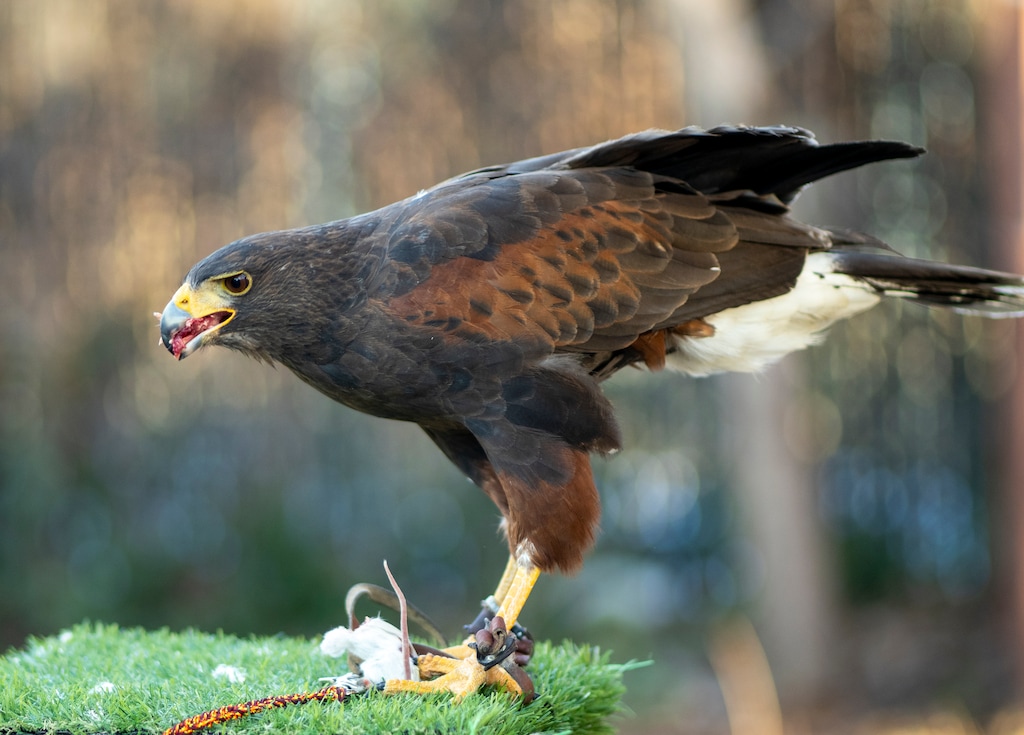
A Harris’s hawk that flew off from his home in Salt Lake City in late June was spotted by keen-eyed searchers, according to conservationists with HawkWatch International.
“We’re so grateful for everyone who put their eyes to the sky to help us locate Stax,” said Melissa Halvorsen, education and outreach director for HawkWatch, which has long cared the hawk, named Stax. “Because of their efforts, we received hundreds of tips over the [July 4] weekend, and ultimately, one of those led us to Stax.”
“Because Stax [was discovered] on private property and extra people could scare him off and thwart recovery efforts, we are not disclosing his location at this time,” wrote Kirstin Elliott, HawkWatch’s communications coordinator, in an email to The Salt Lake Tribune.
Stax had escaped from HawkWatch International on Monday, June 29. Due to a previous injury, he is reliant on human care and unable to survive long-term in the wild.
The recovery team is comprised of biologists on HawkWatch’s staff, plus a few members of Stax’s personal care team.
Who is Stax?
Stax is a Harris’s hawk named for an unusual behavior exhibited by his species — a “back-stacking” behavior, where the birds perch on top of one another when perching options are otherwise limited. Sometimes the birds will stack from two to five birds high. Doing so gives them a place to rest as well as a better view while looking for prey.
Though hatched in the wild, where he also learned how to fly and hunt, Stax was legally caught by a falconer and used to hunt before he turned 1 year old. It was in the course of his hunting career that he broke a leg and was determined medically unfit to continue. His falconer adopted him out to HawkWatch International. He has lived in captivity in HawkWatch’s Sugar House headquarters ever since.
His disappearance was unusual, but not unheard of in the falconry world, where trained raptors sometimes slip their handlers or go missing entirely.
Last fall, two Harris’s hawks used for bird control at Los Angeles’s SoFi Stadium vanished under stranger circumstances — stolen along with the utility vehicle carrying them. One, named Bubba, was recovered weeks later in Hacienda Heights after a resident spotted him; the other, Alice, was never found.
These cases demonstrate how vulnerable Harris’s hawks can be once loose. They are usually bred and trained for human partnership, and while they are found wild in the natural brush of Arizona, Texas, New Mexico, Mexico and parts of Central and South America, they are not native elsewhere — including in Utah.
Furthermore, Harris’s hawks are very social birds, and generally live and hunt in groups. All this contributed to Stax’s jeopardy while missing.
What is HawkWatch International?
Founded in 1986, HawkWatch International is a conservatory program for raptors (re: birds of prey). In addition to hawks like Stax, they study bald eagles, golden eagles, forest owls and more, all across the western United States.
Based out of Salt Lake City, HawkWatch International hosts educational programs, conducts field research, weighs in on environmental policy and offers care and shelter for hurt raptors like Stax.
Stax is a part of the organization’s Raptor Ambassadors program, meaning he helps educate the public on the nature and needs of birds of prey.