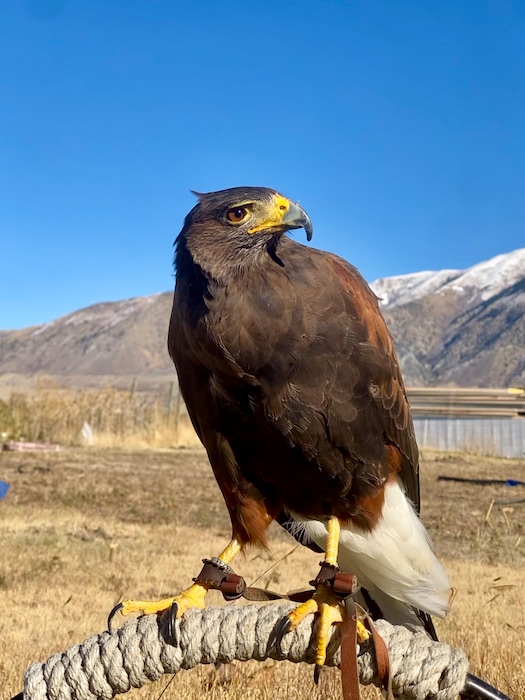
HawkWatch International, a Salt Lake City-based nonprofit, works to help hawks and other raptors — both the ones they care for in captivity as well as ones in the wild.
But on Monday, one of their captive hawks went missing.
Stax, a Harris’s hawk, flew off on Monday near HawkWatch International’s Sugar House headquarters, located at 900 East and Simpson Avenue.
The last confirmed sighting of Stax was at 1:40 p.m on Monday, June 29, HawkWatch International said Thursday afternoon.
The response team is currently confining its focus to a 3-mile radius around Stax’s last known location, according to Kirsten Elliott, a spokesperson for HawkWatch International.
HawkWatch International has issued pleas on social media asking the public to report any sightings. Interested volunteers can also join a planned search effort at 6:30 p.m. Thursday and again at 9:30 a.m. and 6:30 p.m. Friday.
Each search will take about 1.5-2 hours. Anyone interested may stop by the organization’s Sugar House offices to receive an assignment.
If you see Stax, the organization asks that you text or call them at 801-648-9286, or email education@hawkwatch.org.
What to look for
(HawkWatch International) A Harris's hawk named Stax flew away from HawkWatch International's Salt Lake City refuge on Monday, June 29, 2026.
Harris’s hawks, like all hawks, are a type of raptor (or bird of prey).
They are medium to large in size and can be identified by their dark brown plumage, bright, chestnut-colored shoulders and thighs, and long yellow legs. They also have distinct black tails with a prominent white band at the base and tip.
When Stax went missing, he was wearing leather anklets and brown jesses, which are straps attached to the anklets that handlers use to maintain control of the hawk.
Besides the anklets and jesses along with his Harris’s Hawk markings should help Stax stick out among other wildlife.
Harris’s hawks are not typically found in Utah, though they live wild in Arizona, Texas, New Mexico, Mexico and regions of Central and South America.
“[Being a] non-migratory species that is not native to Utah ... means that he is unlikely to stray very far from home, and he should be much easier to spot than a native species,” said Elliott. “He is a very vocal bird with a distinctive call, so people may hear him before they see him.”
(Rick Egan | The Salt Lake Tribune) Stax participates in HawkWatch International's educational outreach, on Tuesday, Jan 28, 2025.
Elliott stressed that Stax’s non-native status means that he is not adapted to live in Utah’s environment.
That, compounded with Stax’s learned dependence on food and shelter, hurt his chances of acclimating to the wild — especially in a new environment full of cars, tall buildings, and power lines, which are notorious among the birding community for the danger of electrocution that they pose to hawks and other birds.
Harris’s hawks also have lower survival rates when they hunt solo; they are typically social creatures who live and hunt in groups. But Stax is alone.
“For these reasons, it is critical that we locate Stax as soon as possible,” Elliott said.
How did Stax come to HawkWatch?
(Rick Egan | The Salt Lake Tribune) Renata Vazquez, an educator with HawkWatch International, holds Kotori the Great Horned Owl, on Tuesday, Jan 28, 2025.
Stax was hatched in the wild and learned how to hunt and fly before a falconer legally caught him to use for falconry before the bird turned 1.
While on a hunt with his falconer, Stax broke his leg taking down a rabbit. Though he healed, a veterinarian determined that the risk of reinjury was too high for Stax to continue his hunting career.
The falconer brought him to HawkWatch International, where he now serves as a Raptor Ambassador for educational programs.
He is named for Harris’s hawks’ “back-stacking” behavior, which involves the birds perching on top of each other when perching options are limited. The extra height also gives them a better view while looking for prey.
Harris’s Hawks have been seen stacked from two to five birds high.
HawkWatch International researches raptors in the Intermountain West, runs educational programs for students and offers internships and scholarships.
“We’ve been overwhelmed by the incredible support from our neighbors and the broader Salt Lake City community, who have offered to help us in the search,” said Elliott.
HawkWatch International is posting updates on their social media, including Facebook and Instagram.