 Brooke Larsen
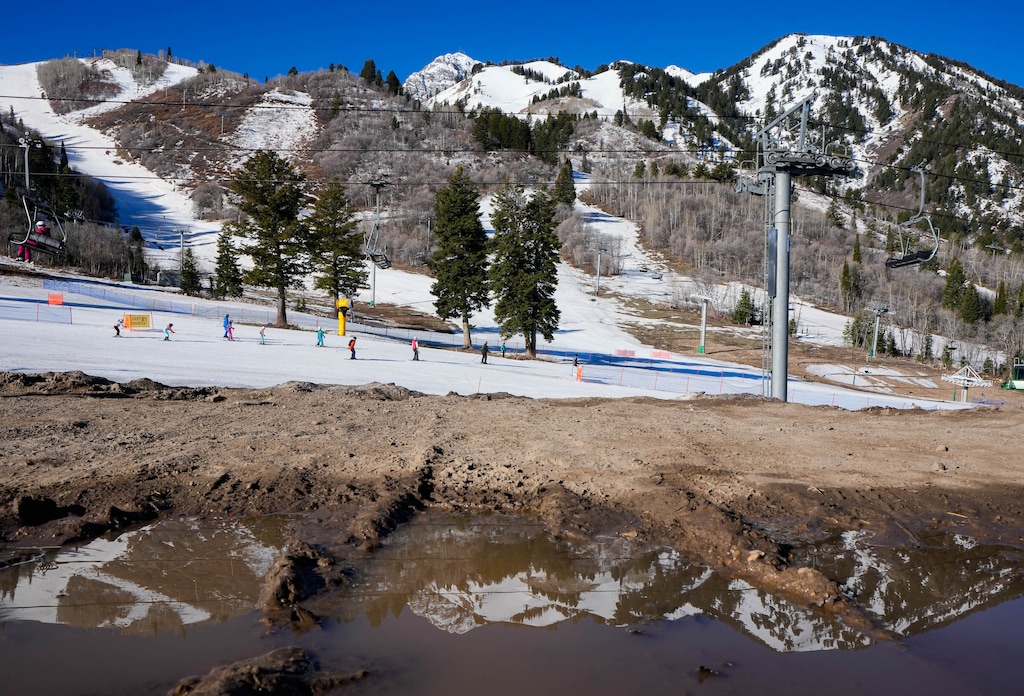
Spring has just sprung yet the weather already feels like summer across Utah and the West this week.
Temperatures are expected to shatter records, with daily highs reaching as much as 30 degrees Fahrenheit above normal, according to the National Weather Service.
The heat wave will likely spark rapid snowmelt and early spring peak flows, Cody Moser, forecaster with the Colorado Basin River Forecast Center, said. This follows an extremely warm winter and abnormally poor snowpack, leading to dismal water supply forecasts for Utah and the greater Colorado River Basin.
“This will be … the warmest winter on record and the driest, and those two things don’t help us when we’re trying to figure out how to fill Lake Powell and Lake Mead,” Gene Shawcroft, Utah’s Colorado River negotiator, said at the Utah Water Users conference on Tuesday.
The nation’s two largest reservoirs that store water for millions of people across the Southwest are nearing critical lows. Lake Powell was 25% full and Lake Mead was 34% full as of March 15.
The Bureau of Reclamation’s latest most probable forecast for Powell shows the reservoir reaching “power pool,” or 3,490 feet, by the end of this year. At that level, Glen Canyon Dam can no longer generate electricity and sustain releases downstream to California, Arizona, Nevada and Mexico.
Infrastructure damage starts happening even higher up, and the bureau aims to keep the lake at 3,500 feet, a level it will reach before the end of September, according to the most probable forecast.
The lake may drop to those critical low levels even sooner, though: The bureau’s latest minimum probable forecast, which shows a dry scenario that has been closer to reality and even optimistic in recent years, says Powell could reach power pool by August and 3,500 feet by July.
The outlook is unlikely to improve as we move further into spring. Utah’s snowpack likely reached its height on March 9 at a new record low and three weeks earlier than usual, Jordan Clayton, data collection officer with the Natural Resources Conservation Service, said at the water conference on Wednesday.
At some survey sites across the state, the snow water equivalent — the amount of water in snow — is more than 16 inches below normal for this time of year. “That’s an incredibly large number,” Clayton said.
(Natural Resources Conservation Service) Snow water equivalent is at a record low for the Upper Colorado River Basin as of Wednesday, March 18, 2026.
“Our snow water equivalent is lower today than it has ever been on this date, and it’s only going one direction with 85 to 90 degree temperatures … that shouldn’t be here until June,” Shawcroft said.
A year with no good comparisons
The current water year, which started on Oct. 1, has been abnormal in various ways that have posed challenges for forecasters, Clayton told The Tribune.
The highest elevations across the state still received decent snowpack but just slightly below those tall peaks, snowpack has been exceptionally poor, Clayton said.
Heavy rains also dumped across the region in the fall. This helped keep Lake Mead levels up as irrigators downstream in California, Nevada and Arizona didn’t need to pull as much water from the nation’s largest reservoir.
Rains, both in the fall and throughout the warm winter, also bumped up the soil moisture, which normally stays steady through the winter before snow melts and seeps into the ground.
“We’ve been boosting our soil moisture in a way that I haven’t seen before,” Clayton said.
That may mean more of the snow that does melt this spring will run into streams and rivers rather than seeping into the soil. “But unfortunately, we just don’t have a lot of snow up there to run off,” Clayton said.
(Brooke Larsen | The Salt Lake Tribune) Jordan Clayton, data collection officer for the Natural Resources Conservation Service, presents on this winter's dismal snowpack at the Utah Water Users Workshop in St. George on Wednesday, March 18, 2026.
The abnormally warm temperatures may also dry out the soils more quickly.
Clayton’s team uses a modeling system that compares current data to historical observations. “We use the past to mirror what we expect in the present,” he said. But this year, there’s no good comparison.
Because of this, he recommends water managers look at the lowest probable forecast rather than the most likely forecast this year.
“We have some obvious, very serious challenges in terms of managing our water,” Clayton said.
Where water managers stand
The federal government has not released its final plans for operations at Lakes Powell, Mead and other upstream reservoirs in the Colorado River Basin.
It’s likely the bureau will release water from Flaming Gorge to boost Powell, Shawcroft said on Wednesday. It will also likely reduce the amount of water it releases from Powell, potentially going as low as 6 million acre-feet.
That brings the Colorado River states into tricky legal territory, as the 10-year combined releases from Powell will drop below what the Lower Basin — Arizona, California and Nevada — has said the Upper Basin — Colorado, New Mexico, Utah and Wyoming — must deliver downstream.
(Trent Nelson | The Salt Lake Tribune) The Colorado River south of Glen Canyon Dam in Page, Ariz., on Tuesday, May 20, 2025.
The seven states in the Colorado River Basin have been at an impasse over future management of the river. The states continue to negotiate and will meet in person on Thursday “to see if there’s any common ground,” Shawcroft said.
Current guidelines for managing the river in dry years expire this year, and a new plan for operating Powell and Mead must be in place by Oct. 1, Shawcroft added.
The bureau is currently undergoing an environmental review process for possible paths forward, but without a seven-state agreement, it has limited legal authorities, according to the draft environmental impact statement.
Note to readers • This article is published through the Colorado River Collaborative, a solutions journalism initiative supported by the Janet Quinney Lawson Institute for Land, Water, and Air at Utah State University. See all of our stories about how Utahns are impacted by the Colorado River at greatsaltlakenews.org/coloradoriver.